Quick answer: AdSpy vs PowerAdSpy is depth against breadth. AdSpy searches Facebook and Instagram down to ad comments and landing-page text, on one $149 plan. PowerAdSpy starts at $69 for the same two networks and adds Google, YouTube, Pinterest and native networks on higher plans. Spytrend, the third tool here, groups ads by the operator behind them.
AdSpy vs PowerAdSpy: three tools side by side
| AdSpy | PowerAdSpy | Spytrend | |
|---|---|---|---|
| Networks | Facebook and Instagram | Facebook and Instagram on every plan; 4, 7 or 11 networks on the higher ones | Facebook and TikTok |
| Database (each company's own figures) | 211,329,000+ Facebook and Instagram ads, 30,185,000+ advertisers, 225 countries (Sep 25, 2026) | 500M+ creatives indexed (Sep 25, 2026) | 1.4B+ Facebook ads; about 280M new Facebook and TikTok ads a month, 170M+ of them on Facebook; 193 countries (Sep 29, 2026) |
| Way in | No free plan or trial. New accounts got a one-time credit of 1,000 ad views, with names and full ad text hidden (Sep 22, 2026) | No free plan. A paid 3-day trial, $1 on Basic or $7 on the rest, renews at full price (Sep 24, 2026) | Starter is free with no card and opens ads older than three months |
| Price | A single $149/mo plan the site calls introductory (Sep 22, 2026) | $69, $99, $279 or $399/mo; Basic drops to $27/mo paid yearly (Sep 24, 2026) | Paid plans are listed on Spytrend's pricing page |
| Search fields and filters | 6 search fields, comments and landing-page text among them; 15 filter menus, affiliate and technologies included; results sorted by date | Keyword, advertiser and domain search; category, CTA, country, sort and AI labels on every plan; affiliate filters from $279 | Ads sorted into 33 categories and 342 subcategories |
| Groups ads by owner? | No advertiser view | Tracks named brands: 1 on Basic, 30 on Palladium | One card per owner, joining domains, pixels and Page IDs |
| Best for | Deep search inside Facebook and Instagram, comments included | Campaigns that also run on Google, YouTube, Pinterest or native networks | Finding the operator behind a set of ads |
Both tools start from Facebook and Instagram, then go separate ways. AdSpy digs deeper into those two networks, while PowerAdSpy adds more of them with each price step.

How I tested
I used my own AdSpy account to look at its search screen. Then I ran a comment search for "where can I buy." PowerAdSpy offers no free plan, and I didn't buy its $1 trial. Everything about PowerAdSpy here is taken from its pricing page and homepage.
The limits of this check: I never saw PowerAdSpy's search from inside. My AdSpy account had no subscription either, which kept advertiser names and full ad texts masked.
AdSpy vs PowerAdSpy pricing: one plan against a ladder
AdSpy pricing has one step. It's $149 a month for what the homepage calls "virtually unlimited usage." The same line says the price is introductory and "will not be the same for long." Paying mostly removes the masks. My account for this series came with 1,000 free ad views as a one-off credit. Creatives and landing-page data opened, but advertiser names ended in "(subscribe to see name)."
PowerAdSpy pricing climbs by networks. Basic at $69 covers Facebook and Instagram, the same pair AdSpy covers, for less than half the price. Standard at $99 adds Pinterest and the Google Display Network. Platinum at $279 adds YouTube, Native and Google. Palladium at $399 adds LinkedIn, TikTok, Quora and Reddit. Paid yearly and upfront, Basic drops to $27 a month ($331 a year) and Palladium to $119 ($1,436).
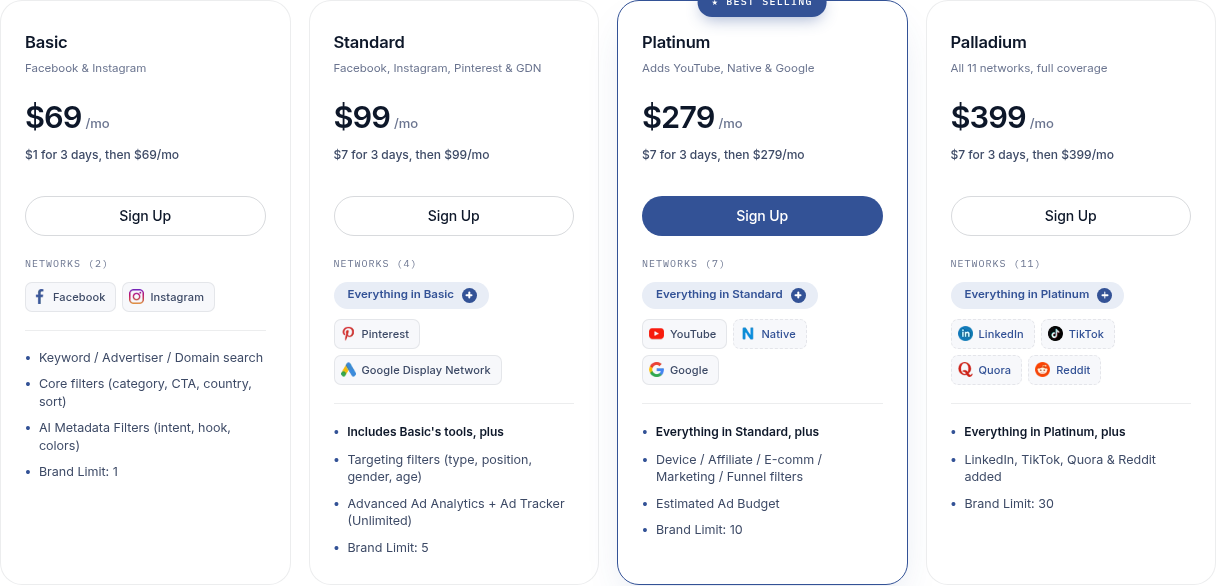

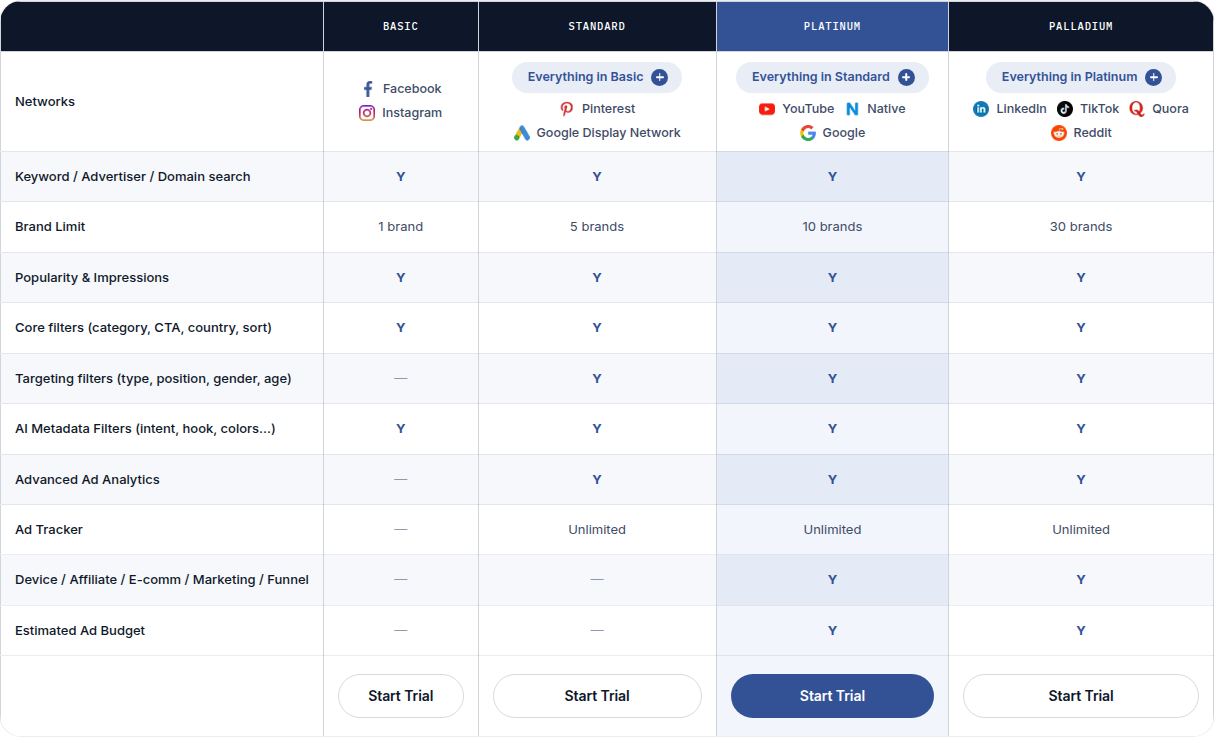
The cheap entry has a catch for affiliate teams. AdSpy's one plan includes affiliate filters. PowerAdSpy puts them on Platinum, so the like-for-like choice is $149 against $279 a month.
For the same two networks, AdSpy's $149 against PowerAdSpy Basic's $69 pays for comment and landing-page search, which the next section shows. The rest of the PowerAdSpy vs AdSpy question is about channels: Pinterest, Google or YouTube coverage only earns its price if you run ads there.
The Trustpilot samples are small. Anyone looking for a PowerAdSpy review from users will find 3.6 out of 5 across 57 reviews, and AdSpy's profile shows 2.4 across only 8 (PowerAdSpy, AdSpy).
Searching Facebook and Instagram ads in each
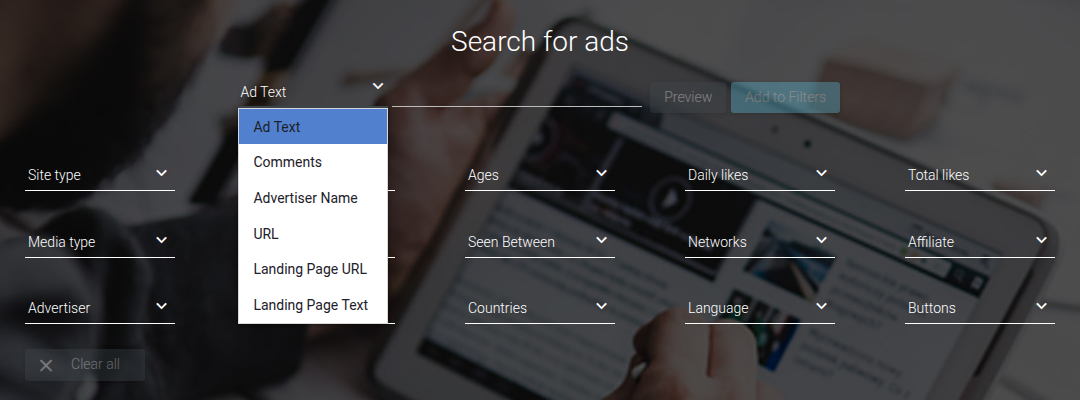
AdSpy puts a field picker in front of the search box. It offers six places to look: Ad Text, Comments, Advertiser Name, URL, Landing Page URL and Landing Page Text. Under it sit 15 filter menus, from Site type, Gender and Ages to Affiliate, Technologies, Language and Buttons.
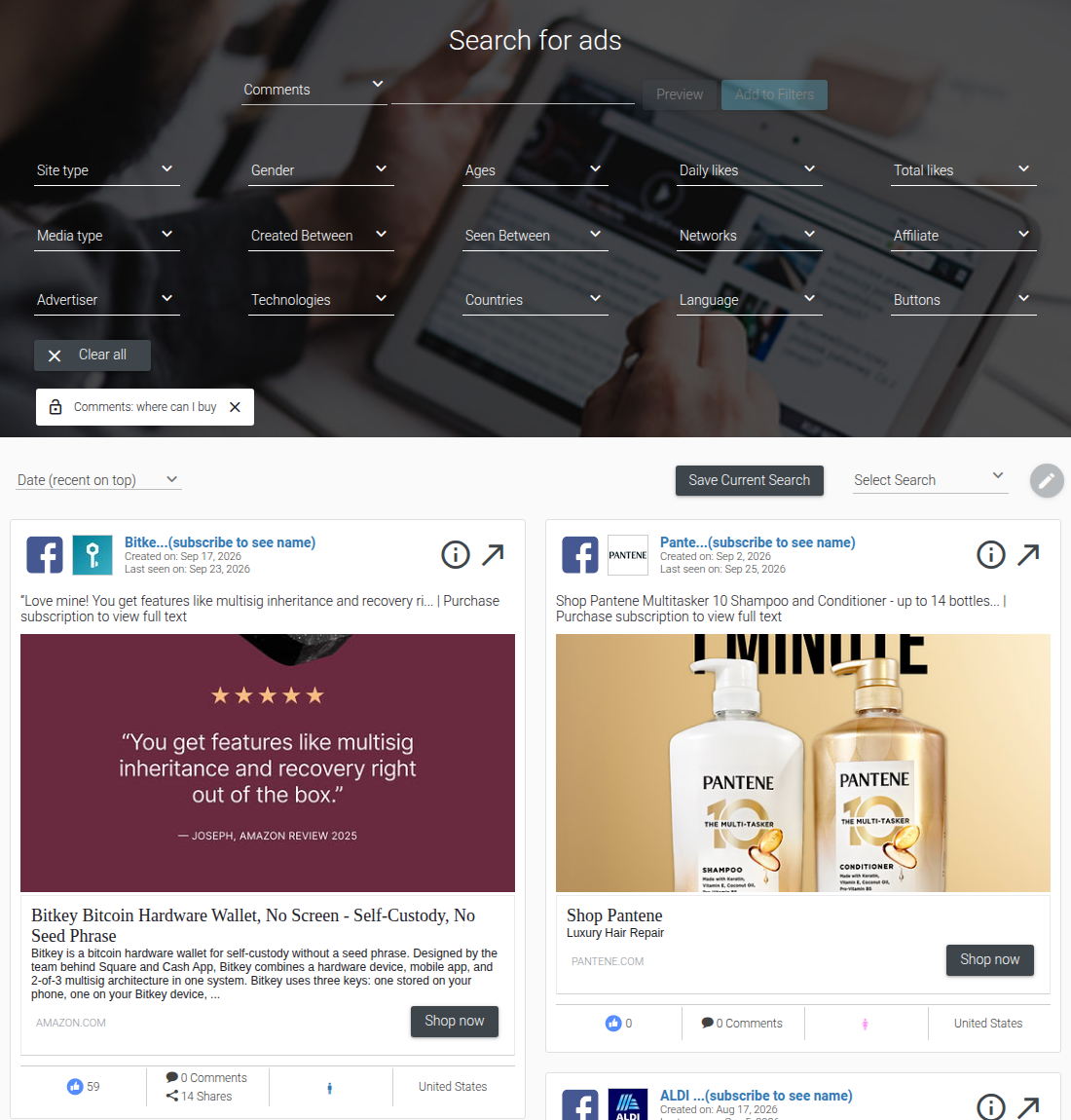
I set the field to Comments and typed "where can I buy." Among the newest results were a Bitkey hardware wallet ad and a Pantene shampoo offer. Each card shows likes, comments, shares where there are any, the country, and when the ad was created and last seen.
Both of those cards read "0 Comments," so the counter won't tell you which comment matched. On an unpaid account, every ad text also breaks off with "Purchase subscription to view full text."
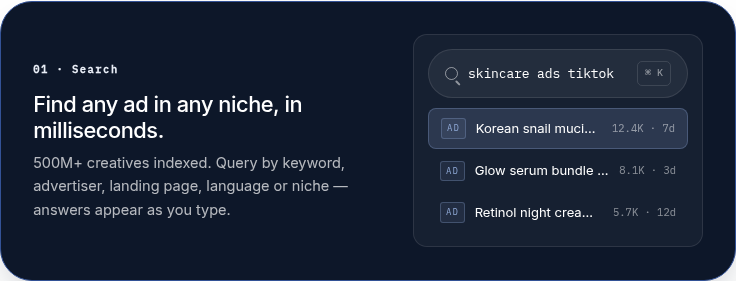
PowerAdSpy describes its search in two ways. The homepage card says you can query "by keyword, advertiser, landing page, language or niche." The pricing table lists keyword, advertiser and domain search on every plan. Neither list mentions comments or landing-page text.
Its filters point somewhere else. Category, CTA, country and sort come on every plan. So do AI labels for intent, hook and colors, which AdSpy's filter list doesn't have. Targeting filters for type, position, gender and age start at Standard.
Put side by side, AdSpy lets you search what buyers wrote under an ad and what the landing page says, and PowerAdSpy sorts ads by AI-tagged traits like hook and intent. I couldn't test that second part from inside, so treat it as PowerAdSpy's own description.
A third option: the owner behind the ads
AdSpy searches ad by ad, and PowerAdSpy tracks a set number of named brands. Neither shows which ads belong to one business once it spreads across several pages and domains. Spytrend's product description, quoted as is: Spytrend is an ad intelligence platform for Facebook and TikTok advertising: an archive of ads going back to 2018, AI-classified into 33 business categories, with every advertiser assembled into a single card — all ads, pages, domains and countries in one place.
Inside those 33 categories sit 342 subcategories, while AdSpy has no industry filter at all. Starter is free and covers ads older than three months. Spytrend's pricing page shows what each paid plan adds.
Here's an owner I opened in the Webmasters section: Modlily (modlily.com), a clothing store. One card holds 11 Facebook Page IDs, all of them active, and 3 domains, 1 of them active. The total is 427,919 ads: 9,664 active and 418,255 stopped. Its top countries are the UK, Australia and the US.
The merge list on the card explains the grouping. Eleven fan pages advertised modlily.com: Modlily Tops, Modlily Dresses, Modlily Swimsuits, Modlily Fashion, MODLILY and six more named plain Modlily. The busiest of them ran 117,701 ads.
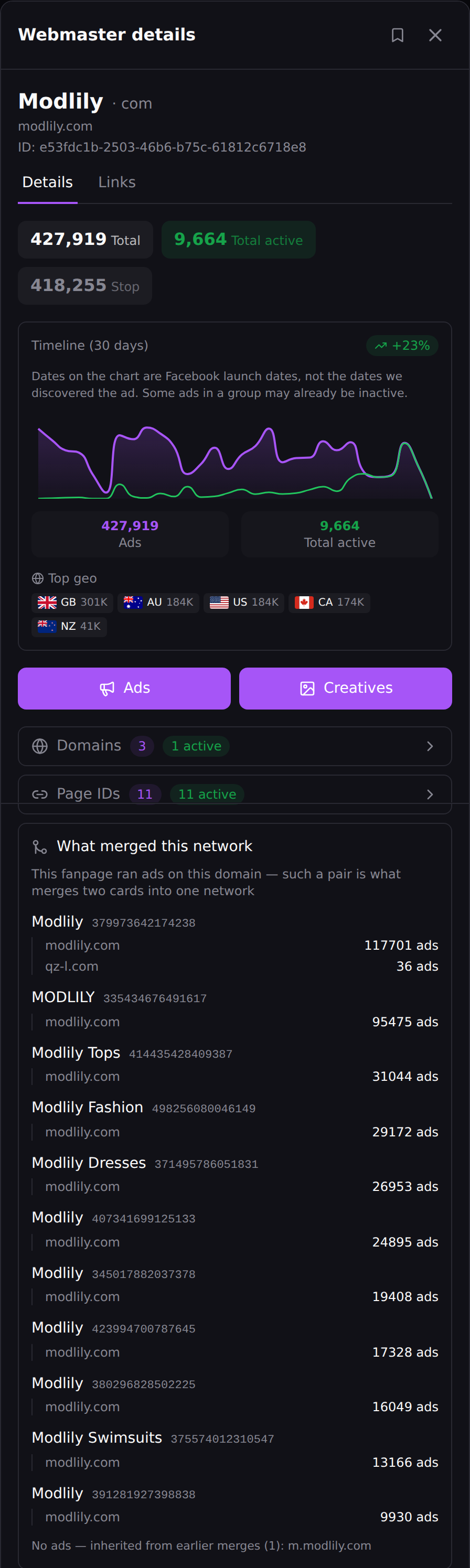
A search by advertiser name in AdSpy returns one page at a time, and one PowerAdSpy brand slot holds one name. Here a single store buys through eleven pages, and the card counts them as one advertiser. The guide to the Webmasters section explains how the card is put together.
Which one to choose
If everything you research runs on Facebook and Instagram, AdSpy goes further inside those two networks, with affiliate filters on its one plan.
PowerAdSpy is built more around a media plan that also includes Google, YouTube, Pinterest or native networks. Pinterest arrives on Standard, YouTube and native on Platinum.
Spytrend covers the question of who is behind a set of ads, on Facebook and TikTok. The Modlily card above is what that looks like.
Try it on your own niche before you pay. Put one phrase your buyers use into AdSpy's comment search, then open the same niche in Spytrend's free Starter. Check PowerAdSpy's plan table against the networks you run on. A wider field is compared in this roundup of ad spy tools. AdSpy has its own review page and appears in AdSpy vs BigSpy and AdSpy vs Minea. PowerAdSpy meets BigSpy in BigSpy vs PowerAdSpy.
FAQ
AdSpy vs PowerAdSpy: how far apart are the prices?
PowerAdSpy has the lower entry price in AdSpy vs PowerAdSpy: Basic costs $69 a month, or $27 a month paid yearly, and covers Facebook and Instagram. AdSpy has one plan at $149. The order flips for affiliate work, because PowerAdSpy's affiliate filters start on Platinum at $279 a month.
PowerAdSpy vs AdSpy: which one lets you search ad comments?
In PowerAdSpy vs AdSpy, only AdSpy lists comment search. Its field picker also covers ad text, advertiser name, URL, landing-page URL and landing-page text. PowerAdSpy names keyword, advertiser and domain search, plus AI labels for intent, hook and colors. I couldn't open PowerAdSpy's search without paying, so that part comes from its own pages.
Is AdSpy worth it if you only buy on Facebook and Instagram?
AdSpy is worth it there if comment or landing-page search is part of the job. Paying $149 a month lifts the masks from advertiser names and ad copy. You still get no other networks, no sorting beyond date and no advertiser view. The Trustpilot score, 2.4, rests on just 8 reviews.
PowerAdSpy pricing: what does each step up add?
PowerAdSpy pricing adds networks at each step. Basic at $69 has 2, Standard at $99 has 4, Platinum at $279 has 7 and Palladium at $399 has all 11. Paid yearly and upfront, Basic falls to $27 a month and Palladium to $119. Even the 3-day trial is paid: $1 on Basic, $7 on the rest.
PowerAdSpy alternative: is there one with a free plan?
Two PowerAdSpy alternatives have one: BigSpy, another multi-network tool, and Spytrend, whose Starter needs no card. Spytrend groups Facebook and TikTok ads by the owner behind them, though Starter only opens ads older than three months. AdSpy has no free plan at all.
Is Spytrend the same as AdSpy or PowerAdSpy?
No. AdSpy and PowerAdSpy return search results ad by ad. Spytrend covers Facebook and TikTok, and merges one owner's domains, pixels and Page IDs into a single card.