Quick answer: AdSpy is an ad database for Facebook and Instagram only: 213M+ ads, 30M+ advertisers, 225 countries. My new account got a one-time welcome credit that opened creatives, demographics and landing-page tech. Advertiser names and full ad text stay locked until you pay $149/month, an introductory price.
What is AdSpy
AdSpy is an ad database that covers two platforms: Facebook and Instagram. Its homepage calls it "the largest searchable database of Facebook and Instagram ads in the world." The stats block right under it showed 211,249,000+ ads, 30,178,000+ advertisers and 225 countries in September, and 213,140,000+ ads and 30,351,000+ advertisers on October 23, 2026; a paragraph further down the same page adds 88 languages. TikTok isn't covered at all.
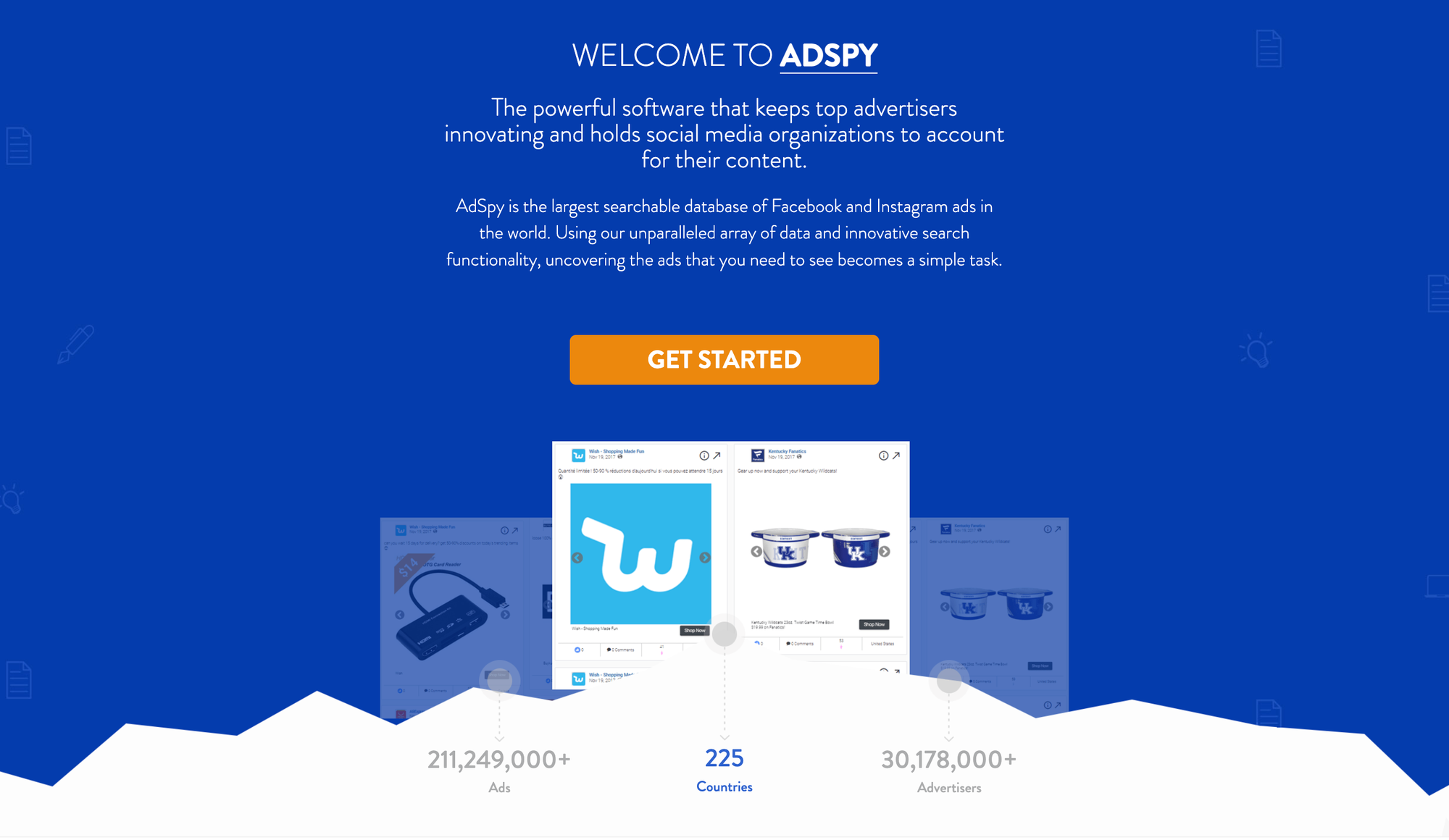
I opened an AdSpy account for this review. Inside, the database sits behind 16 search filters. Advertiser names and full ad text stay masked until you pay for the single $149/month plan. AdSpy covers one step of competitor research, and how to spy on competitor ads walks through the rest.
What AdSpy's filters actually search
AdSpy's public marketing page names its search fields one by one:
- Ad text, URL, advertiser name, media type
- Engagement metrics (reactions, ad duration, when an ad was last seen)
- A comment search that reads what people wrote under an ad, on top of the ad copy
- Advanced filters: affiliate networks, affiliate IDs, offer IDs, landing-page technologies
- Demographic targeting filters: location, gender, age range
The comment field is the unusual entry on this list. Most ad spy tools search the ad copy and skip what the audience wrote underneath. With this field, you read how people react to an offer right next to how the offer is pitched. The affiliate-network and offer-ID filters say a lot about who the tool was built for: affiliate and direct-response advertisers, at least as much as brand researchers.
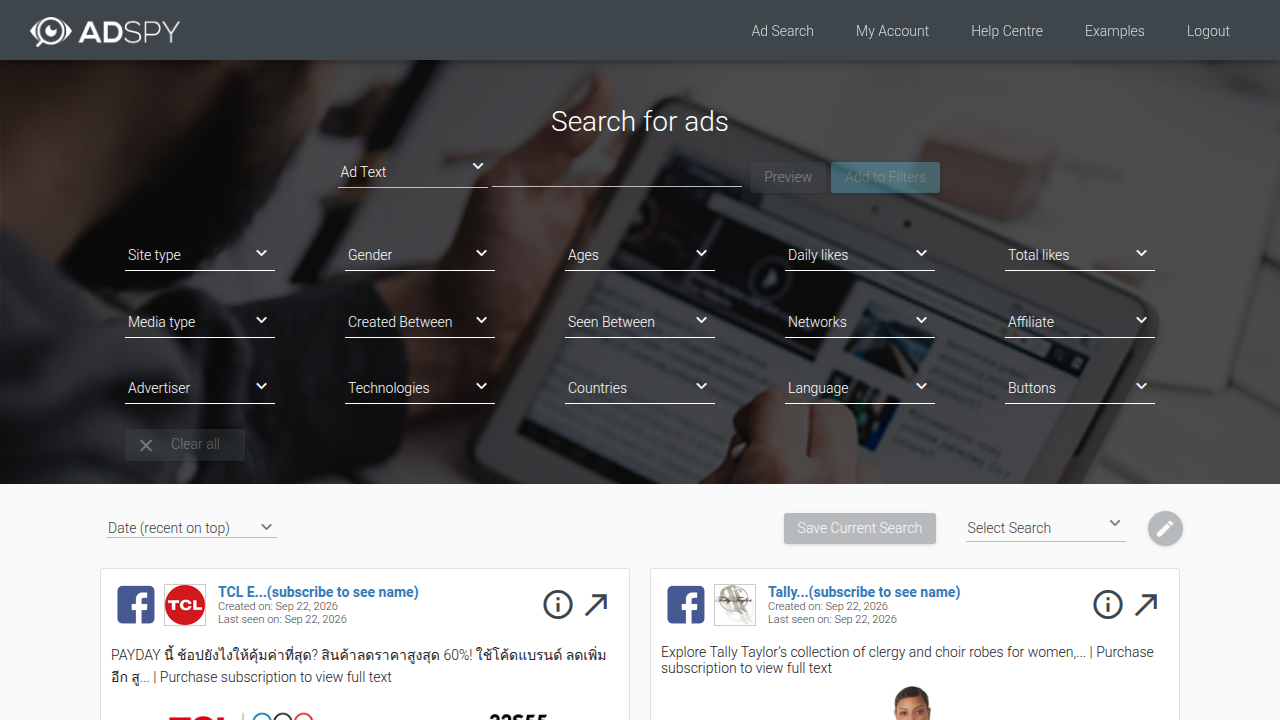
Once I logged in, the search screen went further than the marketing list. It shows 16 filters: Ad Text, Site type, Gender, Ages, Daily likes, Total likes, Media type, Created Between, Seen Between, Networks, Affiliate, Advertiser, Technologies, Countries, Language and Buttons. The last one narrows results by the ad's call-to-action button. Results sort by "Date (recent on top)" by default, and you can save a search to reuse later. None of the 16 filters is an industry category.
AdSpy doesn't say on its public pages how fresh the database is. It also doesn't say how soon a new ad shows up after it starts running. The search screen is the only evidence I have. The top results I saw had been created and last seen on the day I checked. So same-day ads were in the index, but AdSpy publishes no lag figure. One screen on one day can't tell you the typical delay.
Is AdSpy free?
Not on the homepage: there's no free plan there, and no trial either. The only pricing line reads "we offer virtually unlimited usage for just $149 per month." A note under it says "this is an introductory offer and will not be the same for long." The Terms page says nothing about a trial either.
Logging in told a different story. AdSpy had applied its own onboarding coupon to the account, named "adspy-welcome." It's a one-time allowance of 1,000 ad views, and it doesn't renew monthly. When I took the screenshot below, 990 of the 1,000 were still left. That credit let me run real searches and open real ad pages without paying anything.
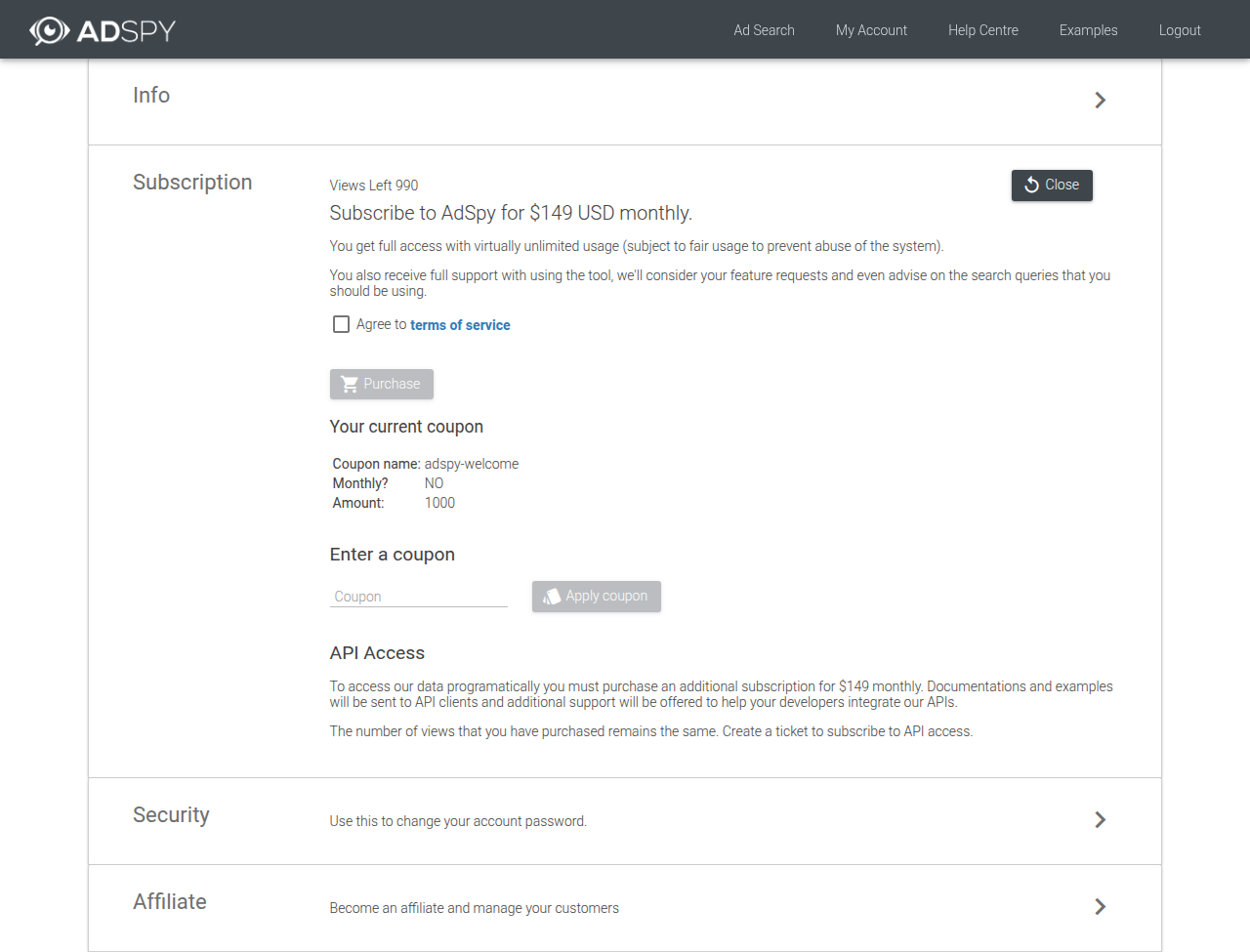
Two things stayed locked. The advertiser's exact name showed up as something like "TCL E...(subscribe to see name)." Every result's copy cut off at "...Purchase subscription to view full text." The same unpaid account opened a lot more. I saw the full creative and a demographics breakdown by gender, country and age. I also got a landing-page screenshot and a full tech-stack table for that page: web server, SSL, analytics and ad-tracking pixels, JavaScript libraries and more. The homepage and the Terms don't mention this credit. You only find it after you register and log in.
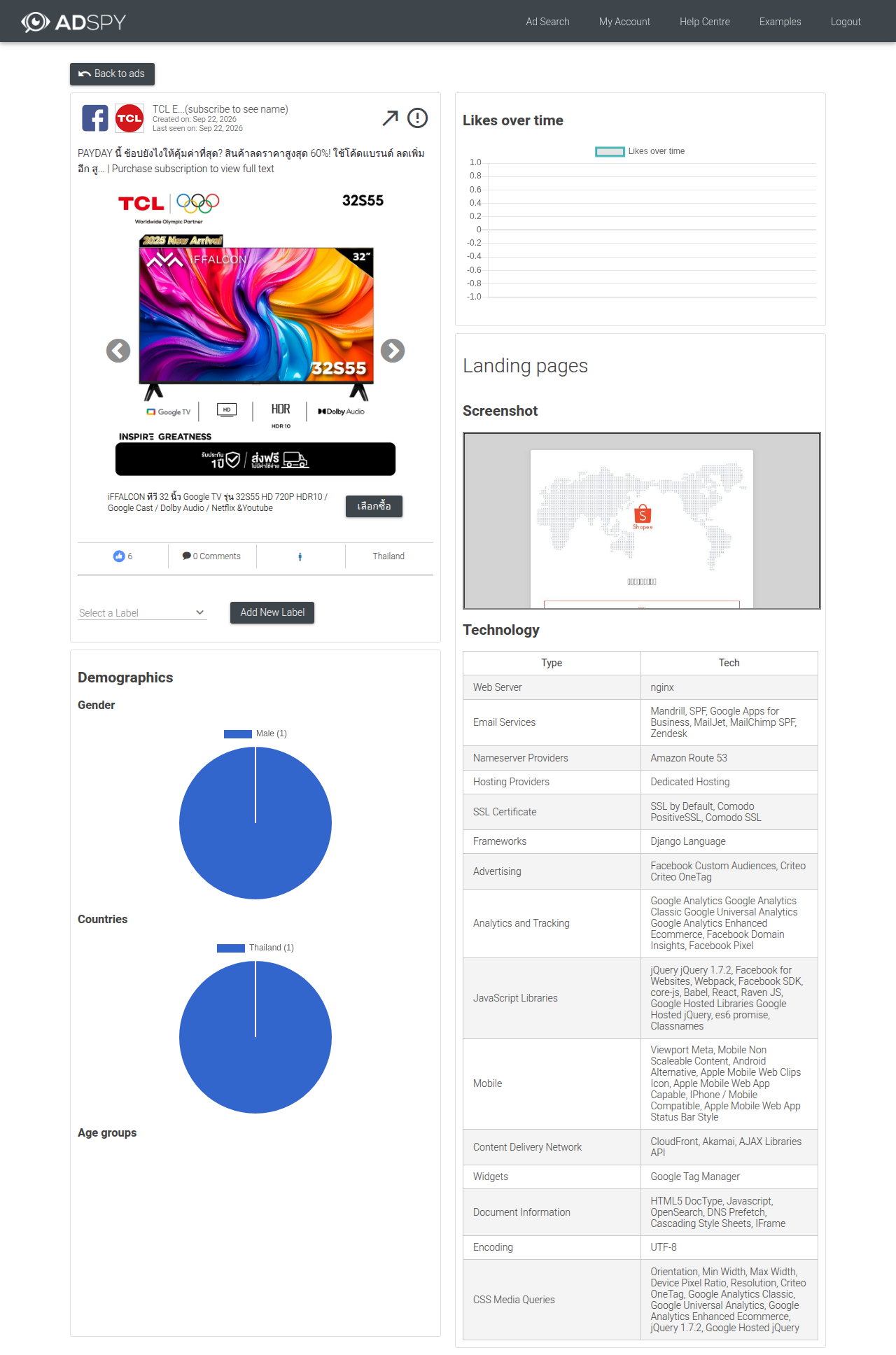
So a free AdSpy account does exist, capped at those 1,000 views. You can use AdSpy for free until the credit runs out, with browsing, creatives, demographics and landing-page tech all open. What $149/month adds is the advertiser's identity and the ad's full text.
Does AdSpy have a free trial?
Not in the usual sense. The homepage lists no time-limited trial and no free plan, only the $149/month introductory price. The welcome credit above is the only free way in, and neither the homepage nor the Terms announce it.
What my check doesn't show: I saw the coupon on one account. I didn't open a second one, so I can't promise that every new signup gets it.
What you see after the AdSpy login
On an unpaid account, the search screen itself marks the boundary: every advertiser name reads "(subscribe to see name)" and every ad's text stops at "Purchase subscription to view full text."
There's no separate AdSpy app for mobile. AdSpy runs in the browser at adspy.com, and one login covers everything I described above.
AdSpy pricing: the single plan, and what it doesn't include
AdSpy lists one plan: $149/month for what it calls "virtually unlimited usage." The marketing page shows no seat count, no credit meter and no named tiers. AdSpy calls the price an "introductory offer" that "will not be the same for long." It gives no end date, and on October 23, 2026, a month after my first check, the same wording was still there.
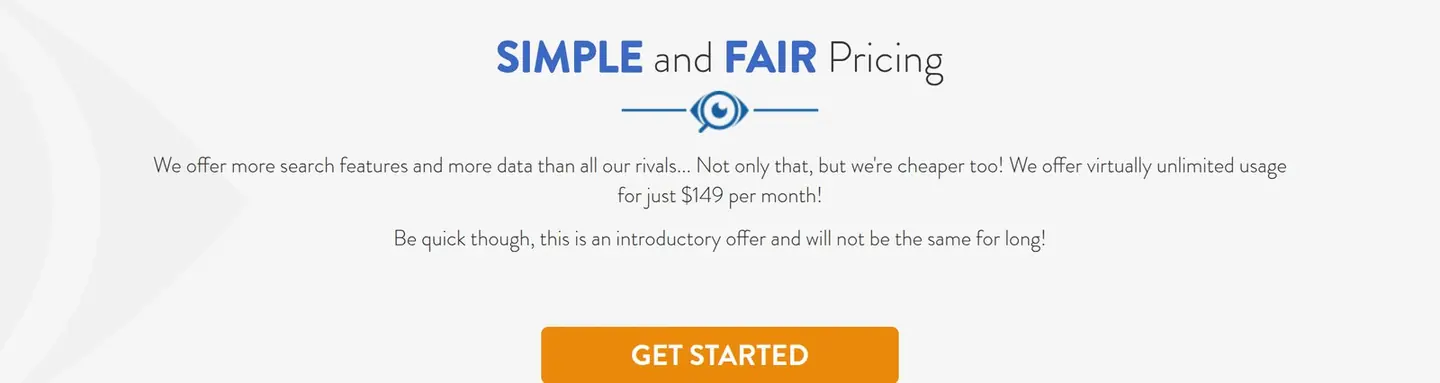
AdSpy publishes no feature ladder beyond that price. There's no cheaper tier to step down to and no bigger tier with more seats to step up to. Compared with the welcome-credit account, the $149 buys two specific things: the advertiser's exact name on every result and each ad's full text.
AdSpy's info page says "users are entitled to receive a full refund within 24 hours of purchase." You contact support with your username and a reason for cancelling. After that, "further refunds are at the discretion of AdSpy." So if those two unlocks aren't worth $149 to you, you've got one day to ask for the money back. AdSpy's Trustpilot profile is unclaimed and shows 2.4 out of 5 across 8 reviews, none of them from the last 12 months.
What an owner-level tool adds
Everything above is one kind of search: you type something in and get matching Facebook and Instagram ads back. Spytrend comes at it from the advertiser's side. The company's standard one-liner, word for word: Spytrend is an ad intelligence platform for Facebook and TikTok advertising: an archive of ads going back to 2018, AI-classified into 33 business categories, with every advertiser assembled into a single card — all ads, pages, domains and countries in one place.
In practice, the starting questions change: who advertises in a niche and on which networks, which ads have run long enough to deserve a closer look, and what kind of operation sits behind an advertiser. The competitive ad intelligence method write-up covers the approach.
On platforms, the overlap is bigger than it looks. AdSpy covers Facebook and Instagram. Spytrend covers Meta ads (Facebook and Instagram placements) and TikTok, so both of AdSpy's networks are there too, and TikTok is the one network only Spytrend has.
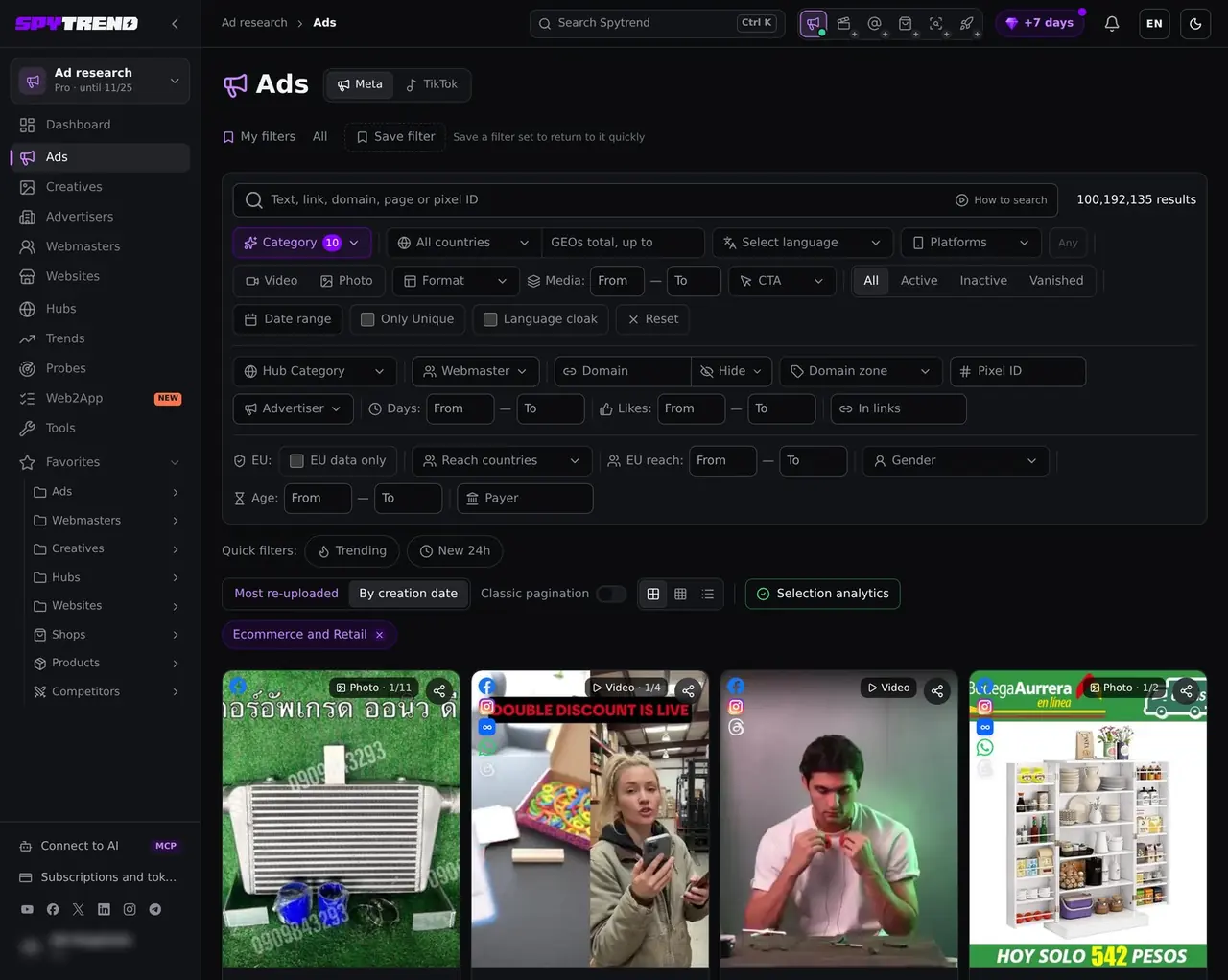
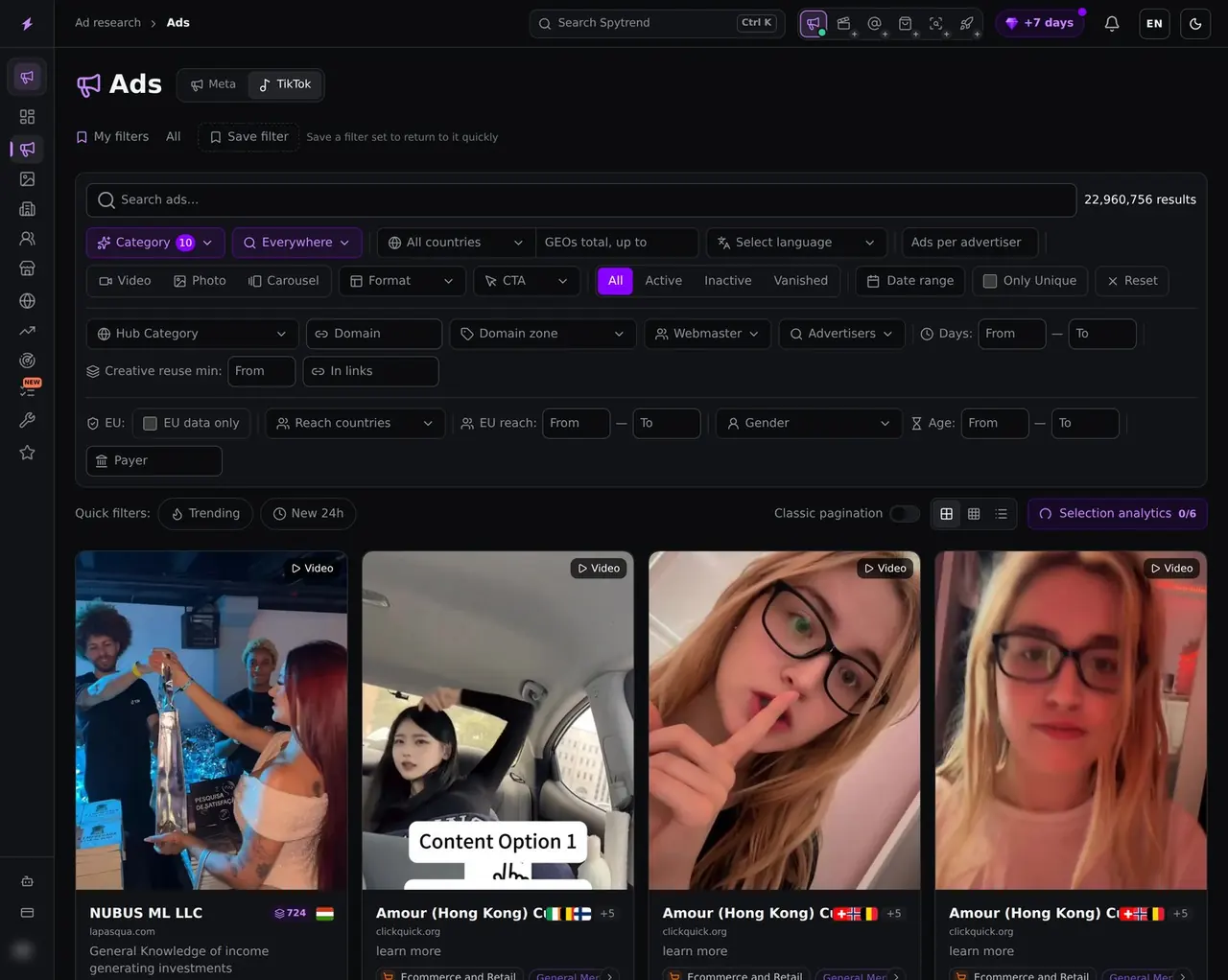
AdSpy searches by text, advertiser, affiliate offer and the 16 filters above. It doesn't sort ads by industry, and I found no category system on its pages or its search screen. Spytrend has one: its AI files every ad under one of 33 business categories, split into 342 subcategories. I opened Spytrend's Ads section and selected the whole Ecommerce and Retail category. It returned 100,192,135 results on Meta and 22,960,756 on TikTok. That means you can browse a whole industry without typing a single keyword.
The bigger gap is in how results are grouped. AdSpy returns ads by advertiser name, ID, URL and the other fields above. You get them one ad at a time, with no advertiser tab or network profile on the search screen. Spytrend starts from the advertiser's identity and works down. Give it a pixel ID, a domain or a Page ID. It pulls every other domain, page and ad tied to the same fingerprint into one card, with a country split.
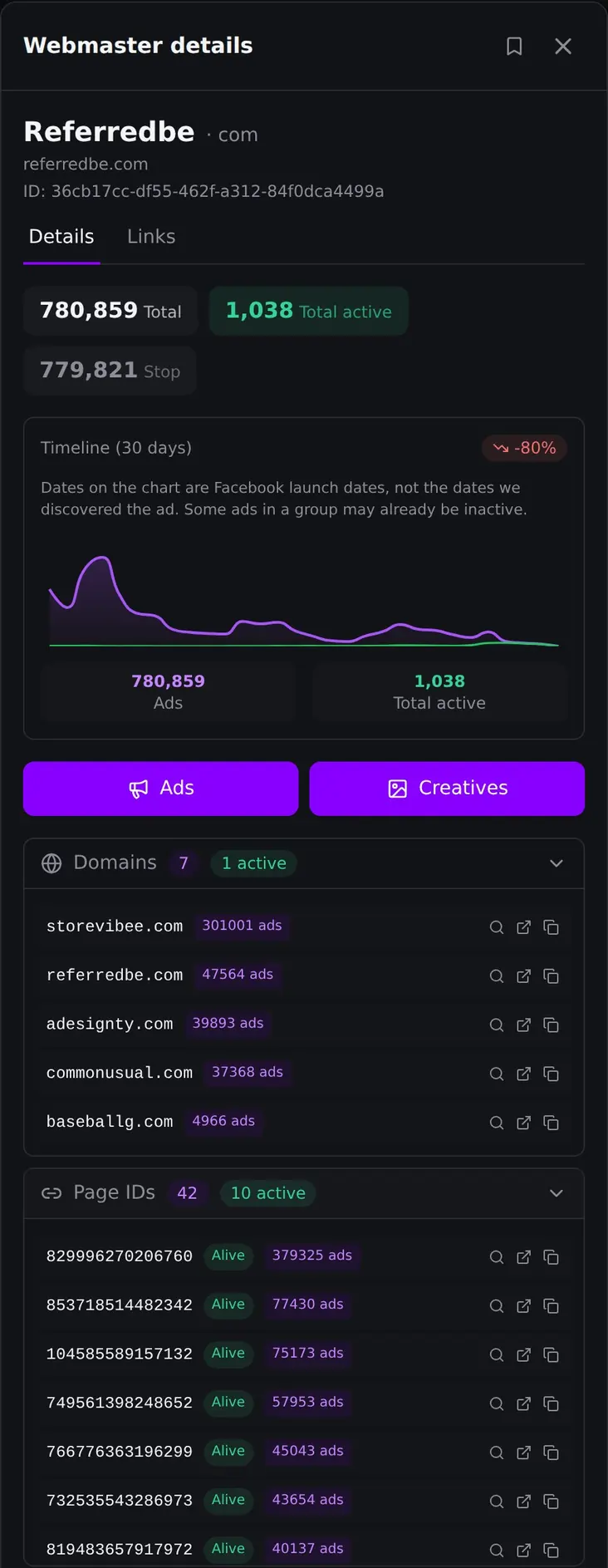
I picked one owner in the Webmasters section: Referredbe (referredbe.com). Its profile ties together 7 domains, only 1 of them active now. It also holds 42 Facebook Page IDs, 10 of them active. The profile counts 780,859 ads in total: 1,038 active and 779,821 stopped. The largest domain, storevibee.com, carries 301,001 of those ads on its own. Next come referredbe.com (47,564), adesignty.com (39,893), commonusual.com (37,368) and baseballg.com (4,966). The card counts seven domains but lists only these five with ad counts. The US, Canada and Australia lead its top countries.
Searched ad by ad, those would look like seven unrelated storefronts. Here they sit under one operator. The Webmasters walkthrough shows how this view is built.
AdSpy's search screen sorts one way: "Date (recent on top)." You can't sort by spend, engagement or run length. There's also no estimate anywhere of what an advertiser spends. Spytrend gives its own spend figures as a range, with a "from" and a "to" value.
One claim on AdSpy's homepage deserves a closer look: "AdSpy also bypasses cloakers to ensure you have flawless information straight from the landing pages." The ad cards I opened showed a landing-page screenshot and tech stack, but the page doesn't say how the bypass works or from which country the page is requested. In Spytrend this is a separate, paid step: from an ad card in the Ads section you can run a Probes check of the real landing page for 100 tokens (tokens are bought in packs inside your account), and the result lands in the Probes section.
On access, AdSpy gives away more for free than its homepage admits. My account opened full creatives, demographics and landing-page tech before any payment. It hid the advertiser's name and the ad's full text. Unlocking those costs $149/month, introductory and subject to change. AdSpy handles refunds through support within 24 hours, and later refunds are at its discretion. Spytrend has a free Starter tier to try the interface before you pay anything. Starter serves ads that are at least three months old, and paid plans open live ads. Paid plans carry a 14-day money-back guarantee on the first payment. What's included on each plan is on the Spytrend pricing page. For comparison, AdSpy publishes its current pricing on its homepage.
AdSpy vs Spytrend, side by side
| AdSpy | Spytrend | |
|---|---|---|
| Platforms | Facebook and Instagram | Facebook, Instagram and TikTok |
| Database size | 213M+ Facebook and Instagram ads, 30M+ advertisers, 225 countries (Oct 23, 2026), 88 languages (Sep 30, 2026); AdSpy's own figures | 1.4B+ Meta ads (Facebook and Instagram) and 380M+ TikTok ads; 31.9M+ advertisers; 193 countries; archive since 2018; 33 AI-assigned business categories and 342 subcategories |
| Search fields | Ad text, URL, advertiser name, media type, comments, affiliate network/ID, offer ID, landing-page tech, demographics, call-to-action button | Country, category, platform, format, run duration; for ads shown in the EU: reach, gender, age; owner-level Webmaster profiles built in advance; real landing page check (100 tokens per check, bought in packs) |
| Owner grouping | Ads matched by advertiser name/ID; no published network profile across domains | One webmaster profile per operator, built in advance from a shared pixel ID, domains and pages |
| Access model | Welcome-credit account shows full creatives, demographics, landing-page tech; advertiser name and full ad text need $149/month, introductory (Sep 22, 2026) | Free Starter tier with ads three months old and older; live ads on paid plans; details on the pricing page |
| Refund/guarantee | 24-hour refund window, later refunds at AdSpy's discretion | 14-day money-back guarantee on the first payment |
Who AdSpy is for and who it isn't
AdSpy makes the most sense when your research lives entirely on Facebook and Instagram and you want one of the largest published ad archives for those two platforms. Comment search and the affiliate-offer filters add to that, if they match how you work.
It's harder to justify once TikTok is part of the job, or when you want to browse an industry by category or trace every domain, page and country back to one operator. Then there's the paywall. On the free credit you can't see which advertiser runs an ad or what exactly it says, and both stay hidden until you pay $149/month.
The free account is still handy for checking whether an ad like this exists and what its creative and landing page look like. An owner-level platform puts the advertiser's name next to that from the first search.
AdSpy alternatives
If AdSpy's Facebook-and-Instagram scope is what limits you, or the paywall on names and copy, start from the job you need done. For a deep Facebook and Instagram archive with comment search and affiliate-offer filters, AdSpy itself is built around that workflow. It publishes its current price on its homepage, and the $149 rate is labeled introductory, so check it there. This ad-spy tool comparison places AdSpy among the alternatives. It says AdSpy "suits teams that want a large, established Facebook and Instagram library and don't mind its single plan." On the Spytrend side, the table above adds four things: TikTok on top of Facebook and Instagram, a category system, the advertiser's whole network mapped out, and names plus full ad text without a per-result paywall.
You can check all of this yourself. Register at adspy.com and see whether your account gets the same welcome credit. Then look up the same niche on Spytrend's free Starter tier and compare what each one shows you.
FAQ
What is AdSpy?
AdSpy is a searchable database of Facebook and Instagram ads. The homepage lists 213M+ ads, 30M+ advertisers, 225 countries and 88 languages. There's one plan, $149/month, and AdSpy labels that price introductory.
Is AdSpy free?
AdSpy is free only in part. The welcome credit on my account covered 1,000 ad views, once, with no monthly top-up (990 were left when I took the screenshot), and that was enough to open creatives, demographics and landing-page tech. Names and full ad text still need the $149/month plan.
How to use AdSpy: what do you search first?
Using AdSpy starts with logging in at adspy.com and running a search by ad text, URL, advertiser name or what people wrote in the comments. Then narrow it down with the affiliate-network, offer-ID, landing-page-technology and Buttons (call-to-action) filters, or by location, gender and age. Results come sorted by date. Click an ad and its card shows demographics, a landing-page screenshot and the site's tech stack.
AdSpy: can it show who's behind an ad?
The AdSpy tool shows who's behind an ad only by name, and only after you pay. On the free credit the name reads "(subscribe to see name)". AdSpy matches ads by advertiser name or ID and publishes no profile that ties several domains to one operator. Spytrend builds that profile in advance from a shared pixel ID, domains and pages, on Facebook, Instagram and TikTok. Its free Starter tier shows ads three months old and older.