Best Ad Spy Tools in 2026: Compared (Free & Paid)
Spytrend, BigSpy, AdSpy, AdHeart, and SocialPeta each target media buyers who need competitive ad intelligence — but they solve different problems. This review maps out who should pick which tool, based on what each one actually does and what it costs.
Quick Answer
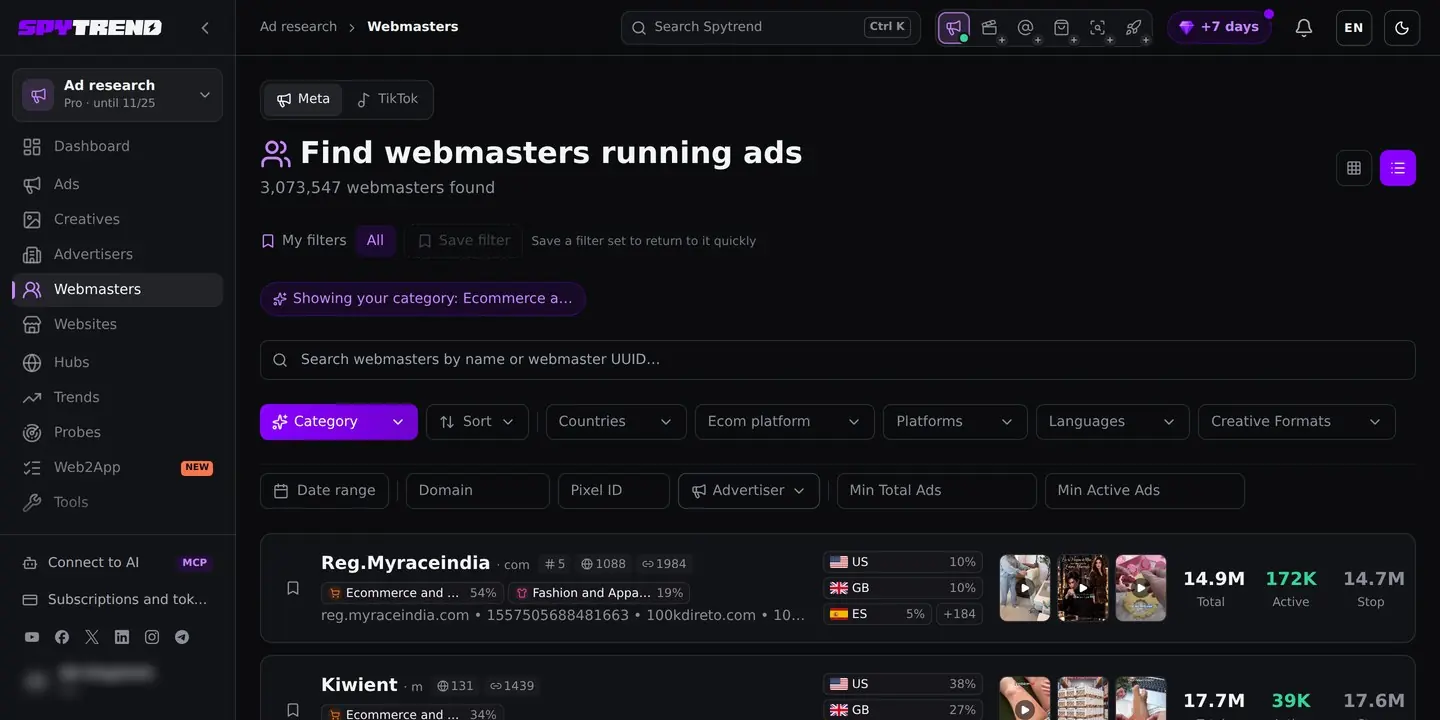
The best ad spy tool depends on your goal. Tools like BigSpy, AdSpy, SocialPeta and AdHeart give you large libraries of competitor ad creatives to browse and filter. Spytrend takes a different angle: instead of showing individual ads, it groups every ad by webmaster — pixel, domain, Page ID and IP — so you see a competitor's whole ad network, and it flags profitable, long-running campaigns in real time. So pick Spytrend when network-level intelligence matters more than raw creative browsing, and a high-volume library tool when you mainly want to scroll fresh creatives. The comparison below scores all five on the dimensions that actually decide a media buyer's workflow.
Who this comparison is NOT for: teams running Google PPC or Pinterest campaigns exclusively, or agencies that need a white-label reporting layer. Spytrend focuses on Facebook, Instagram and TikTok creative intelligence; it is not a multi-network ad platform.
How It Compares
All five alternatives surface competitor ad creatives, but they differ in how deep they look and what they cost. Spytrend's distinguishing feature is grouping by webmaster — it links a competitor's pixels, domains, Page IDs and IPs into one profile, where the other tools in the table publish grouping or search by advertiser, page or domain. Prices below are each vendor's cheapest paid monthly plan as published on its own site, checked in September 2026 and re-checked on October 23, 2026, when all five were unchanged: AdSpy, BigSpy, AdHeart, SocialPeta, Tyver.
| Tool | From / month | Free tier | Networks | Grouping depth |
|---|---|---|---|---|
| Spytrend | $79 (Base) · $0 Starter | Yes | Facebook, Instagram, TikTok | Webmaster-level (pixel, domain, Page ID, IP) |
| AdSpy | $149 (single plan) | No | Facebook, Instagram | Advertiser / page |
| BigSpy | $69 (Starter) | Yes | FB/IG; more on top tiers | Page / domain |
| AdHeart | $69 | Yes (demo) | Meta (FB/IG/Messenger) | Page / domain / IP |
| SocialPeta | Custom quote | Free trial | 40+ channels | Advertiser / network |
| Tyver | $79 (Free $0) | Yes | Facebook / Meta | Fan page / domain filters |
Where each one fits. Pick Spytrend when you need to map a competitor's whole operation rather than browse single creatives — webmaster grouping, pixel-chain tracing and real-time Active/Inactive/Vanished status are its edge, and the free Starter plan lets you test it first. AdSpy suits teams that want a large, established Facebook and Instagram library and don't mind its single plan. BigSpy starts at $69 a month and covers up to 11 platforms on its top tier. AdHeart is a Meta-focused option from $69 a month. SocialPeta is the honest choice when you genuinely need cross-network breadth across dozens of networks. Tyver matches Spytrend on price for Facebook-only research; its search filters by keyword, domain and fan page.
Key Features
Spytrend's core differentiator is the Webmasters section. Every ad a competitor runs is tied to one of four identifiers — pixel, domain, Page ID, or IP — and collapsed into a single operator profile. This exposes an entire ad operation rather than a stream of disconnected creatives. The guide to the Webmasters section walks through one profile step by step.
Pixel chain tracing follows the full chain from ad to landing page to pixel to server. This reveals hidden connections between campaigns that share infrastructure, even when the surface creatives look unrelated. Affiliates running competitor analysis in verticals like Gambling & Betting or Ecommerce & Retail use this to identify which traffic flows share a backend.
Trend Detection surfaces three signal types: Explosive growth (a creative with 5 or more new ads yesterday, 3× or more its average for the chosen period, and new fan pages joining), Early signal, and Revival. The Trends view compares performance against yesterday, the 3-day average, or the 7-day average; the Trends guide shows it on real data. New ads reach Spytrend within minutes, and it shows live ad status as Active, Inactive, or Vanished.
Creative Deduplication collapses duplicate banner variants — up to 50 copies of the same image — into a single unique creative with aggregated usage data. This removes the noise that inflates apparent creative diversity in tools that show raw ad counts without deduplication.
Long-running ads are found with the Days filter in Ads: set a minimum number of days and keep only Active ads, and you get creatives that have outlived testing. Days-active filtering lets buyers prioritise creatives with proven staying power over untested new launches; for online stores, the Creative burn block in Shops shows what share of each month's ads is still running.
Tracking in the Telegram bot @spytrends_bot alerts buyers to new ads from a domain, page or advertiser and repeats a saved question — for example, a keyword in one country — on a schedule (3 watches free, 20 on paid plans) — a passive monitoring layer on top of search. Setup is in the Telegram bot guide.
Real landing page check: every ad card in the Ads section has a Probes check priced at 100 tokens (tokens are bought in packs inside your account). Spytrend requests the page a real visitor would see, and the result appears in the Probes section.
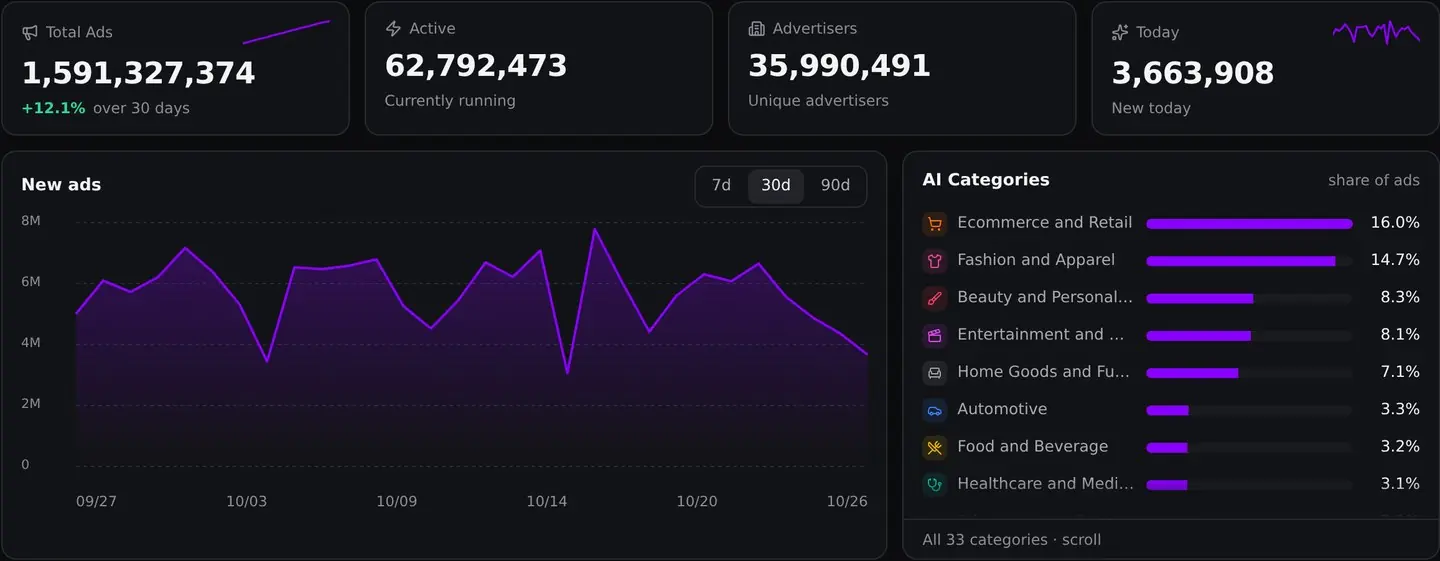
AI Category Classification sorts the database into 33 categories and 342 subcategories, including Gambling & Betting, Ecommerce & Retail, Fashion & Apparel, Beauty & Personal Care, Technology & Software, and Adult & Restricted. The Webmasters section sorted By active, with Date from set 7 days back, surfaces the most active webmasters of the last 7 days, giving an immediate entry point without manual search.
The searchable database covers more than 1.4 billion Meta ads (Facebook and Instagram) and 380M+ TikTok ads, from more than 31.9 million advertisers, with an archive going back to 2018.
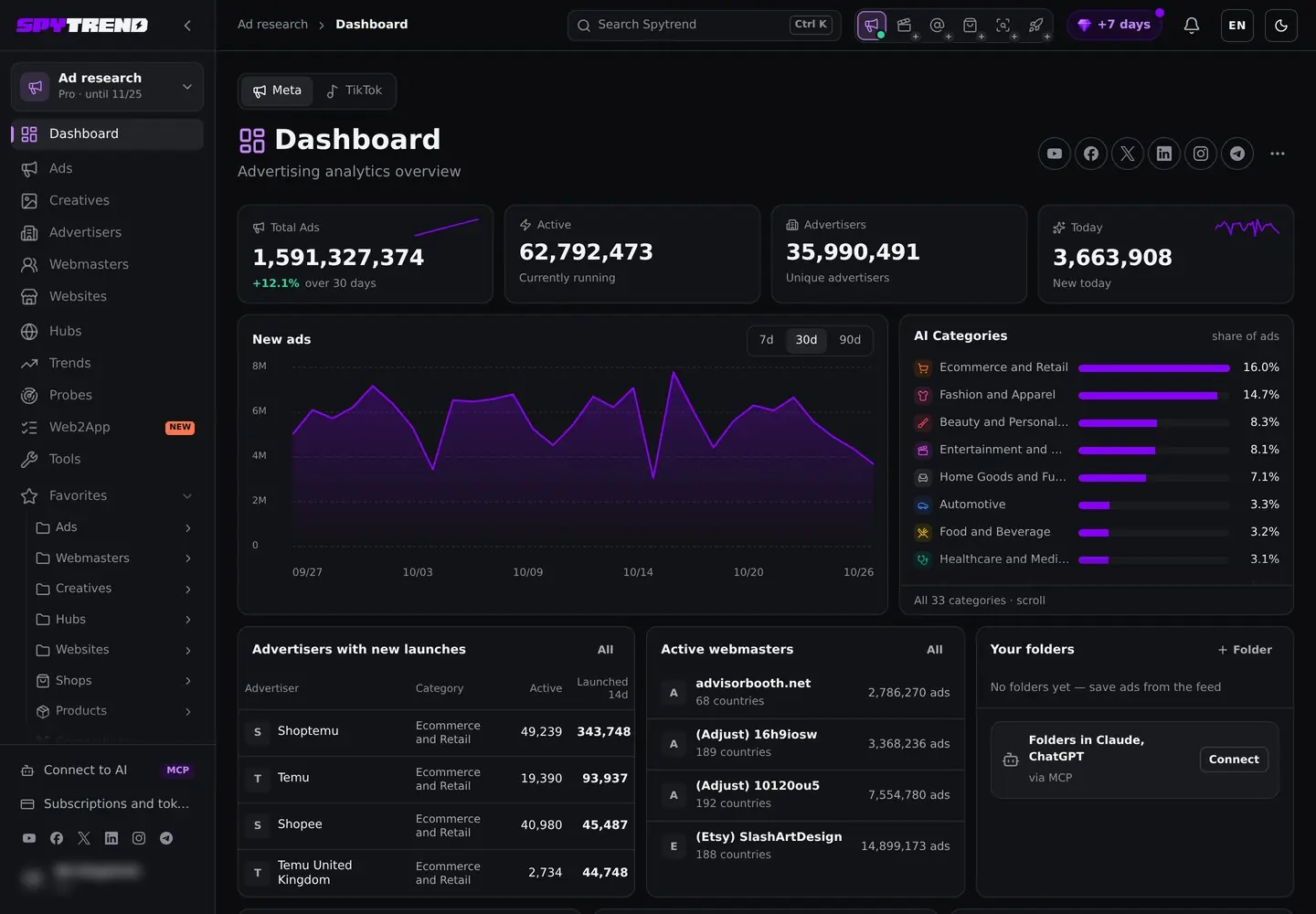
Search takes text, links, domains, pages and pixel IDs, with filters by country, language, platform, CTA, format, status, date range, days active, likes, webmaster, advertiser and domain zone, plus a Unique-only toggle. For ads shown in the EU there are filters by reach countries, EU reach, gender, age and payer. Quick filters for Trending and New 24h sit at the top, with sorting by most re-uploaded or by creation date.
Spytrend exposes an HTTP API and an MCP server with 40 tools; paid plans include 40,000 tokens a month (1 token per result), and another 40,000 cost $50, allowing teams to pipe ad intelligence into their own reporting or bidding workflows.
Affiliates in specific verticals can add paid sections on top of any plan: Nutra Affiliate and Crypto Affiliate from $249/mo, and Web2App from $599/mo, a library of app funnels walked to the paywall. Current prices are on the pricing page.
Verdict
Spytrend is the right choice for media buyers and affiliates whose primary objective is mapping a competitor's full ad operation on Facebook and Instagram — not just collecting individual creatives. Its webmaster grouping by four identifiers, pixel-chain tracing, and real-time active/inactive status are built for exactly that job. The free Starter plan with no credit card required and a 14-day money-back guarantee on first-time payments lower the risk of testing it.
It is not the right tool for teams that need multi-network coverage across Google, YouTube, or mobile ad networks, or for agencies that require a white-label reporting environment. For those needs, SocialPeta's breadth or a broader multi-platform tool is a more honest fit — and Spytrend's own positioning does not claim otherwise.
More than 1,100 media buyers already use Spytrend — a targeted base, which matches the product's focus: depth over breadth, for operators who need to understand a competitor's network architecture, not just look at a single winning creative.
Frequently Asked Questions
Does Spytrend cover ad networks beyond Facebook and Instagram?
Yes — TikTok. Besides Facebook and Instagram ads from the Meta Ad Library, Spytrend covers TikTok ads; the full TikTok corpus is part of every paid plan: Base, Pro Exclusive and Enterprise. Google, YouTube and native ad networks are not collected. Telegram, WhatsApp and Amazon appear as link filters inside Facebook and TikTok ads, not as separate sources.
How does Spytrend's database size compare to alternatives?
Spytrend tracks more than 1.4 billion Meta ads on Facebook and Instagram and 380M+ TikTok ads from more than 31.9 million advertisers. As of September 2026, AdSpy's homepage cites 211 million+ ads. The two tools measure and present their counts differently, making a direct comparison less meaningful than the search quality and grouping logic each applies to its data.
Is there a free plan or trial available?
Spytrend offers a free plan with no credit card required. First-time paid subscribers also receive a 14-day money-back guarantee.
What payment methods does Spytrend accept?
Spytrend accepts payment via Stripe, Visa, and Mastercard. Base is billed monthly, Pro Exclusive is prepaid for three months and Enterprise for six; any plan can be cancelled at any time.
What makes Spytrend different from a free ad spy tool?
Free ad spy tools surface individual creatives without operator context. Spytrend's Webmasters section links every ad from one competitor across pixel, domain, Page ID, and IP into a single profile. Watches in the Telegram bot @spytrends_bot and creative deduplication work on top of that.
Which verticals does Spytrend's AI classification cover?
Spytrend classifies ads across 33 categories and 342 subcategories: Gambling & Betting, Ecommerce & Retail, Fashion & Apparel, Beauty & Personal Care, Technology & Software, and Adult & Restricted, among others. This lets buyers filter ads by industry without manual keyword workarounds.