Part 2: Learn how to choose search arbitrage ad setups to test.
Spytrend has added Search Arbitrage, an add-on available with any plan, with its own section on the website. It covers Meta search arbitrage ads that send users to articles and search pages monetized through clicks on Google, Yahoo or Bing ads. For almost every ad, you can see the monetization network (identified for 99% of ads in September), monetization type, verdict (confirmed or probable arbitrage), keywords embedded in the URL, final domain and full redirect chain.
Previously, researching a search arbitrage setup meant piecing things together: finding the creative in the Meta Ad Library, then manually extracting keywords from URLs. Now it is all in one ad card.
Why is everything below based on September 2026? We reserve fresh data for subscribers. One number for scale: over the 30 days from September 21 to October 20, the section added 3.19 million new search arbitrage ads, including duplicates.
Interface screenshots were taken on October 21–22, 2026.
What is search arbitrage in 2026?
The flow is straightforward. You buy a click on Meta. The user lands on an article or search page, clicks one of the “related searches,” sees search results with ads, then clicks an advertiser’s ad. Only that final click earns revenue; you pay for everything before it. Profit is feed revenue per incoming Meta click minus CPC (cost per click on Meta). Feeds report RPC (revenue per click), but that measures revenue per click on an ad in the search results, not per incoming Meta click: users drop off both on the article and on the results page.
A feed provider sits between you and the ads: Tonic, System1, Predicto, Visymo, Media.net, Sedo and others. They have contracts with Google AFS (AdSense for Search, Google ads in search results on third-party sites) or with Yahoo and Bing feeds. You do not.
This model is also called search feed arbitrage. In Russian-speaking media buying circles, it is sometimes confused with doorway pages and contextual ad arbitrage. These are different models. Doorway pages rely on organic traffic; here, you buy traffic. Contextual ad arbitrage buys Google Ads traffic for an offer; here, you are not buying Google traffic, you are selling a click on a search ad. There is also search-to-search arbitrage, where buyers purchase search traffic and monetize search results, but this article focuses on Meta.
Over the past year and a half, Google has tightened the rules considerably:
- Google began winding down domain parking through AFD (AdSense for Domains) in March 2025 and removed it entirely on February 10, 2026. The remaining options are search pages through AFS and articles with related search blocks through RSOC (Related Search on Content).
- Since August 25, 2025, Google has had RAF (Restricted Access Features). Without RAF, a page is limited to five terms and one block, and Google selects the terms. Custom terms are available only to accounts with RAF. Access must be approved by an AdSense account manager. To retain it, an account must generate more than $10,000 in monthly revenue in at least three of the last four months and have no strikes.
- Since November 1, 2025, RSOC pages receiving traffic you buy must pass the exact text of the originating ad creative to Google through referrerAdCreative. Failing to pass the creative text is a violation. In practice, the creative and keywords are now checked together.
The takeaway: search arbitrage has become stricter, and guessing at a setup is expensive. It costs less to research what others are already running.
Why buyers use search feed arbitrage, and where it gets difficult
The advantages are clear. There is no offer or lead approval process, no call center and no need to wait for a customer to complete a purchase. You can work with almost any topic: cars, dental implants, loans, housing, jobs or travel. The limits are the rules of Google and Meta. Scaling comes through countries and languages: the same article can be translated and used across different markets.
But “no payment hold” is a myth. Feeds pay on NET 30–45 terms, meaning 30–45 days after the end of the month. Final revenue figures reach the tracker with a delay ranging from a couple of hours to a week or more. Buyers report clawbacks for traffic quality, frozen payments and domains being removed. Meta has no separate policy against search arbitrage, but it takes action against low-quality post-click experiences: thin content, excessive ads and unnecessary clicks. With repeated violations, an assessment can extend from a single ad to the entire account and domain.
What is inside Search Arbitrage in Spytrend?
Search Arbitrage opens as a separate mode with its own menu: Ads, Creatives, Analytics, Sites, Dynamics and Trends.
Search arbitrage ads and filters
The feed looks like the standard Spytrend feed, with an additional set of search arbitrage filters at the top.
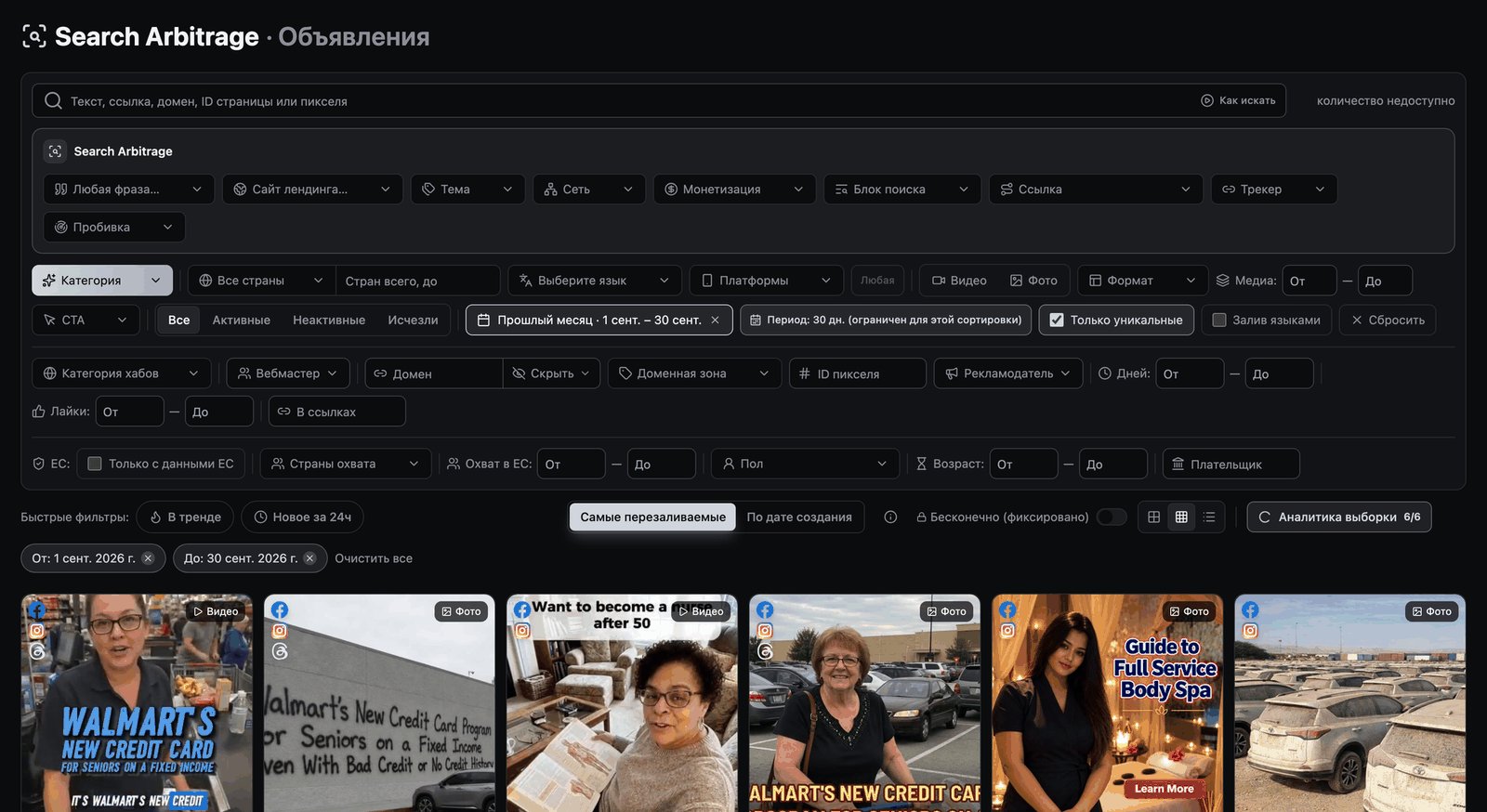
You can filter by:
- Any phrase. Search for keywords embedded in the URL or found on the page.
- Landing site. The site where the redirect chain ended when our crawler checked the ad. This uses the root domain without subdomains. A tracker at the start of the chain does not get in the way: you can find an ad linking to a tracker by searching for the site it ultimately sends users to. For Yahoo feeds, this will be yahoo.com because the chain ends directly on the search results page.
- Topic. Travel, Cars Sale, Dental, Loans, Real Estate, Jobs, Insurance and others, with 30 topics in total.
- Network. The monetization provider: Media.net, Cortex Media, Visymo, Tonic, Predicto, System1, CodeFuel and individual Google AFS accounts identified by pub-ID (the publisher number in AdSense).
- Monetization. Google AFS (a search page), RSOC (an article with a related search block), Yahoo feed or Bing feed.
- Search block. Whether a search block is present in the page code.
- Link. Whether the ad URL leads directly to the landing page or first goes through a tracker domain.
- Tracker. ClickFlare, Binom, Voluum, Keitaro or RedTrack. This filter checks the entire redirect chain for a tracker, so its counts differ from the “Link” filter. The figures below explain the difference.
- Landing page check. Whether our crawler reached the final page. It detects anti-bot protection (for 85,061 ads in September, or 4%), but not every time: for some networks, the check says “ok” while the screenshot shows a verification page. Always inspect the screenshot as well.
All the usual filters are also available: country, language, dates, active and disappeared ads, webmaster, advertiser and EU reach.

Sorting by “Most reuploaded” shows which creative has been uploaded the most times. September’s leaders include a Walmart credit card for seniors with bad credit (953 ads using one creative), nursing courses for people over 50, spas, bank-repossessed cars, the new Audi Q9 and home repair grants. Almost all focus on people aged 50+ and money. Hundreds of reuploads show that a topic is being run widely. To assess whether it may be paying off, look at how long the creative stays live.
Analyze your search arbitrage ad selection
You can break down any selection into analytics blocks. The section contains 2,071,885 ads launched in September, including duplicates of the same creative. Only 138,892 (6.7%) are active; another 896,761 (43%) are inactive, and 1,036,232 (50%) have disappeared from the Meta Ad Library. The data does not tell us why they disappeared, but search arbitrage creatives tend not to stay live for long.
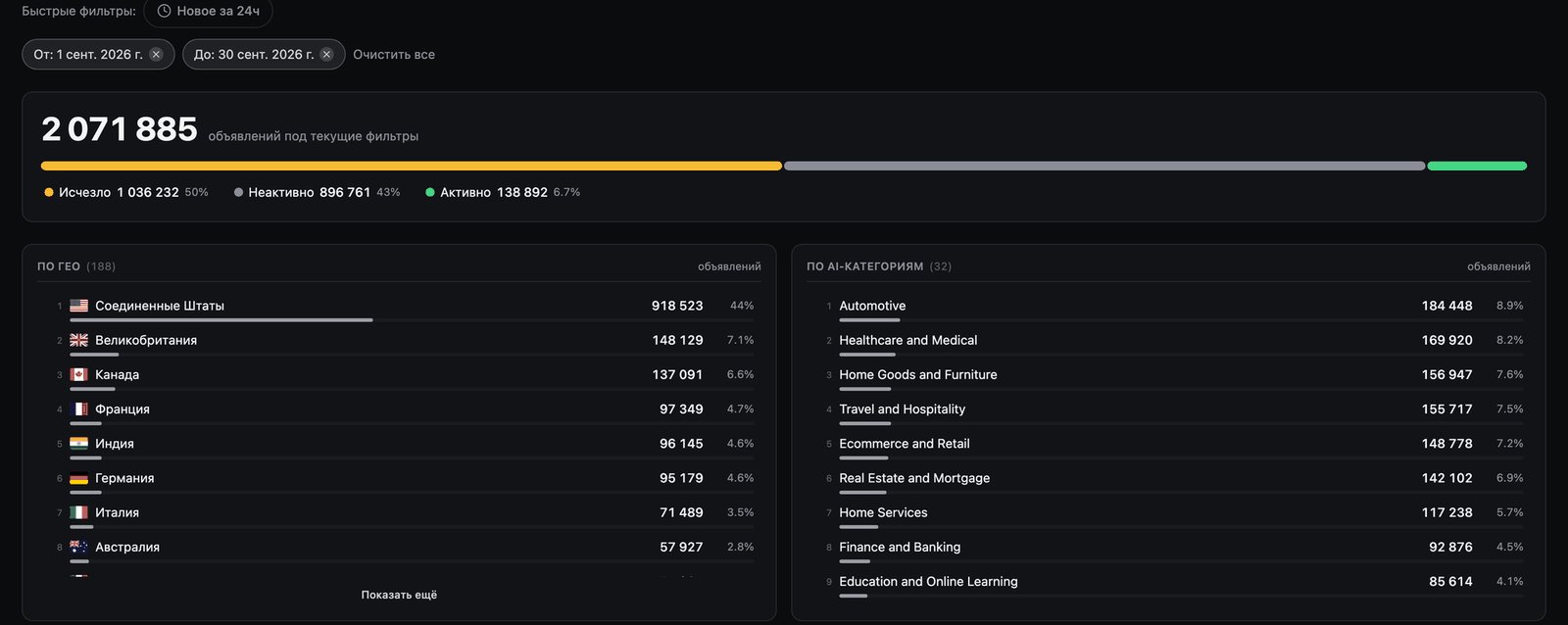
By country, the US accounts for 918,523 ads, or 44% of the selection. Next are the UK (7.1%), Canada (6.6%), then France, India and Germany, each at around 4.6–4.7%. There are 188 countries in total. One ad can run in several countries, so country totals exceed the total number of ads.
Alongside this is the “By AI categories” block. These categories are assigned from the creative itself, rather than its keywords, so they do not match the “Topics” breakdown below. The leaders are Automotive (184,448, 8.9%), Healthcare and Medical (8.2%) and Home Goods and Furniture (7.6%).
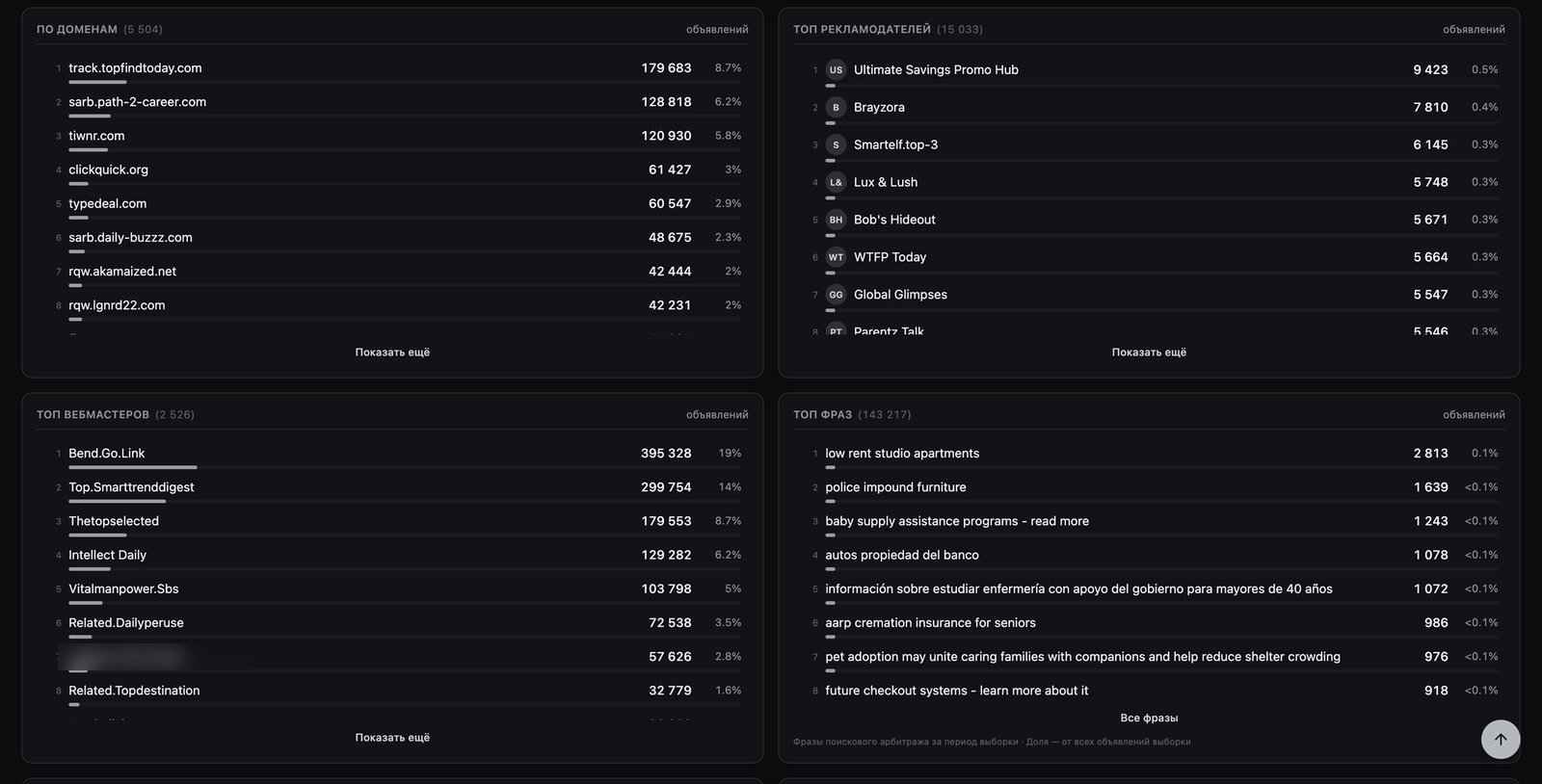
Below are breakdowns by domains, advertisers (15,033), webmasters (2,526) and phrases (143,217). There is an important distinction with domains. “By domains” counts the domain in the ad’s original URL. There are 5,504 of these, led by track.topfindtoday.com, which is a tracker domain rather than a landing site. September has 1,226 final landing domains after all redirects; the “Landing site” filter is the easier way to explore them. Percentages in these blocks are calculated against all 2,071,885 ads in the selection.
The top phrases are worth browsing manually. September’s leader is “low rent studio apartments,” with 2,813 ads across 29 domains. Next come “police impound furniture,” assistance with baby supplies, the Spanish phrase “autos propiedad del banco” (1,078 ads across 23 domains), government-supported nursing training for people over 40 and cremation insurance for seniors. When a phrase runs across two dozen domains, more than one person is testing the topic.
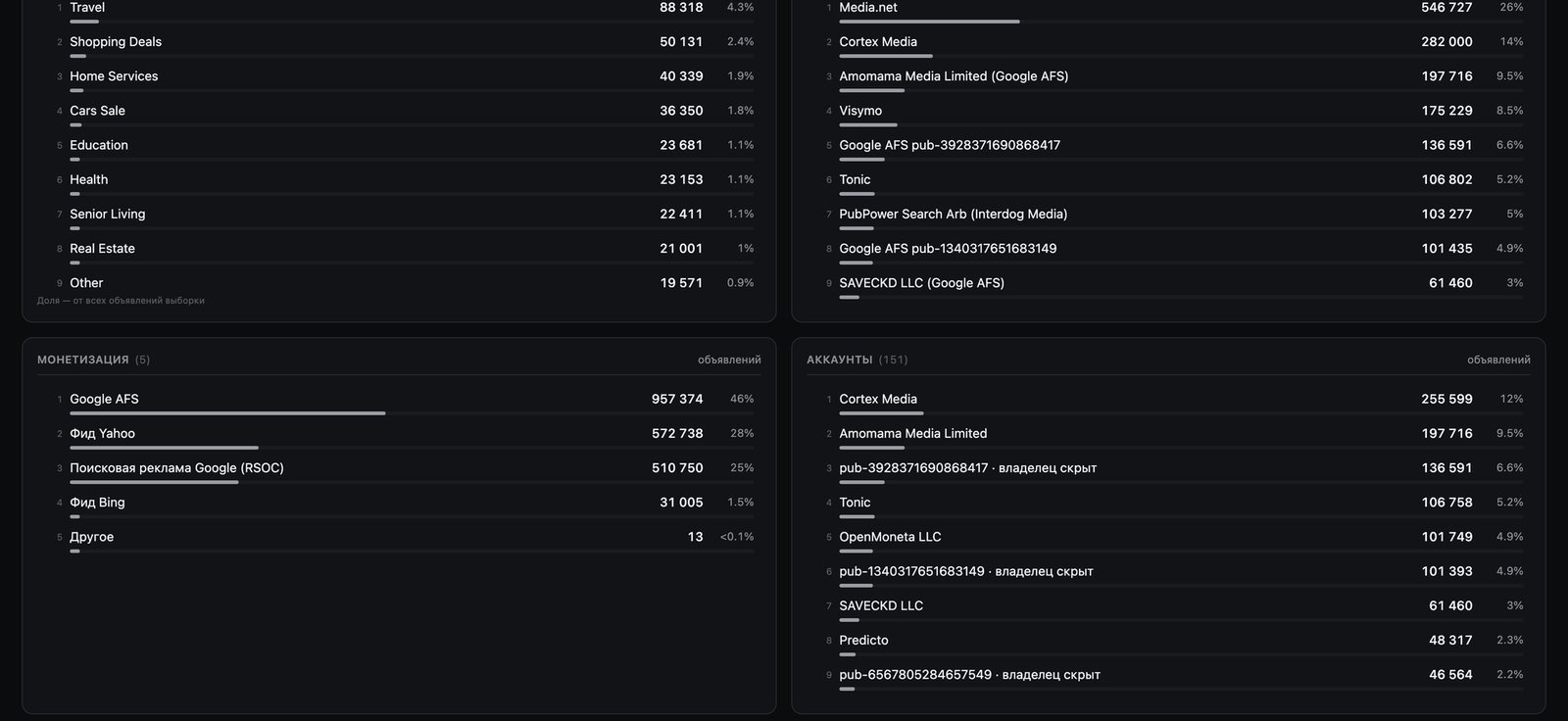
The September “Networks” block has 123 entries, covering both networks and individual Google AFS accounts. The leaders are Media.net (546,727 ads, 26%), Cortex Media (282,000, 14%), the Google AFS account of Amomama Media Limited (197,716, 9.5%), Visymo (175,229, 8.5%), a Google AFS account with an undisclosed owner (136,591, 6.6%) and Tonic (106,802, 5.2%). By monetization type, Google AFS accounts for 957,374 (46%), Yahoo feed for 572,738 (28%), RSOC for 510,750 (25%) and Bing feed for 31,005 (1.5%). Media.net accounts for almost all Yahoo feed ads: 546,727 out of 572,738, or 95%.
A separate “Accounts” block groups ads by Google pub-ID. This is useful when the network is hidden: a single pub-ID reveals all ads associated with that account, regardless of which webmasters run them. Some account owners are undisclosed; others are named, including Cortex Media, Amomama Media Limited, OpenMoneta LLC and SAVECKD LLC.
Topics are assigned to 453,301 ads, or 22% of the selection, so focus on absolute counts. Travel leads with 88,318, followed by Shopping Deals (50,131), Home Services (40,339) and Cars Sale (36,350). Next come education, health, senior housing, real estate, jobs and insurance.
One more point about trackers. For 401,613 ads (19%), the ad URL leads straight to a tracker. ClickFlare is identified in 180,624 of these; the other 220,989 use custom tracker domains that cannot be identified from the link. Another 97,254 ads have a direct link, but a tracker appears later in the chain, mainly ClickFlare (72,710), Binom (18,462) and Voluum (6,067). This explains the different ClickFlare counts in the two filters. “Link” counts it only when the ad URL leads directly to ClickFlare: 180,624 ads. “Tracker” checks the entire chain and adds another 72,710 where ClickFlare appears after the first hop. The total under “Tracker” is therefore 253,334 for ClickFlare.
Three September examples: what an ad card reveals
Each ad card has a “Search Arbitrage” tab. Here is the full tab for the System1 ad discussed below:
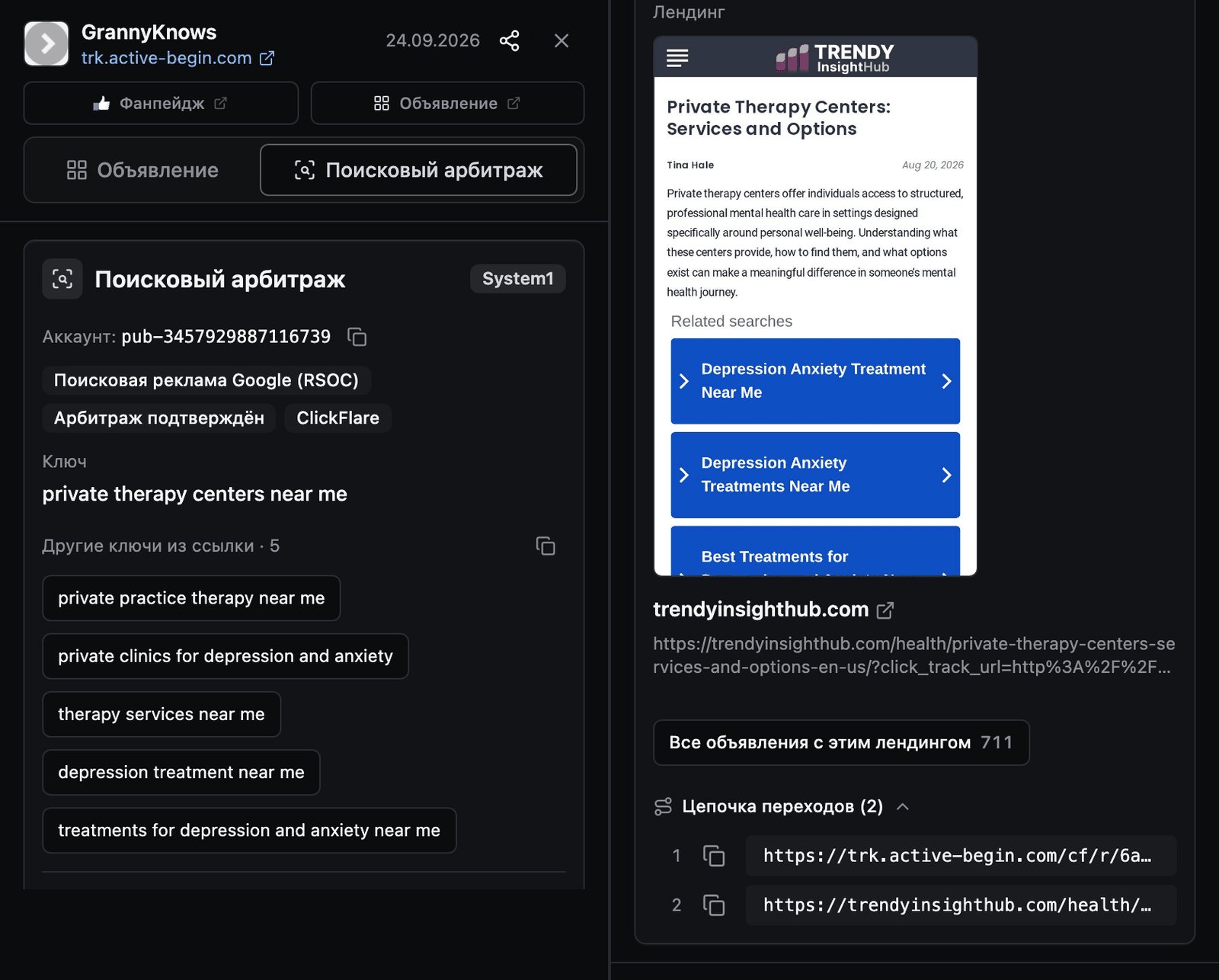
The network and AdSense account appear at the top left, followed by labels for monetization, verdict and tracker, or a note that the link is direct. Below are the keywords embedded in the URL. On the right are a screenshot of the page the user reaches, its domain and full URL, a button to view all ads pointing to that landing page, and the redirect chain from the ad URL to the final page.
These examples cover three different setups: an AFS search page, System1 RSOC with keywords in the URL, and Tonic RSOC. All three ran for more than a day.
One caveat about keywords. The card shows the keywords the buyer passed to the feed in the URL. Whether Google displays them in the search results depends on the feed account: without RAF, Google substitutes its own terms. These are the terms requested, not a guarantee of what the user saw.
Bank-repossessed cars in Spanish: Predicto and an AFS search page
The ad from the My happy place page launched on September 18 and was still running on October 14, almost four weeks later. The creative is in Spanish, with 439 ads using it in the September selection. The network is Predicto, the account is pub-7319700424839433, monetization is Google AFS, and arbitrage is confirmed.
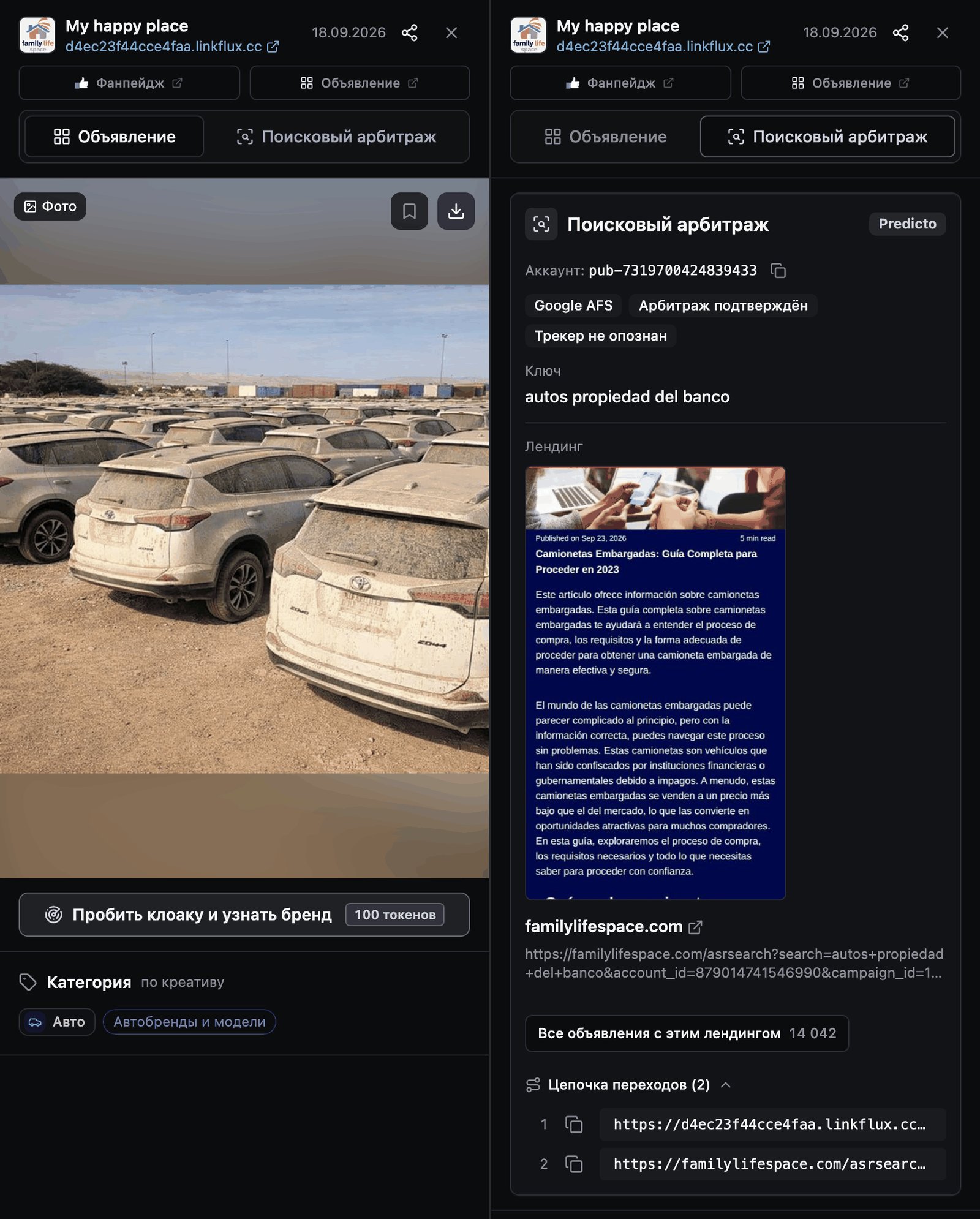
There is one keyword: “autos propiedad del banco.” These are the bank-repossessed cars seen in the top phrases. The link leads to d4ec23f44cce4faa.linkflux.cc, a redirect on a custom domain; we could not identify the tracker. The crawler followed it to familylifespace.com/asrsearch, a search page with the query directly in the URL’s search= parameter. The screenshot shows a short article above the results, “Camionetas Embargadas,” about vehicles repossessed by banks over unpaid debts.
The URL also reveals:
- account_id, campaign_id, adset_id and ad_id. These are the account, campaign, ad set and ad IDs, which Meta inserts through macros when the click happens;
- fb_pixel_id and event=Purchase. Judging by the names, the page sends a Purchase event to the pixel, and the campaign most likely optimizes for it;
- cid=ch35815+ch38307, which looks like Predicto channels used for revenue reporting.
In total, 14,042 ads in the database point to familylifespace.com.
Private therapy: System1 RSOC with six keywords in the URL
The GrannyKnows ad launched on September 24 and was last seen on October 13, giving it almost three weeks live. It targets the US. The network is System1, the account is pub-3457929887116739, monetization is RSOC, and the tracker is ClickFlare.

The ad URL leads to trk.active-begin.com/cf/r/…, which is ClickFlare on a custom domain. The crawler followed the redirect to an article on trendyinsighthub.com/health/…. The tab screenshot at the start of this section shows a typical RSOC page: an article titled “Private Therapy Centers: Services and Options,” with an author and date, and a Related searches block below the first paragraph.
There are six keywords, all on the same topic: “private therapy centers near me,” “private practice therapy near me,” “private clinics for depression and anxiety,” “therapy services near me,” “depression treatment near me” and “treatments for depression and anxiety near me.”
The final URL is especially useful. It contains exactly the parameters System1 describes in its partner documentation:
- forceKeyA, forceKeyB and so on: each keyword has its own parameter;
- segment=rsoc.trendyinsighthub.001: the traffic segment;
- headline and a set of s1p… parameters for campaign data;
- click_track_url with a postback URL where System1 sends the click together with its keyword.
If you are building a System1 integration, this is a live example of how someone else has implemented it.
There is also a policy risk to consider. Mental health falls under Meta’s personal attributes policy: the creative must not imply that the viewer has depression. The neutral headline here, “Looking Into Private Therapy?”, is no accident.
Cash App loans: Tonic RSOC without keywords in the URL
The Zenith & Angle ad launched on September 16 and was still active on October 6, more than two weeks later. It targets the US. The network is Tonic, the account is pub-1902826156353358, monetization is RSOC, and the link is direct.

The article on intuitionlink.com/en/articles/… covers Cash App loans with repayment over six months. The card has no keywords, which is expected: Tonic does not pass keywords in the URL and selects the search results itself. The URL contains site=rsoc, network=facebook, tonicId, adtitle with the article headline, and subid2–subid4 with the ad set, campaign and ad IDs. Tonic returns the keyword in the postback, so it is not visible from outside.
The card notes that a search block is present in the page code. In total, 53,770 ads in the database point to this landing page.
Here is how the three links compare:
| Predicto | System1 | Tonic | |
|---|---|---|---|
| Monetization | Google AFS, search page | RSOC | RSOC |
| What the URL reveals | The complete query in the page URL (search=) | Six keywords, each in its own forceKey parameter | Only the article headline (adtitle) |
| Tracker | Custom redirect on linkflux.cc | ClickFlare on a custom domain | None, direct link |
| Time live | Almost four weeks | Almost three weeks | More than two weeks |
The feed determines how much of a competitor’s setup you can actually see.
Sites, daily activity and search arbitrage keyword trends
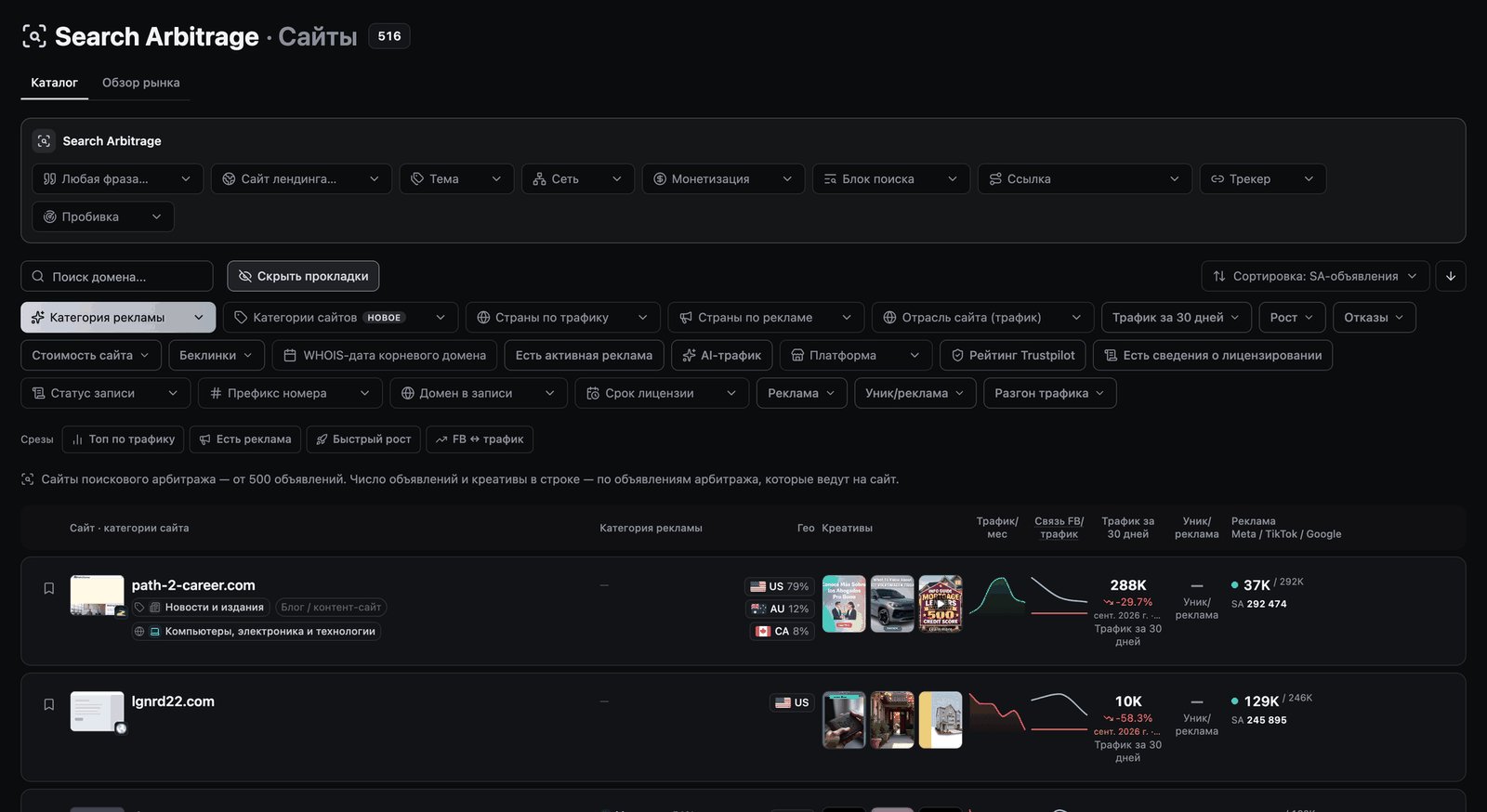
Sites. A directory of search arbitrage sites with at least 500 ads pointing to them. For each site, you can see monthly traffic, paid traffic share, growth, countries, categories, creatives, the number of search arbitrage ads and the relationship between Facebook advertising and traffic. You can hide intermediary sites with one button. The screenshot shows September 2026 traffic, while ad counts cover all time. At the top is path-2-career.com, with 288,000 visits in September and more than 292,000 search arbitrage ads pointing to it. Having more ads than visits is not an error. The ad count includes all duplicates across all time: it measures how much advertising points to a site, not how many people visited it. Traffic figures are estimates, and the interface flags low accuracy for some sites.
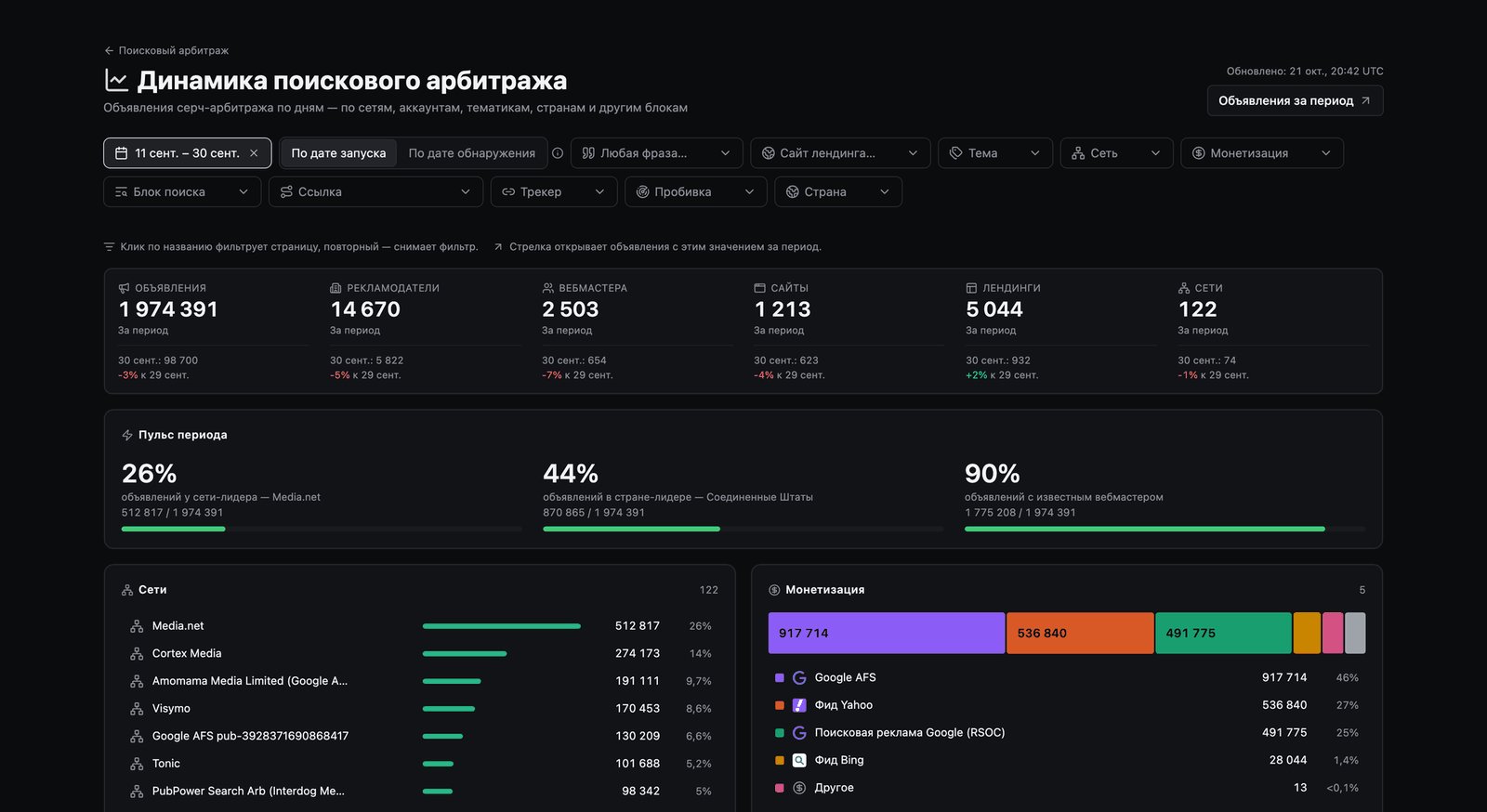
Dynamics. Daily search arbitrage ad activity by network, account, topic, country and the other breakdowns. You can count by launch date or by the date we found the ad. At the top, the “Period pulse” shows the shares held by the leading network, the leading country and ads with an identified webmaster. Clicking a name filters the page; the arrow opens ads with that value for the period. Dynamics covers roughly the previous 40 days, so the screenshot shows September 11–30: 1,974,391 ads, 14,670 advertisers and 1,213 sites, with 26% on Media.net and 44% targeting the US.
Keyword trends. Phrases with growing ad counts compared with the previous seven days. New phrases that did not appear at all in the previous period are shown separately. For each phrase, you can see how many advertisers and sites have started using it. Filters cover country, network and topic.
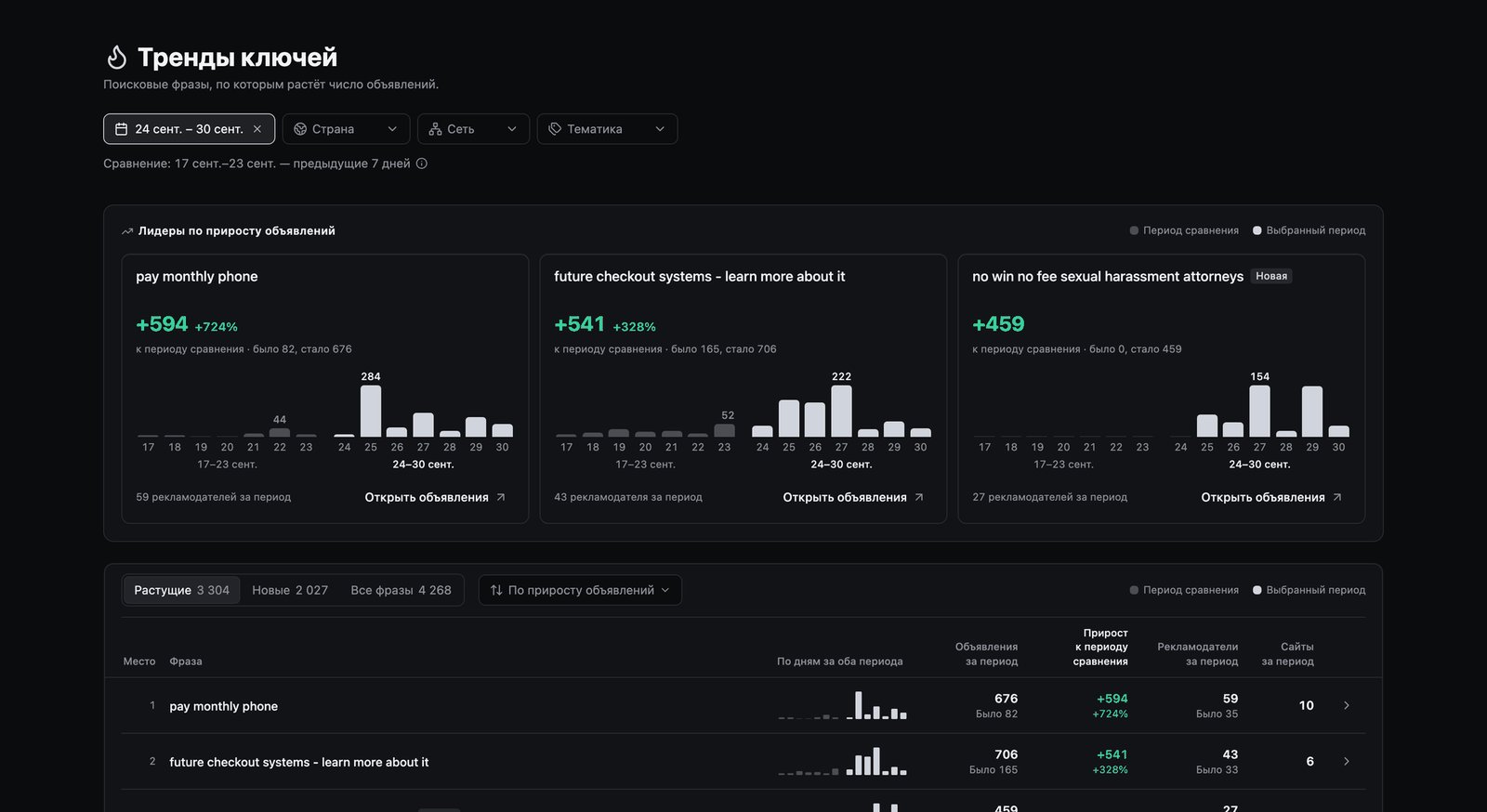
In the last week of September, “pay monthly phone” led the list: its ad count rose from 82 to 676, with 59 advertiser pages using the phrase. In third place was the new phrase “no win no fee sexual harassment attorneys.” It had no ads the previous week, then reached 459 ads from 27 advertisers.
How to research search arbitrage ads in Spytrend
Start with your feed, rather than with trends. A buyer usually works with one or two feeds they can access and can only reproduce setups using those feeds. A System1 setup is of limited use if your account is with Tonic.
- In the section’s ad feed, set “Network” to your feed, choose your country and select “Active.” This shows what is running now and what you could, in principle, reproduce.
- Open “Selection analytics.” “Topics” and “Phrases” show what is running on that feed in that country. “Accounts” and “Webmasters” help you see how many players are involved.
- Go to “Keyword trends” with the same network and country. Look at growing and new phrases, and how many pages and sites are using them. In Spytrend, an advertiser means a Facebook page, and search arbitrage teams run one creative from dozens of pages, so twenty pages could belong to one team. Also check the number of sites using the phrase and the webmasters in Analytics: if a phrase runs across different sites through different webmasters, more than one person is testing it.
- Click “Open ads” for a phrase and sort by “Most reuploaded.” Many duplicates mean the topic is being run widely. A long time live combined with fresh duplicates suggests the topic has not been abandoned. But ad budgets and revenue are not visible, so this indicates interest, not proven profit. For EU countries, the “EU reach” filter also shows how many people the ad actually reached.
- In the “Search Arbitrage” tab, note the keywords, URL parameters, tracker and pixel events, and inspect the page screenshot. “All ads with this landing page” shows the other creatives pointing to that page.
- In “Sites,” investigate the site behind the page: its traffic and how that relates to Facebook advertising.
- In “Dynamics,” check the last few days for a phrase or topic to see whether activity is growing or fading. Search arbitrage keywords do not stay relevant for long, so a monthly view tells you little here.
Spytrend does not show revenue per click; only the buyer and feed know that. Profitability can therefore be assessed only indirectly, through creative lifespan, the number of sites and webmasters using a phrase, and volume. These are indirect signals, nothing more.
Do not copy someone else’s article word for word. Google now checks whether the creative, content and keywords align, and policy violations accumulate as strikes. Use the section to research ideas, keywords and creative angles, then build your own page.
What Search Arbitrage does not show
Here is what to know before paying:
- No revenue, RPC or budgets. EU countries have reach data; other countries have only dates, statuses and duplicate counts;
- No actual Google search results. You see the keywords the buyer passed to the feed in the URL; what Google displayed depends on RAF;
- For some networks, the landing page screenshot may show an anti-bot page;
- The history is short: full collection started in September 2026, and “Dynamics” covers roughly the last 40 days;
- There is one source: Meta ads.
Search Arbitrage pricing
Search Arbitrage is available as an add-on to any Spytrend plan and is billed separately. There are three options:
- Section: $249/month for access to the section on the website;
- Section + MCP: $499/month, adding access to Search Arbitrage data through MCP (Model Context Protocol, which connects the data to AI agents);
- Annual with MCP: $4,500/year, 25% less than 12 months of “Section + MCP” at $499/month, saving $1,488.
Get access: spytrend.com/search-arbitrage/
Continue reading: how to choose search arbitrage ad setups to test — Part 2