Updated: 2026-09-25
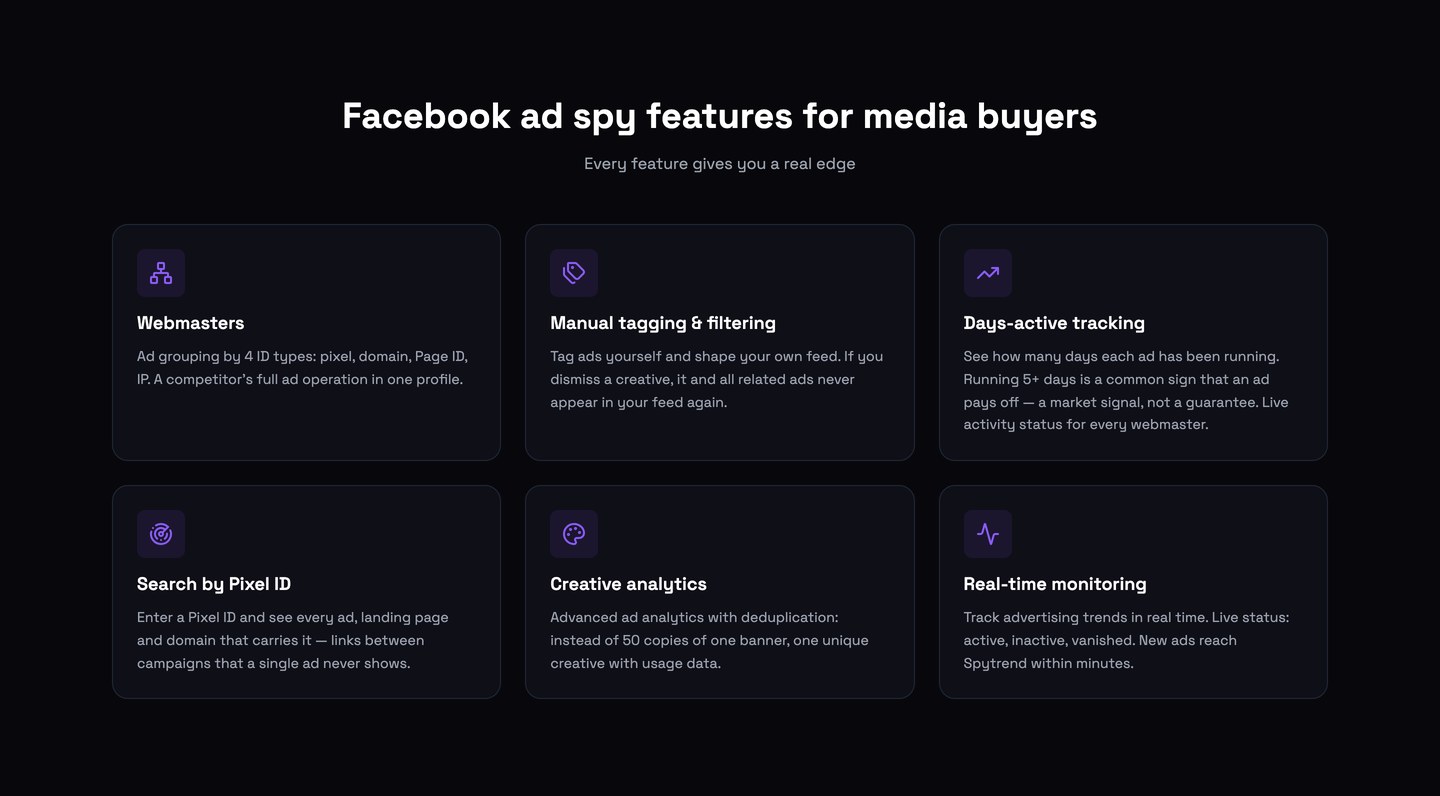
Spytrend delivers a differentiated take on ad intelligence by grouping competitor ads by webmaster — one profile per webmaster, which none of the five tools compared below lists on its official site as of September 2026. The database covers about 1.8 billion Facebook and TikTok ads, and paid plans start at $79/mo. The free Starter plan requires no card.
Quick Answer
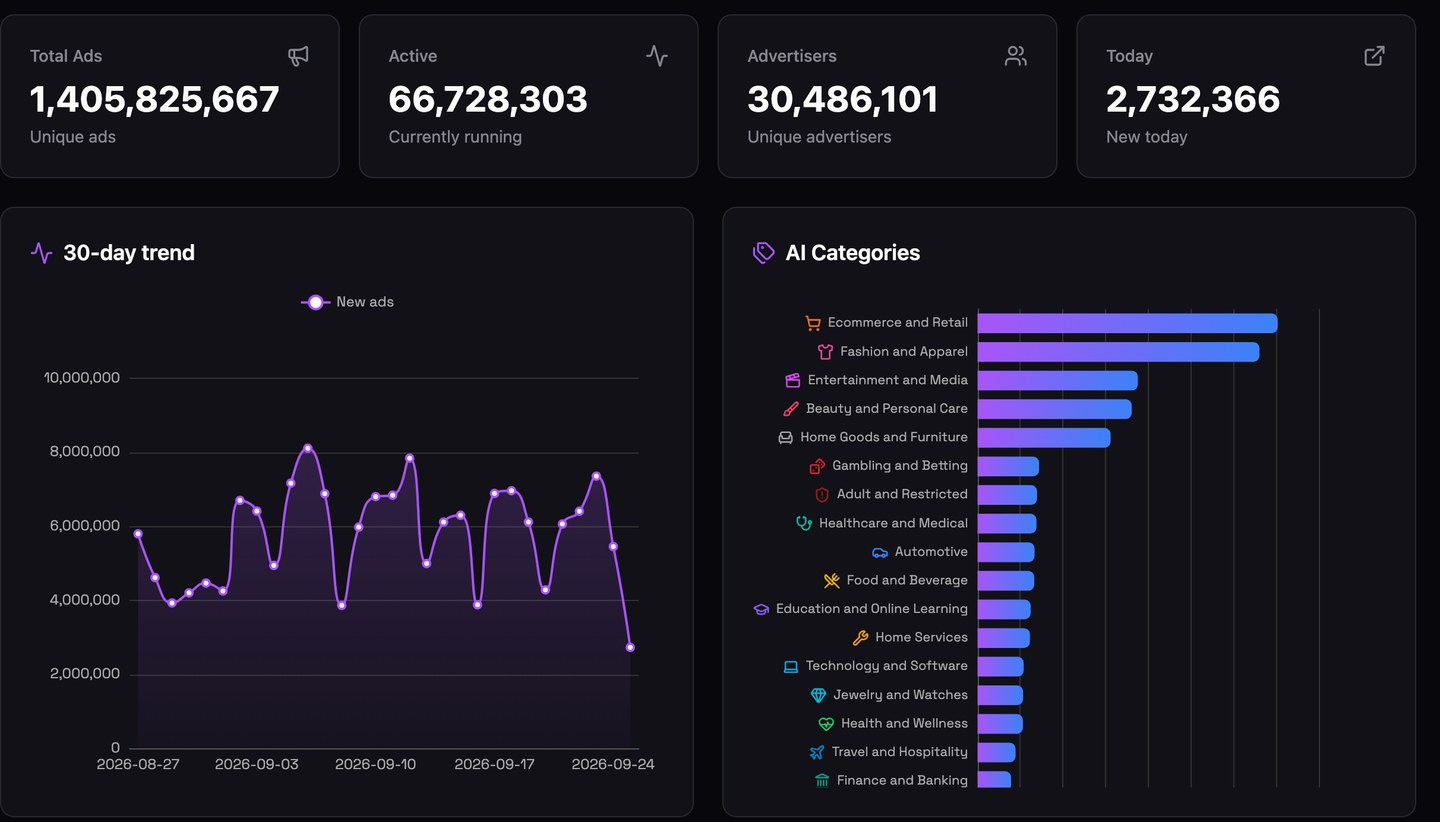
Spytrend is the competitive ad intelligence tool for US media buyers who need to identify the specific webmaster behind a campaign, not just the creative. Its Webmasters section, which joins a webmaster's pages, domains, and pixels into one profile, is not listed on the official sites of AdSpy, BigSpy, AdHeart, SocialPeta, and Tyver as of September 2026 — the main difference from these alternatives. Starting at $79/mo on a freemium model, it targets performance marketers who need attribution-layer intelligence, not just creative inspiration.
Spytrend is not the right fit for brand marketers running awareness campaigns on premium inventory, or for teams whose primary need is bulk social creative downloads. Those use cases are better addressed by tools purpose-built around social network libraries rather than advertiser-level intelligence.
Key Features

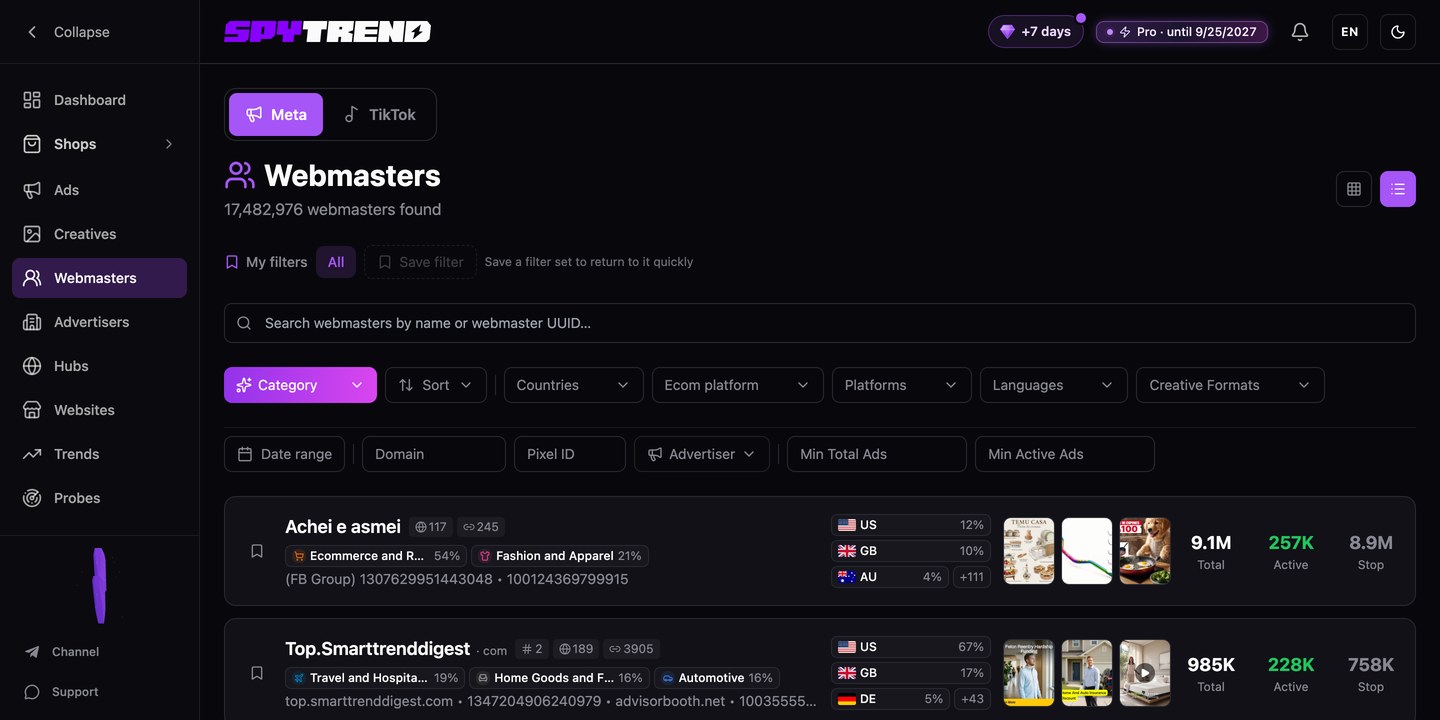
The Webmasters section — grouping ads by webmaster — is Spytrend's lead differentiator. The tool clusters ads by the webmaster account running them, letting analysts see the full portfolio of creatives, landing pages, and GEOs operated by a single advertiser — rather than viewing individual ads in isolation. None of the five competitors named below lists such a profile on its official site; they offer lookups by a single page, domain, IP, affiliate ID, or app developer (as of September 2026).
Pixel search tracks the tracking pixels embedded in competitor campaigns. Knowing which pixel a competitor uses — and on which landing pages — reveals the attribution stack and funnel structure behind a campaign. None of the five benchmarked competitors (AdSpy, BigSpy, AdHeart, SocialPeta, Tyver) lists search by pixel ID on its official site; AdSpy shows which tracking technologies a landing page uses, by vendor name (as of September 2026).
Deduplication (the Only Unique filter) collapses duplicate creatives, so analysts see unique ad variants rather than hundreds of re-uploads of the same image. Trend Analytics and GEO Trends surface which creatives and verticals are growing fastest by geography, replacing manual monitoring with growth rankings.
Probes ($1 per run, refunded if the run fails) open the real landing page behind an ad, including one hidden behind a cloak, with screenshots of every step — enabling funnel reconstruction without clicking through live campaigns. Days-active filters show how long each ad has been running, helping buyers distinguish scaling campaigns from dying ones. Creative Analytics shows each unique creative with how many ads used it and how long it has been active.
Keyword search rounds out the feature set by letting users search ad text, titles, fan page names, and links for their own terms, and the Telegram bot can re-run a saved question on a schedule (up to 3 watches free, 20 on Pro). This matters for verticals with specialized terminology (finance, nutraceuticals, software) where standard taxonomy falls short.
Use Cases
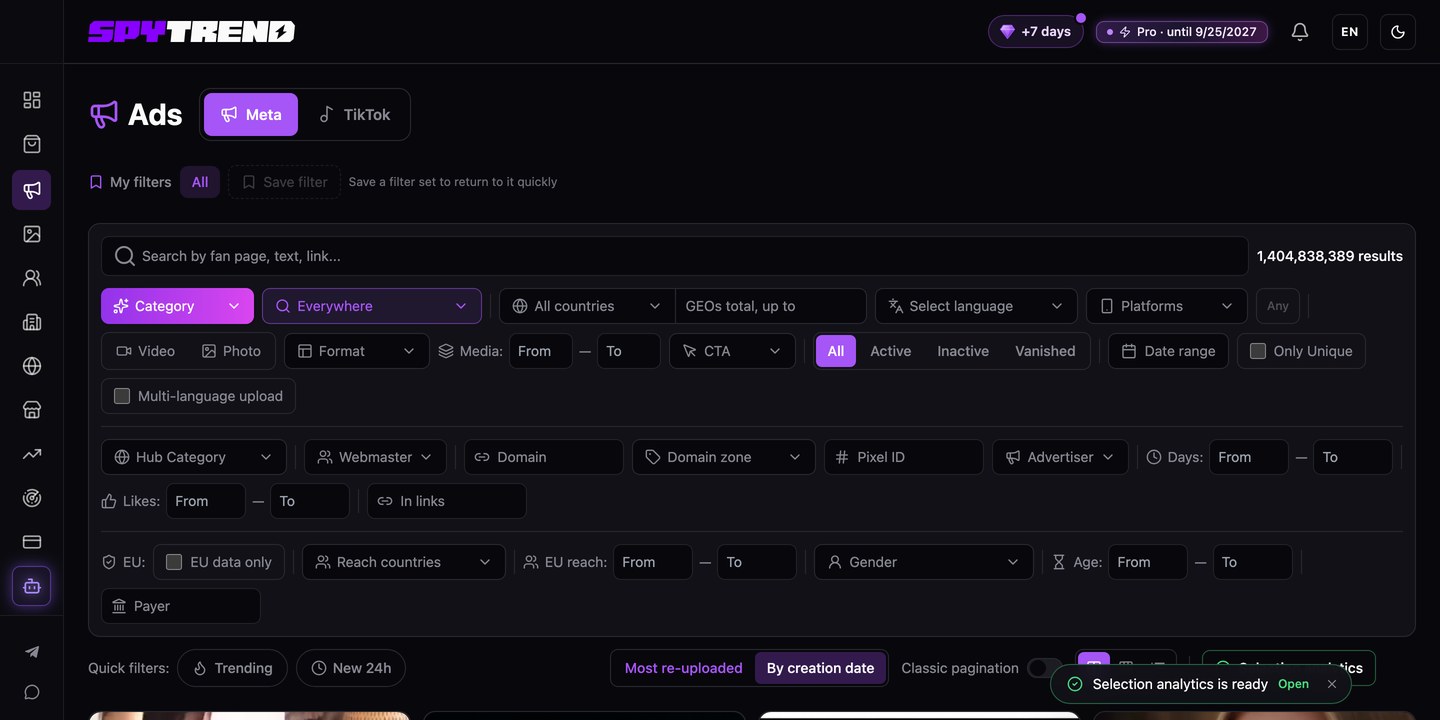
Mapping What's Scaling in a New Vertical
A performance media buyer enters a new vertical and needs to know which advertisers are scaling, not just which creatives look polished. Using Spytrend's days-active filters and Trend Analytics, the buyer filters for campaigns showing growth signals in a target GEO, then uses the Webmasters section to see the full campaign portfolio of the top five advertisers. The result is a structured picture of what's working — verticals, angles, funnel structure — in under an hour.
Countering a Competitor's Pixel Strategy
An affiliate team is losing margin and suspects a competitor is using a pixel-based retargeting strategy to re-capture their traffic. Pixel search exposes the pixel stack on competitor landing pages, confirming the hypothesis. The team restructures its own funnel to counter the identified tactic directly, cutting the attribution gap.
Reconstructing a Client's Funnel in One Session
A media buying agency onboards a new e-commerce client and needs to reconstruct the client's top competitors' funnels. Probes ($1 per run) pull the real destination pages behind running ads without requiring live traffic. Combined with Creative Analytics, the agency produces a competitive audit in a single session rather than over multiple days of manual browsing.
Who Spytrend Is Not For
Spytrend is not suited for teams that need deep organic SEO intelligence or content performance tracking. The tool is built around paid advertising signals; organic and content-focused workflows fall outside its scope.
How It Works
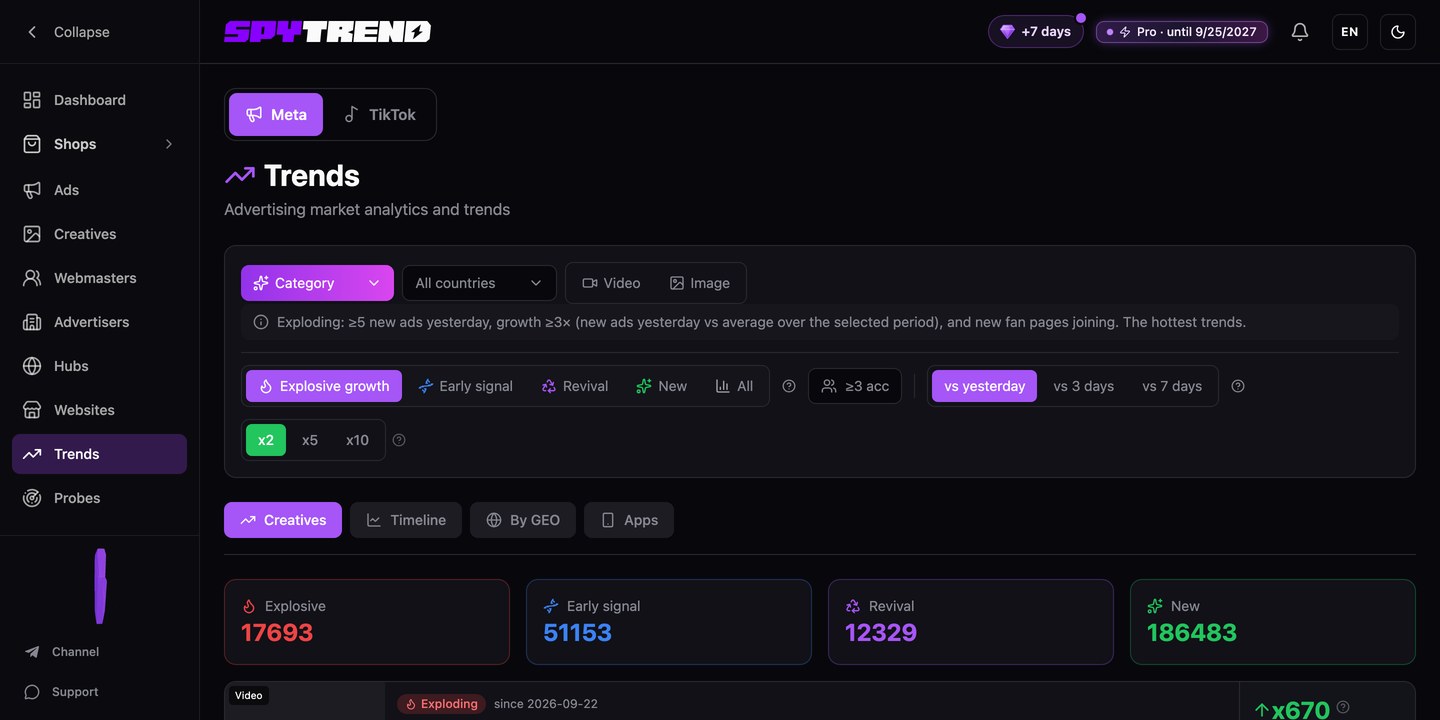
Spytrend operates as a web-based platform — no installation or local client required. The system continuously indexes Facebook and TikTok ads, building a database that currently stands at about 1.8 billion ads. Indexing is paired with deduplication, so the Creatives section counts each unique creative once rather than inflating counts with re-uploads.
The Webmasters section links indexed ads that share a pixel, an own landing domain, or a Facebook page, associating creatives, pixels, and landing pages with the same advertiser identity. This operates independently of the advertiser's declared identity — the grouping is structural, based on shared pixels, domains, and pages.
Trend Analytics and GEO Trends are computed from daily time series of ad volume. The system flags creatives and verticals crossing a growth threshold, surfacing them in the trend feed. Keyword search matches your own terms against ad text, titles, fan page names, and links at query time, enabling segmentation that the platform's default taxonomy does not cover.
Spytrend exposes an HTTP API (the same tools as its MCP server, with OAuth sign-in), allowing teams to pull data into internal dashboards or custom workflows. The per-user seat model means each team member accesses the platform under their own credentials, making role-based access straightforward for agencies managing multiple clients.
Pricing & Plans
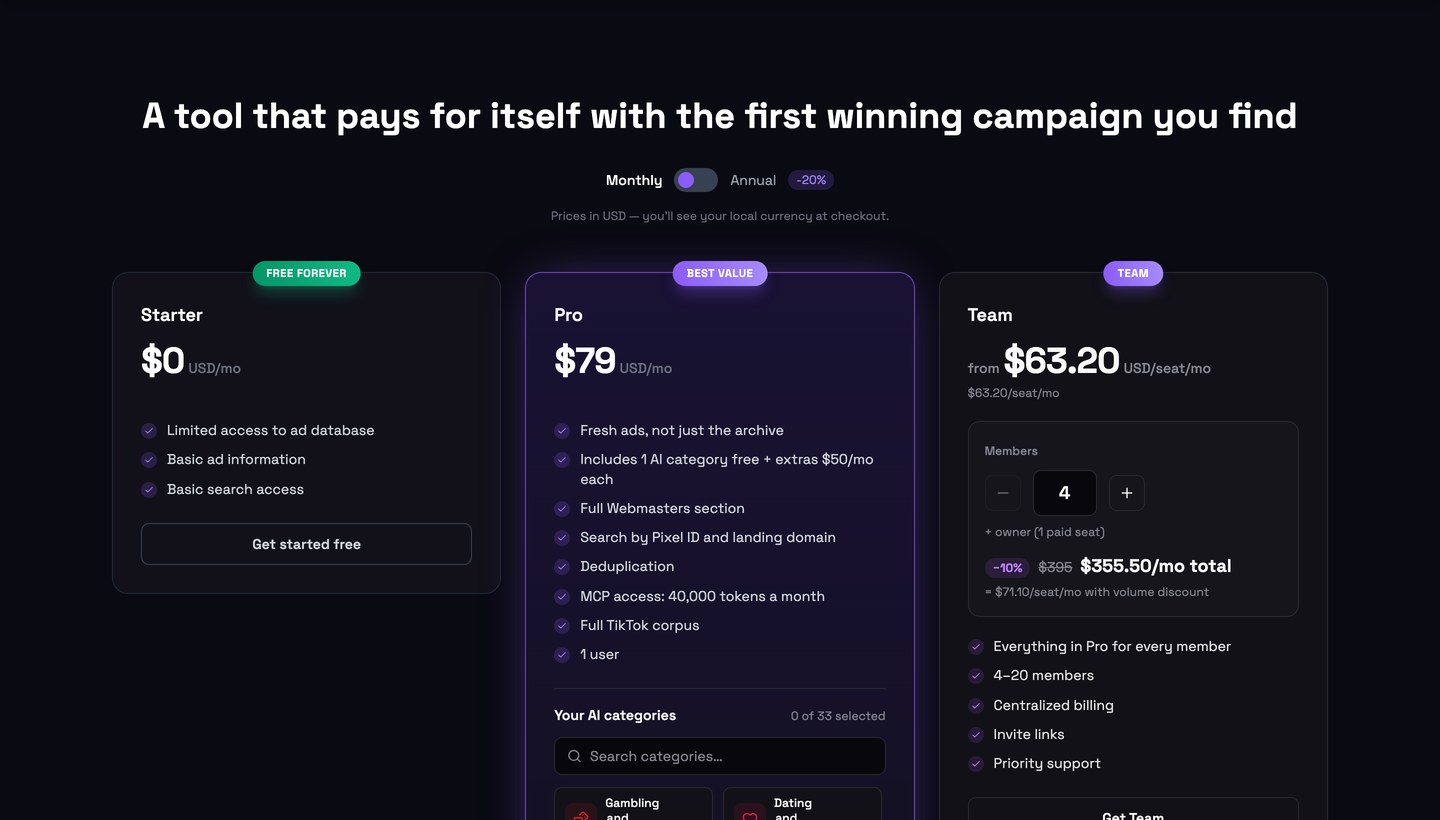
Spytrend uses a freemium pricing model with paid plans starting at $79/mo. A free plan is available for users who want to evaluate core search before committing. The paid tier unlocks the full feature set including the full Webmasters section, pixel search, and Trend Analytics.
The free Starter plan requires no card. First-time payments are covered by a 14-day money-back guarantee, so the financial risk of upgrading is minimal. Billing is per user, and payment is accepted via Stripe, Visa, and Mastercard.
Getting Started
Sign-up is web-based. Create an account, select the plan tier that matches your team size and intelligence needs, and access the dashboard immediately — no desktop software install is required. The free plan provides a functional baseline for first searches before any payment decision.
The recommended starting point is a search in the Webmasters section on a known competitor in your target vertical. Enter a domain or creative keyword, open the webmaster profile, and review the associated ad portfolio. From there, apply GEO Trends filters to narrow results to the specific markets you buy in.
Teams integrating Spytrend data into proprietary dashboards can authenticate with the HTTP API from day one. The per-user seat model means each additional analyst gets their own login rather than sharing a single account, which keeps audit trails clean for agency environments.
How It Compares
The five closest alternatives in the competitive ad intelligence category are AdSpy, BigSpy, AdHeart, SocialPeta, and Tyver. The table below maps the capabilities that differentiate Spytrend across those tools. Spytrend's core argument: one profile per webmaster and search by pixel ID are not listed on any named competitor's official site — and Spytrend's starting price matches Tyver and undercuts AdSpy.
| Capability | Spytrend | AdSpy | BigSpy | AdHeart | SocialPeta | Tyver |
|---|---|---|---|---|---|---|
| Grouping Ads by Webmaster | ✓ | Partial | Partial | Partial | Partial | Partial |
| Search by Pixel ID | ✓ | ✗ | ✗ | ✗ | ✗ | ✗ |
| Trend Monitoring | ✓ | ✗ | ✓ | ✗ | ✓ | ✗ |
| Starting Price | $79/mo | $149/mo | $69/mo | $69/mo | On request | $79/mo |
Competitor data as of September 2026, from each tool's official pages: AdSpy, BigSpy, AdHeart, SocialPeta, Tyver. “Partial”: the site lists lookups by a single page, domain, IP, affiliate ID, or app developer, but not one profile that joins a webmaster's pages, domains, and pixels. ✗: not listed on the official pages checked.
On pricing alone, Spytrend's $79/mo entry point matches Tyver, undercuts AdSpy ($149/mo), and sits above the entry plans of BigSpy ($69/mo) and AdHeart ($69/mo); SocialPeta publishes no price and quotes on request. The cost argument is secondary, however — the primary differentiator is the webmaster-layer view: none of the five competitors lists one profile that joins a webmaster's pages, domains, and pixels.
Frequently Asked Questions
Does Spytrend offer a free version?
Yes. Spytrend has a free plan that provides access to core search functionality. Upgrading to a paid plan unlocks the full Webmasters section, pixel search, Trend Analytics, and the full API.
Is there a free trial on paid plans?
There is no public free trial of paid plans; the free Starter plan requires no card. First-time payments are covered by a 14-day money-back guarantee.
Which payment methods does Spytrend accept?
Spytrend accepts payment via Stripe, Visa, and Mastercard. Billing is managed per user seat.
Does Spytrend provide an API?
Spytrend offers an HTTP API (the same tools as its MCP server), allowing teams to pull ad intelligence data into proprietary dashboards or automated workflows.
Which competitors offer one profile per webmaster?
As of September 2026, none of AdSpy, BigSpy, AdHeart, SocialPeta, and Tyver lists on its official site a profile that joins a webmaster's pages, domains, and pixels; they offer lookups by a single page, domain, IP, affiliate ID, or app developer. In Spytrend, the Webmasters section groups ads by the webmaster identity behind a campaign.
Is Spytrend suitable for organic search or SEO intelligence?
No. Spytrend is built around paid advertising signals. Teams whose primary need is organic search tracking or content performance monitoring will find the tool out of scope for those workflows.