Quick answer: AdSpy vs Minea is an ad archive against a product finder. AdSpy searches Facebook and Instagram ads, their comments and landing pages for $149 a month. Minea is built for dropshippers, with Meta and TikTok ads, a daily Top 10 and Shopify store data from $49. Spytrend starts from the owner and shows every ad that owner runs.
AdSpy vs Minea vs Spytrend in one table
| AdSpy | Minea | Spytrend | |
|---|---|---|---|
| Networks | Facebook and Instagram | Two tabs in the account: Meta Ads Library and TikTok | Facebook and TikTok |
| Database (each company's own figures) | 211,249,000+ ads, 30,178,000+ advertisers, 225 countries (Sep 24, 2026) | "100M+ ads from Meta & Tiktok" on the Browse ads screen (Sep 10, 2026) | 1.4B+ Facebook ads; about 280M new Facebook and TikTok ads a month, 170M+ of them on Facebook; 193 countries |
| Free access | New account got 1,000 free ad views as a one-time coupon; names and full ad text stay hidden (Sep 22, 2026) | Free registration: ad search with advertiser names; shop metrics marked Premium (Sep 24, 2026) | Free Starter plan with ads three months old and older |
| Price | $149 a month, one plan, called an introductory offer (Sep 22, 2026) | Starter $49, Premium $99, Business $199 a month; $39, $79 and $158 a month paid quarterly (Sep 23, 2026) | Paid plans listed on the pricing page |
| Refunds | Full refund within 24 hours of purchase, later at AdSpy's discretion (Sep 28, 2026) | Not checked | 14 days |
| Where a search starts | Ad text, comments, advertiser name, URL or landing page | A keyword, brand or website, then shop filters | A business category, an advertiser or a domain |
| Ads grouped by owner | No | One shop at a time | Domains, pixels and Page IDs joined in one profile |
How I ran the comparison
I opened accounts on both services and typed the same phrase, "dog harness", into each on the same day. A dog harness is a typical dropshipping item, so it suits Minea, and it's specific enough that AdSpy's text search should find it. Prices, limits and counts come from the accounts and from each company's own pages. Every date sits in the table above.
What I couldn't test: neither account was paid. In AdSpy I worked on the welcome credit, in Minea on a free registration. So I haven't seen Minea's store traffic or revenue figures, its AI Analysis, or AdSpy's full advertiser names. Those parts are described from the vendors' own screens.
"Dog harness" in AdSpy
AdSpy lets a search phrase go into six fields: the ad's text, its comments, the advertiser name, a URL, or the landing page's address or text. Under the search box sit 15 drop-down filters, including Affiliate, Technologies, Networks, Countries and Buttons. None of them is an industry or a niche, so I put "dog harness" into Ad Text and left the rest alone.
The list came back sorted by "Date (recent on top)". It shows no count of matching ads. Every advertiser name was cut to a few letters with "(subscribe to see name)" after it, and every ad text stopped at "Purchase subscription to view full text."
The matching is loose. A no-pull harness video from dogfriendlyco.com was there, labelled "Dog F...". So were a Lacoste polo from a concept store and a box of Pedigree dog treats. A word anywhere in the copy is enough to land an ad in the results.
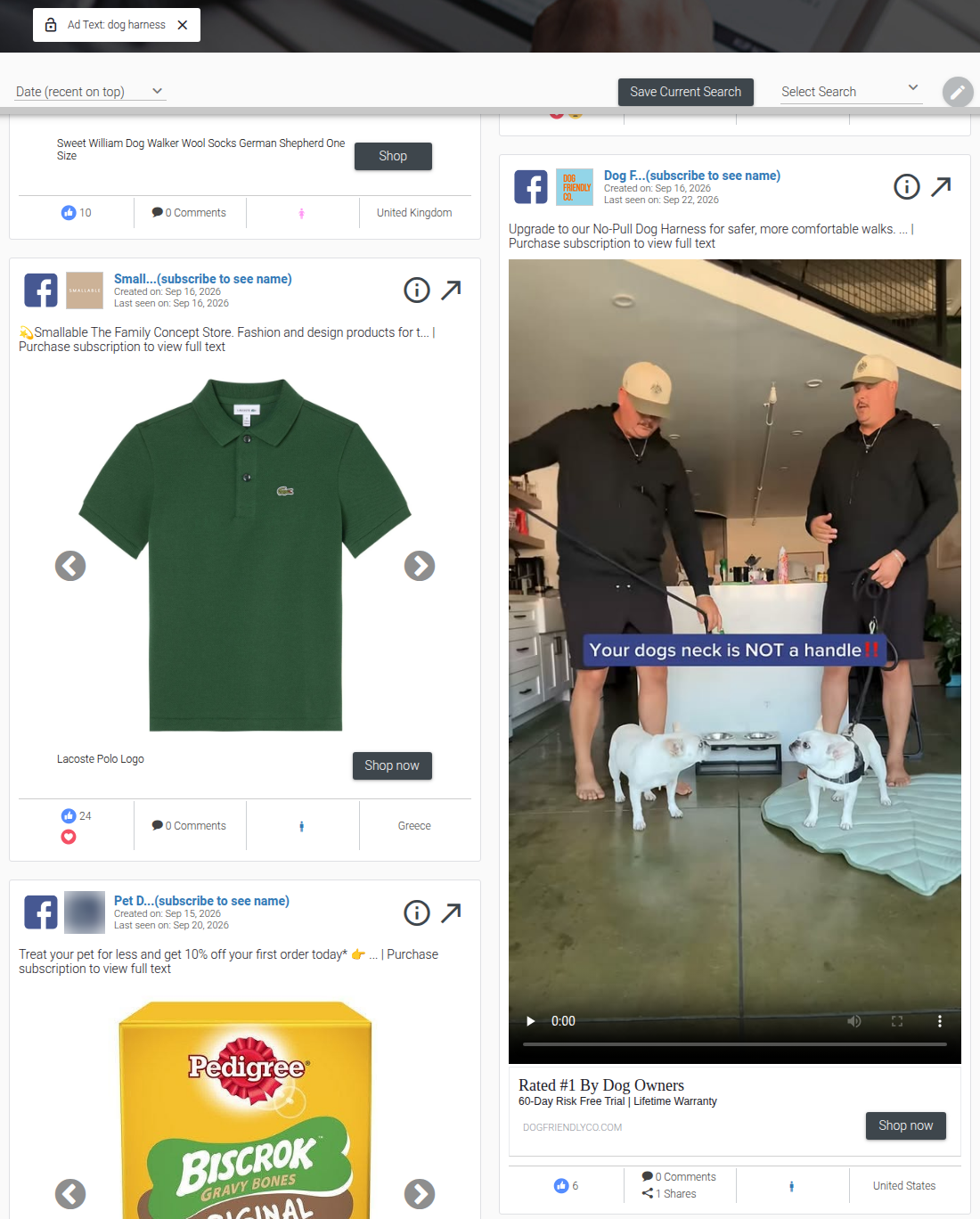
On the welcome credit an ad still opens into its detail page. I got a gender and country breakdown, a screenshot of the landing page and a long table of the site's technology: web server, analytics tags, the Facebook Pixel. For an affiliate checking how a competitor's funnel is built, that table answers more than the creative does.
"Dog harness" in Minea
Minea ran the phrase against its Meta Ads Library, sorted by publication date. The free account showed names in full. Dog Friendly Co. had 2.5k active ads out of 5.7k, and PawlyLab Co. had 358 of 485. Above them sat Indihopshop (50 of 50) and Leader K9 (8 of 8), each card with an Ad link to the product page and an Ad analysis button.
I compared links in both result lists. The "Dog F..." that AdSpy hid is Dog Friendly Co., and its "Pawly..." is PawlyLab Co. The second one sits further down AdSpy's list, below what fits in my screenshot.
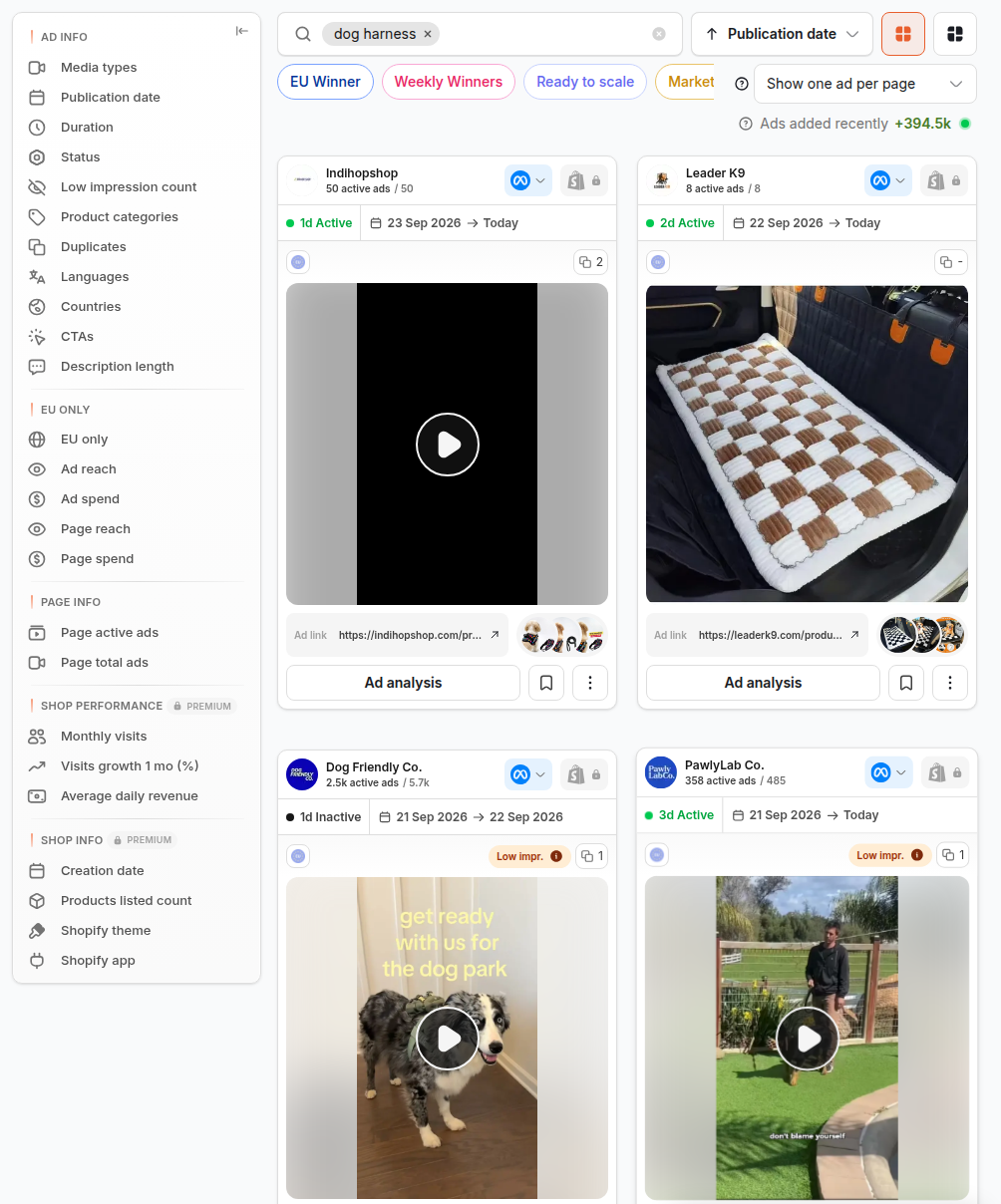
Minea's paywall sits in the filter panel instead. Shop performance (monthly visits, visit growth, average daily revenue) and Shop info (creation date, products listed, Shopify theme, Shopify app) both carry a Premium badge. The shop icon on each card has a small lock.
So the same phrase gave me two kinds of answer. Minea named the sellers and showed how many ads each keeps running. AdSpy proved the ads exist and kept the sellers' names back until I pay.
Pricing and what free access opens
AdSpy sells one plan, $149 a month. The pricing block calls that price introductory and warns it won't stay. When I registered, the account came with a coupon called adspy-welcome worth 1,000 views. By the time I took a screenshot of the Subscription screen, the counter read 990. API access is a separate subscription, another $149 a month. Money comes back in full if you ask within 24 hours of buying; past that, AdSpy decides case by case.
Minea has three tiers. Starter is $49 a month, Premium $99 and Business $199. Paying quarterly brings them down to $39, $79 and $158 a month. The cheapest tier is thinner than its price suggests. On the in-app Plans screen, Starter shows four lines crossed out: Daily niche lists, Notifications, Brand tracker and Shops. AI Transcript and AI Analysis of an ad are capped at 10 a month on Starter, 50 on Premium, unlimited on Business. For store research, the real entry point is Premium.
Put side by side, AdSpy's $149 lands between Minea's Premium and Business. Minea's quarterly Premium works out at $79 a month, about half of AdSpy. AdSpy, in return, has no feature tiers at all: one price opens everything it sells, apart from the API.
AdSpy's Trustpilot page is unclaimed and holds 8 reviews averaging 2.4 out of 5. Eight reviews can't carry much weight either way. I didn't save a screenshot of Minea's Trustpilot page, so I'm not quoting its score here.
Which one suits dropshipping
Dropshipping research starts from a product, and Minea is laid out around that. The Home screen opens on Today's Top 10, a daily pick of ads, products and shops that Minea says is "refreshed every day", with a separate tab for each of the three. Each ad card links to the product page. On paid tiers, the Shopify filters narrow results to stores on a given theme or app.
AdSpy has no product layer. It doesn't know what a store sells, only what an ad says. What it has is reach into the parts of an ad that Minea doesn't search: the comment thread and the landing page. Comments are where buyers complain about sizing or delivery, which tells you something about a product before you order samples. The Affiliate filter and the technology table matter more to affiliate and direct-response teams than to store owners.
TikTok is the other split. Minea has a TikTok tab next to Meta. AdSpy covers Facebook and Instagram only, so a TikTok-first product test has nothing to search there.
Neither tool answered one question I had after the harness search. Is Dog Friendly Co. one store, or one of several run by the same people? Minea looks at a single shop per lookup, and AdSpy at a single ad.
Where Spytrend fits
Spytrend is designed around that missing question. The vendor sums it up in a sentence I'm leaving exactly as written:
Spytrend is an ad intelligence platform for Facebook and TikTok advertising: an archive of ads going back to 2018, AI-classified into 33 business categories, with every advertiser assembled into a single card — all ads, pages, domains and countries in one place.
The 33 categories split further into 342 subcategories. Ads are matched to an owner by pixel, domain and Page ID before you search, so a network shows up as one profile.
Here is one I opened in the Webmasters section: Alacloth (alacloth.com). The profile joins 26 domains, 19 of them active, and 2,583 Page IDs, 880 of them active, under 5 pixel IDs, 2 of them active. Across the network there are 478,121 ads: 65,082 active and 413,039 stopped. The 30-day timeline shows −8%. The US leads its top countries, followed by the Netherlands, Germany, Canada and Australia.
The panel also says why these pieces belong together. Under "What merged this network" it lists fan pages that ran ads on more than one domain. Family is My Anchor X723 sent 897 ads to placeproud.com and 408 to eustylewear.com. Name Pride X502 did the same with 730 and 335. Pages like Funny Family Gifts B004 send their ads to a third shop, bellisty.com.
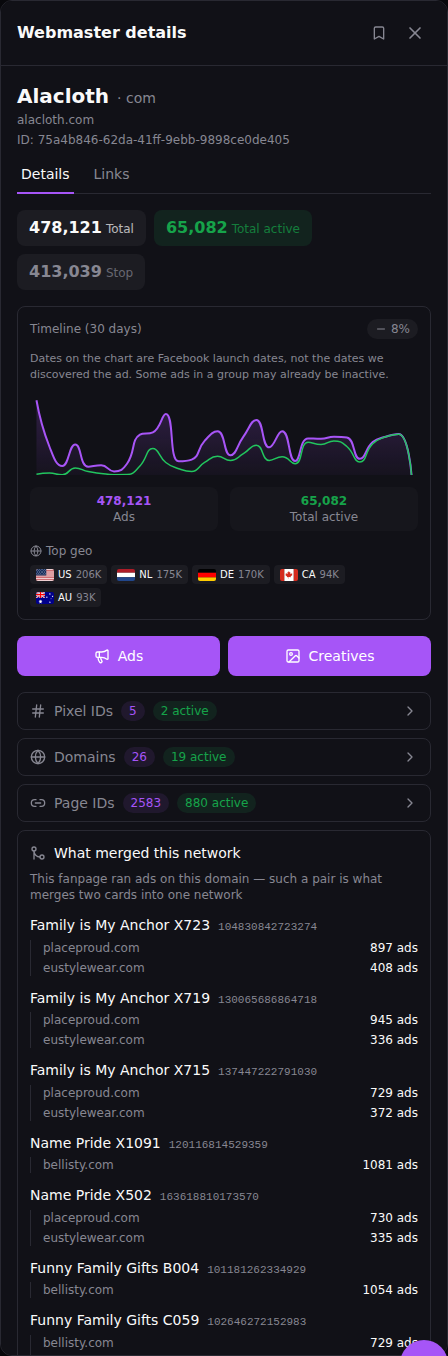
In AdSpy, placeproud.com and eustylewear.com would come up as two advertisers with their names hidden. In Minea they'd be two separate shops, looked up one by one. The shared fan page is the link that neither of them shows. How the profile is put together is explained in the Webmasters walkthrough.
Spytrend has limits worth knowing before you compare. It covers Facebook and TikTok only. On the free Starter plan the archive opens from the three-month mark back, while live ads start on paid plans. Searches are unlimited within the categories you pay for, and refunds run for 14 days. Plan contents are on the Spytrend pricing page.
So which one
Product sourcing for a Shopify store points to Minea, at least from Premium up, where the shop data opens. Affiliate work that stays on Facebook and Instagram, where you want to read comments and inspect landing-page tech, is closer to what AdSpy does. Tracing which operator stands behind several stores at once is the job Spytrend's Webmasters section was built for.
You can check most of this without paying. Minea's registration is free, Spytrend's Starter is free, and my AdSpy account came with view credits. Type a product from your own niche into all three and look at what each one tells you about the seller. AdSpy and Minea each have a separate breakdown too, and AdSpy is also set against BigSpy. More tools of this kind are lined up in a roundup of ad spy tools.
FAQ
AdSpy vs Minea: which one names the advertiser before you pay?
In AdSpy vs Minea, only Minea shows advertiser names on free access. A free registration lists the full page name with its active and total ad counts. AdSpy cuts every name to a few letters and adds "(subscribe to see name)" until you buy the $149 plan, even while the welcome credit is running.
Minea pricing: what does quarterly billing take off?
Minea pricing drops by $10 to $41 a month when you pay quarterly. Starter goes from $49 to $39, Premium from $99 to $79 and Business from $199 to $158. The tier you pick matters more than the billing period, since Starter has no Shops, Brand tracker or Notifications.
Is Minea worth it for a first store?
Minea is worth it for a first store once the free account has shown you the data you need. Search and advertiser names cost nothing there. Shop traffic and revenue start at Premium, $99 a month or $79 paid quarterly. Starter at $49 leaves shop data out entirely, so it's an odd middle step for store research.
AdSpy review: is the $149 plan worth it?
This AdSpy review comes down to two features: comment search and the landing-page technology table. If you'll use them on Facebook and Instagram ads, $149 buys names, full texts and what AdSpy calls virtually unlimited usage. It won't search TikTok or sort by industry. The 24-hour refund window is short, so test on the welcome credit first.
Minea vs AdSpy: which one sees TikTok?
Minea vs AdSpy on TikTok is simple. Minea has a TikTok tab next to its Meta Ads Library, and its Browse ads screen counts 100M+ ads from Meta and TikTok together. AdSpy covers Facebook and Instagram only.
Is Spytrend the same as AdSpy?
No. AdSpy is a searchable archive of Facebook and Instagram ads, opened one ad at a time. Spytrend works with Facebook and TikTok ads, labels each with one of 33 business categories and puts an owner's domains, pixels and Page IDs on one profile. Its free Starter plan shows ads from three months back and earlier.