Quick answer: Minea is an ad-and-product research tool for e-commerce and dropshipping: Meta and TikTok ads in the account (its site adds Instagram and Pinterest) plus Shopify store analytics. There's no free trial, only free registration, and paid tiers run $49–$199/month. It has no view grouping stores and ads by owner.
What is Minea
Minea is built for e-commerce and dropshipping sellers who want to know which products and ads are working right now. On minea.com the product has two sides. One is an ad-spy tool that its site lists as covering Facebook, Instagram, TikTok and Pinterest. The other is a product-research tool that publishes "10 Winning Products, Every Day," with a dropshipping supplier finder next to it.
A third piece, Shop Analytics, pulls up "key insights on traffic, revenue, and top ads" for a given store. Two AI features sit on top of the ad side: AI Analysis of an ad and AI Transcript. There's also a creative-lookup tool Minea calls "One Screenshot to Endless Creatives." You upload a product image and get back ads that use similar creative. A Chrome extension comes alongside the web app.
Inside the account, the Home screen backs up the "10 Winning Products" claim with a Today's Top 10 carousel. Its in-app label reads "The day's best-performing Meta ads, winning products and trending shops — refreshed every day." The carousel is split across Meta Ads, Products and Shops tabs. So the daily feed is a bit wider than the homepage's product-only framing suggests.
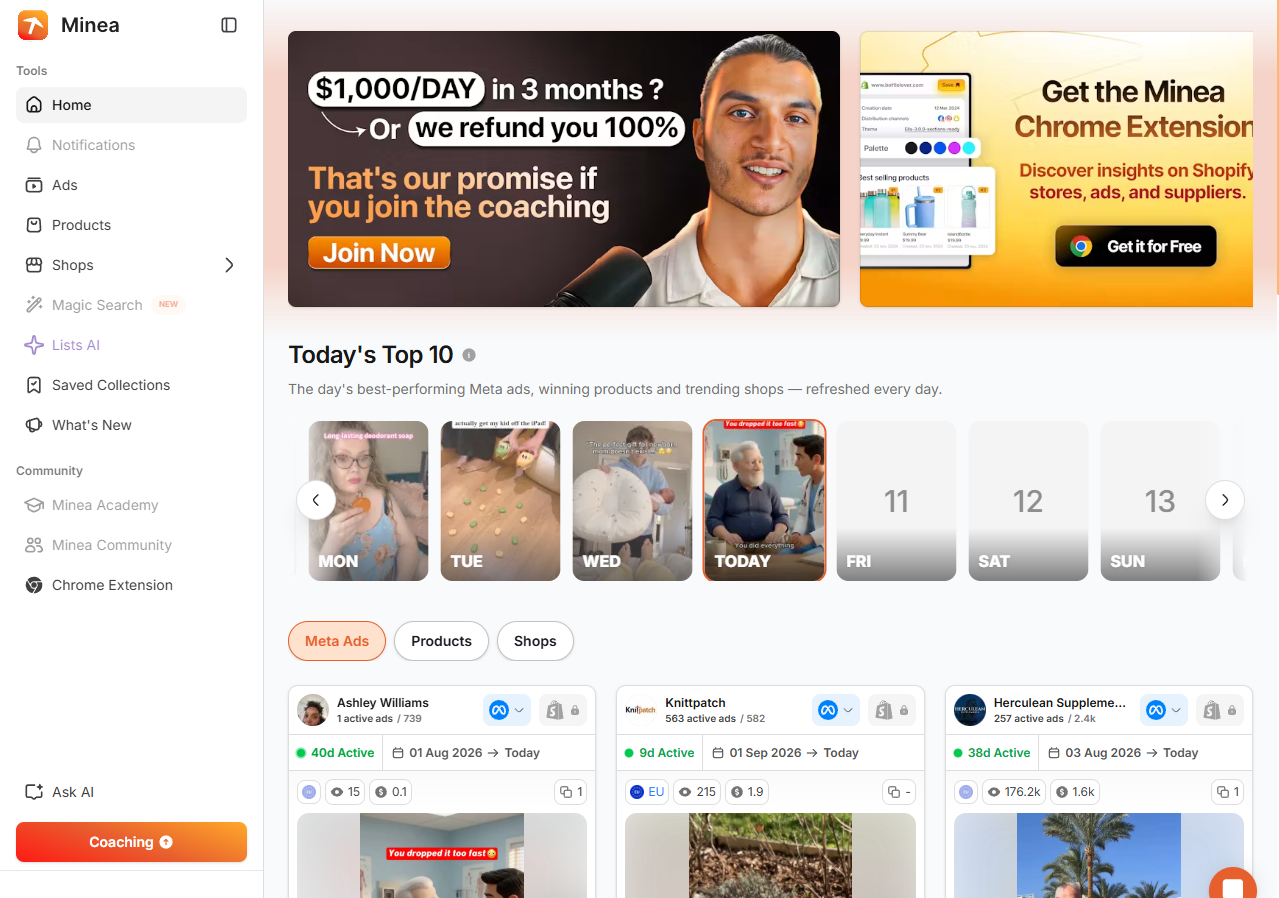
Ad search, a product feed and store analytics in one place suit one job well: sourcing a product and checking who else advertises it. Coverage stops when the research question is bigger than e-commerce. You might want a general category system across all Facebook and TikTok advertising. Or you might want the whole network of domains and pages behind one advertiser, where Minea gives you one store's numbers at a time. This breakdown measures both gaps against Spytrend's Ecommerce and Retail category. The wider workflow this research fits into is in how to spy on competitor ads.
Minea's homepage states 80M+ active ads in its database and 120k+ daily ad and shop updates. The same page claims 200,000+ users ("Trusted by +200,000 DROPSHIPPERS") and a self-reported 4.7/5 rating. On Trustpilot Minea holds 3.8 from 306 reviews. Its ad-spy-tool page gives a larger figure with a different scope: "100M+ ads" in a "searchable database." Minea doesn't reconcile that with the homepage's 80M+ active count. The site doesn't say whether the difference is active ads against total ads.
How I tested
I went through a Minea account's Home screen, its Plans screen and the Browse Ads search. Later I checked a registered account with no paid plan, to see what the free level opens and what it locks. I also read minea.com, its pricing page and its Trustpilot page.
To have something to compare against, I ran a similar search in Spytrend. I filtered Ads by Ecommerce and Retail and opened one owner profile in Webmasters.
What this test doesn't show: I didn't buy a paid tier, so I didn't try AI Analysis, AI Transcript or Shop Details from the inside. I also saw no Pinterest tab, so I couldn't check Minea's Pinterest coverage myself.
Minea pricing and the free trial: what you actually get
Minea doesn't sell a time-limited trial. Its pricing page on minea.com carries no countdown-timer discount, and the only free option there is "Register now for free." That creates an account with no trial subscription attached.
I checked a registered account with no paid plan. Browse Ads still ran a full keyword search with country, category and other filters. Opening an ad showed its status, run dates, duplicate count and the page's active-ads count. There was no upgrade prompt anywhere on that path.
The store side is different. On every ad card the shop icon carries a small lock, and the Plans screen only adds Shops from Premium up. So searching and browsing ads is free past registration, while shop-level analytics isn't.
In practice, you can test Minea's ad search for free, but store analytics starts at Premium.
Three paid tiers sit behind that registration, each with a monthly rate and a cheaper quarterly one. I confirmed the breakdown on the account's own Plans screen (Account → Plans). The public pricing page lists the same items under Starter without the cross-outs:
| Tier | Monthly | Quarterly (per month) | AI Analysis of ads | AI Transcript | Magic search | What's included |
|---|---|---|---|---|---|---|
| Starter | $49 | $39 | 10/month | 10/month | 50/month | Meta ads, Products. Shops, Brand tracker, Notifications and Daily niche lists aren't included at all |
| Premium | $99 | $79 | 50/month | 50/month | 100/month | Adds Shops, Brand tracker (unlimited), Notifications (10 shops), Daily niche lists |
| Business | $199 | $158 | Unlimited | Unlimited | Unlimited | Every remaining cap removed |
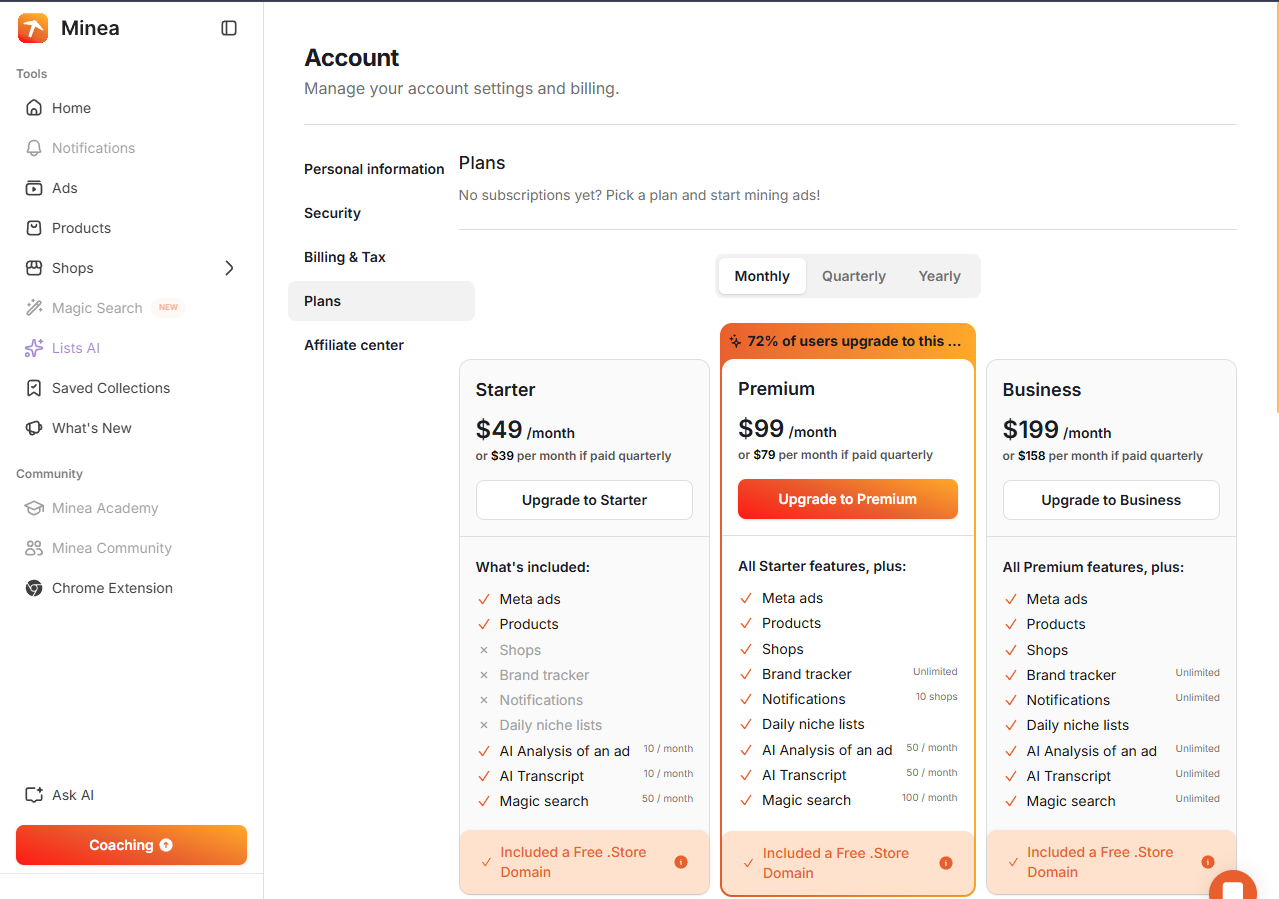
All three list a free .Store domain as an included extra. The ladder is shaped by more than a shared AI-credit cap. On the Plans screen, Starter shows Shops, Brand tracker, Notifications and Daily niche lists crossed out. They aren't capped on Starter; they're simply missing from it. Premium adds all four, with Brand tracker unlimited and Notifications covering 10 shops. Business removes every remaining cap, AI Analysis, AI Transcript and Magic search included.
Minea ads: what the search filters actually show
Minea's ad-spy-tool page says you search by "brand, product, keywords, or niche" and filter by "spend, engagement, platforms, and demographics." I opened the live screen behind that copy, Browse Ads → Meta Ads Library. It shows more than the marketing page does:
- Ad info: media type, publication date, duration, status, low-impression flag, product category, duplicates, language, country, CTA, description length
- EU-only: EU-only flag, ad reach, ad spend, page reach, page spend
- Page info: page active ads, page total ads, and more below the fold
- Quick chips for EU Winner, Weekly Winners and Ready to scale, with results sorted by publication date
So country and product-category filters are both there, which the marketing page alone doesn't tell you. Each ad card shows the advertiser name and an active-over-total ads count (for example "37 active ads / 3k"). It also has a days-active badge, the date range it ran, a platform icon and a couple of unlabeled numeric badges. The interface doesn't explain those badges, so I don't guess at what they measure.
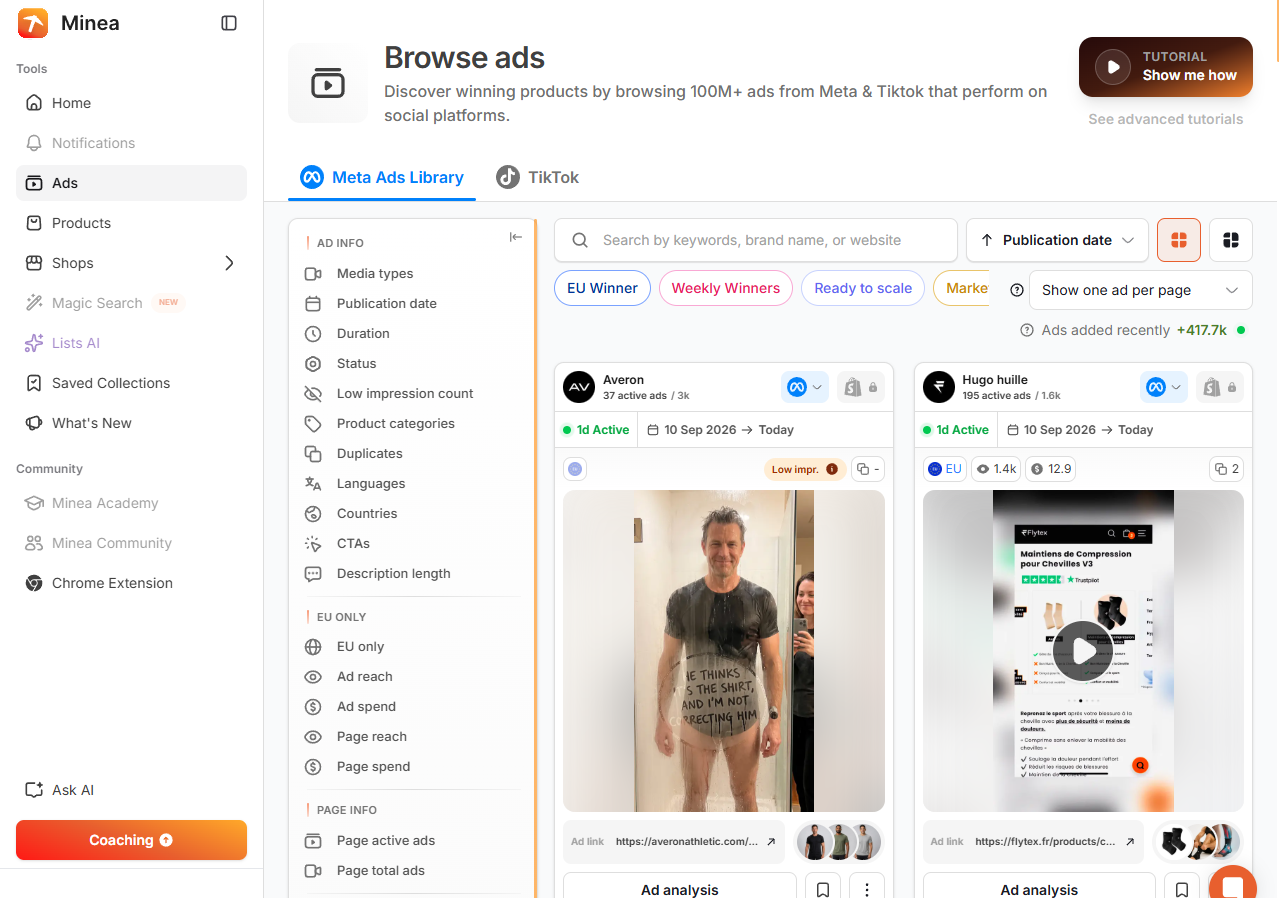
That screen shows two network tabs, Meta Ads Library and TikTok. Minea's own site names the other networks across two pages. Its ad-spy-tool page lists Facebook, TikTok and Pinterest, and adds Instagram in its Facebook & Instagram ads line. Meta's ad library serves Facebook and Instagram placements from one feed, which would explain the missing Instagram tab. Minea doesn't say so, though. I saw no separate Pinterest tab in this account. There was no Snapchat tab either, though some third-party reviews attribute Snapchat to Minea.
Minea's own wording, "brand, product, keywords, or niche," points at product-level search. It doesn't describe an industry-wide category system, even with country and category filters inside it. On the Shopify side, Shop Analytics works the same way. It shows one store's traffic, revenue and top-ad numbers at a time, and no store network tied to one owner.
Where a broader competitive-intelligence tool picks up
Every Minea tool starts from something you already have: a brand name, a product or a store URL. Then it shows what's running around it. In its own words, Spytrend is an ad intelligence platform for Facebook and TikTok advertising: an archive of ads going back to 2018, AI-classified into 33 business categories, with every advertiser assembled into a single card — all ads, pages, domains and countries in one place. It starts from the other end. Its category system spans many verticals on Facebook and TikTok, e-commerce among them, so you don't need a lead to start looking. The category-first approach is laid out in Spytrend’s competitive ad intelligence guide.
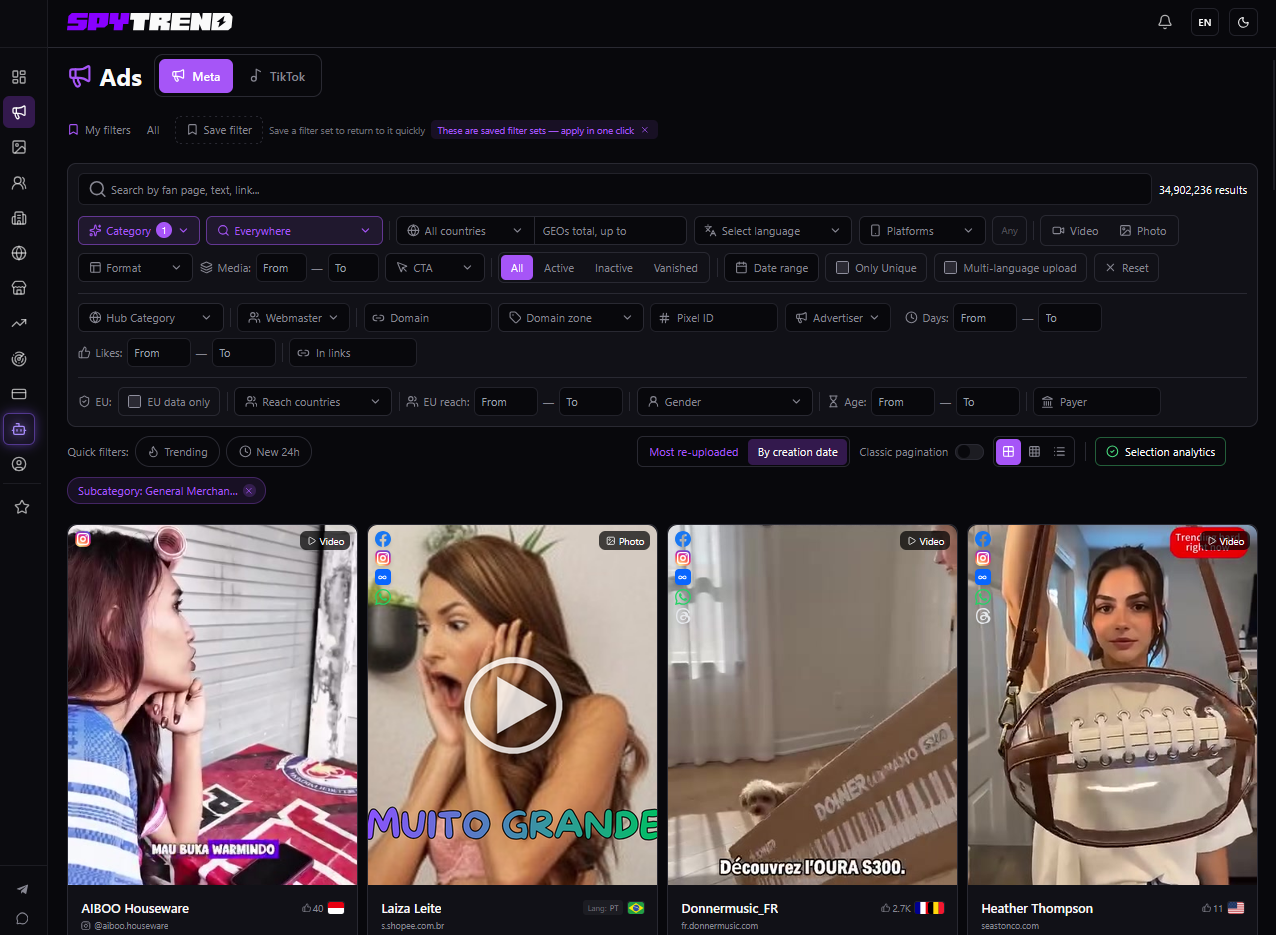
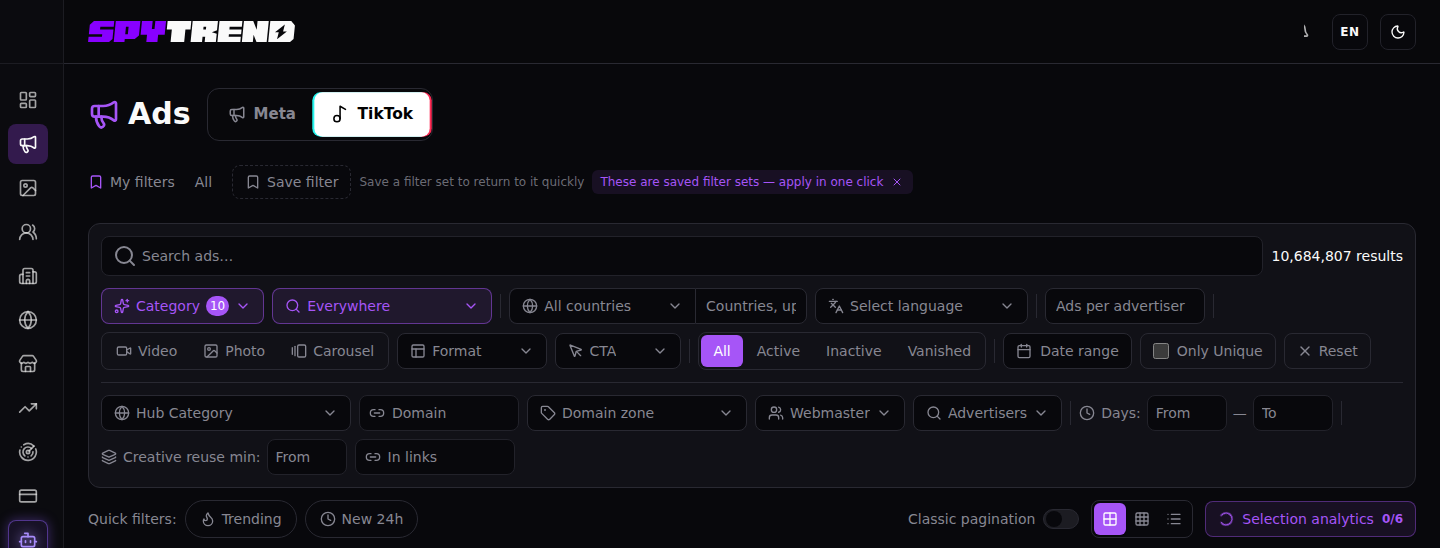
Category taxonomy. The same gap shows up in the filters. Nothing in Minea's ad-spy or product tools lets you browse an industry outside e-commerce and dropshipping, say finance or SaaS advertisers. Spytrend's AI tags Facebook and TikTok ads with 33 business categories and 342 subcategories inside them. E-commerce is one category among many there. On TikTok, I filtered to the whole Ecommerce and Retail category and got 10,684,807 results. On Meta, I narrowed it to just one of that category's ten subcategories, General Merchandise, and it returned 34,902,236 results on its own.
One store at a time. Shop Analytics and Brand tracker are Minea's closest features here. You can pull up one store's traffic, revenue and top ads, or watch one brand's activity over time. Neither is built to notice that several stores share the same operator. Each screen still starts from a single store name typed in by hand. Spytrend links an owner's ads, pages, domains and landing pages into one webmaster profile ahead of time. The profile is built from the pixel ID, domain and Page ID that tie them together, plus a country breakdown. So the network surfaces before anyone goes looking for it.
For a real case, I searched Webmasters under Ecommerce and Retail and opened Crispelyx. Its network (fan page name Festivalment) ties together 3 domains under one owner: festivalment.com, crispelyx.com and occasionalous.com. Only 1 of the 3 is active right now. The network also has 37 Facebook Page IDs, all still active. Across it there are 563,895 ads in total: 4,557 active and 559,338 stopped.
The two larger domains, festivalment.com and crispelyx.com, carry close to 289,000 and 273,000 of those ads each. The third, occasionalous.com, trails far behind at 2,499. That's three separate-looking storefronts and one operator.
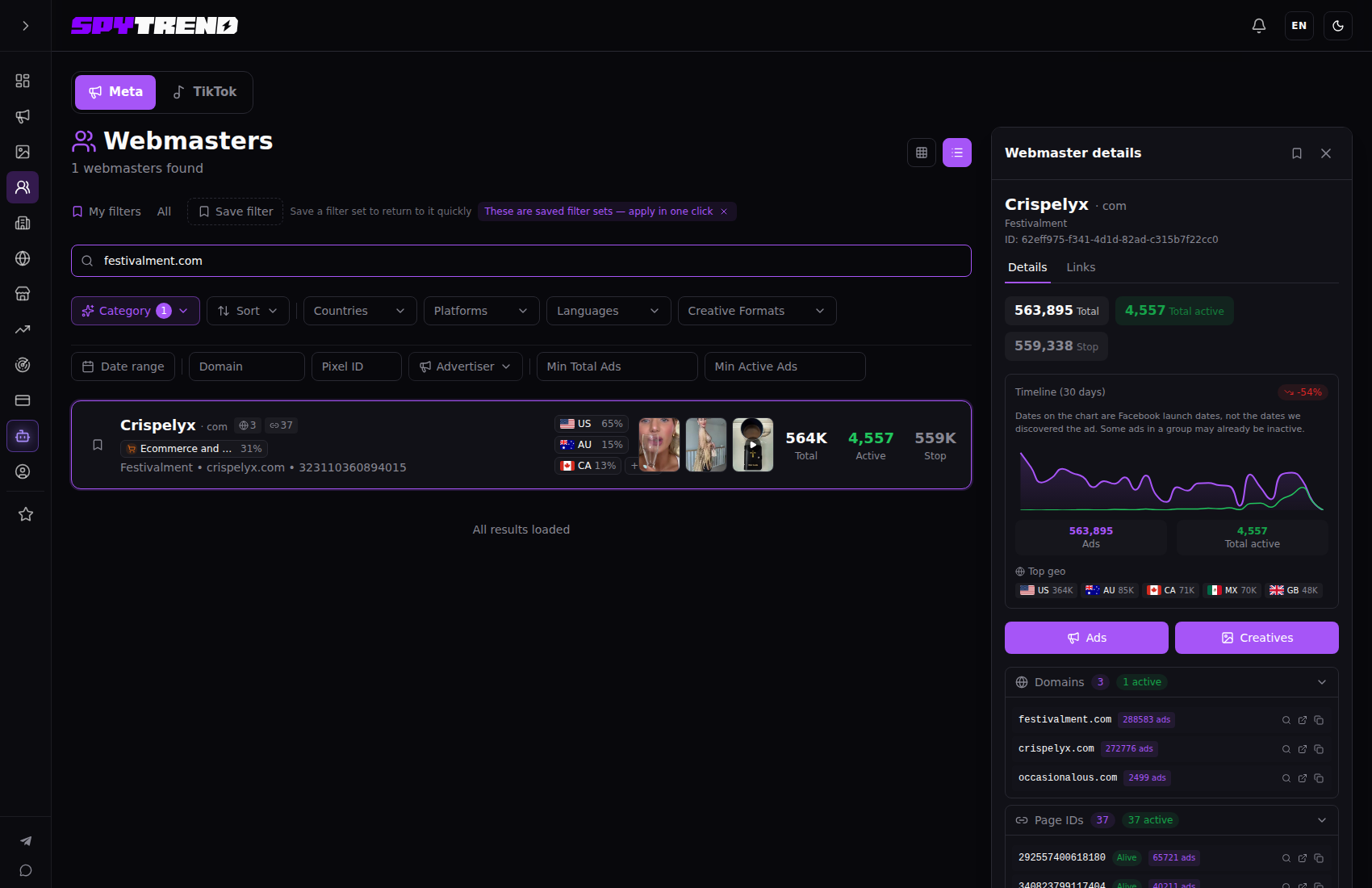
The Webmasters walkthrough goes through the profile layout screen by screen: domain list, Page IDs and country split.
Spend numbers differ in kind as well. Minea's filter panel lists ad spend and page spend among its EU-only filters. Spytrend states spend only as a from–to range and never as a single figure, because nobody outside the ad account can measure it exactly.
Access works differently too. Minea has no time-limited trial, only free registration ahead of a paid tier from $49/month. Below Premium, Shops, Brand tracker and Notifications are missing entirely, and AI credits are capped on top of that. Spytrend's free Starter tier opens the interface without payment and states one limit up front. Starter serves archive ads more than three months old, and live data starts on the paid tiers. Plan contents are listed on the Spytrend pricing page; Minea's own tiers are on its pricing page.
Minea vs Spytrend, side by side
| Minea | Spytrend | |
|---|---|---|
| Data | Meta and TikTok ads in the account (Facebook, Instagram, TikTok and Pinterest by its own site) plus Shopify store analytics, searched by brand, product, keyword or niche | Facebook and TikTok ads in one base, each tagged by AI with one of 33 business categories and 342 subcategories |
| Owner grouping | Store by store (Shop Analytics, Brand tracker); no cross-domain network profile published | One webmaster profile per operator, matched in advance on pixel ID, domain and Page ID |
| Access model | No time-limited trial: free registration, then $49–$199/mo with feature and AI-credit caps that widen tier by tier (Sep 10, 2026) | Live data on paid tiers; free Starter tier with archive ads more than three months old |
| Price | $49/mo Starter to $199/mo Business, cheaper with quarterly billing (Sep 10, 2026) | Free Starter; see the pricing page for paid tiers |
Who Minea is for, and who it isn't
Minea is built around product sourcing: a daily list of winning products for dropshipping and e-commerce, plus the ads and stores behind them. The core ad search and its filters already work on the free registered account, before you pay anything.
It gets harder to use in three situations:
- when the advertiser you're researching sells outside e-commerce and dropshipping, where Minea has no search entry point at all;
- when you want to see the stores and pages one operator runs as a group, without pulling each one up by hand;
- when you need shop-level analytics (traffic, revenue, top ads by store), which the Plans screen only opens from Premium up.
Minea shows one store per lookup, so a 3-domain operator like Crispelyx takes three separate searches. Nothing in the product says the three belong together. In Spytrend, that grouping is the default view and needs no extra search.
Minea alternatives
Think about the job Minea is built for: a daily list of winning products with the ads and stores behind them, for e-commerce and dropshipping. For that job, Minea itself is built around the workflow, gaps and all. The ad-spy tool comparison ranks it against the other tools in the same class. The gaps start to matter once your research grows past one store or one niche. That means tracking an operator's full domain-and-page footprint, searching outside e-commerce, or testing the product itself before paying.
You can check this yourself. Minea's registration is free, and so is Spytrend's Starter. Search the same product keyword in Minea's Browse Ads and in Spytrend, and compare what each one tells you about the advertiser behind a result.
FAQ
What is Minea?
Minea is a research tool that covers both ads and products, aimed at e-commerce and dropshipping. In the account it offers Meta and TikTok ad search, and its own site lists Facebook, Instagram, TikTok and Pinterest. It also has Shopify store analytics, a daily winning-products feed and AI ad analysis. Paid tiers run $49–$199 a month, and registration is free.
Is Minea free?
Minea is free to register, and the free account already runs Browse Ads. You get keyword search, country and category filters, and each ad's status, dates and page-level active-ads count. AI Analysis and AI Transcript credits start with the paid Starter tier at $49/month, and Shops only arrive with Premium.
Minea pricing: what's missing from Starter?
Minea pricing has three tiers: Starter at $49/month ($39 billed quarterly), Premium at $99/month ($79 quarterly) and Business at $199/month ($158 quarterly). Premium adds Shops, Brand tracker and Notifications, which Starter lacks entirely. It also raises the AI Analysis, AI Transcript and Magic search limits. Business removes every cap.
Is Minea legit?
Minea is legit in the plain sense: it's a working product with a published feature set and a pricing page. Its homepage states a user base of 200,000+, and it scores 3.8 from 306 reviews on Trustpilot. Two caveats remain. There's no free trial, and there's no published way to see an advertiser's whole domain-and-page network.
How to use Minea: which screen comes first?
Using Minea starts with a free registration and the Browse Ads screen. Search by brand, product, keyword or niche, then narrow by country or category; the daily winning-products feed sits on the Home screen. AI Analysis and AI Transcript work per ad and need a paid tier, where each use draws down a monthly credit cap.
Minea vs Spytrend: what does Minea leave out?
In Minea vs Spytrend, what Minea leaves out is the owner. It looks at one store, brand or product at a time. Spytrend starts from the advertiser's full footprint. Domains, pages and countries are grouped under one owner automatically, in each of its 33 business categories, e-commerce included. Spytrend has live data on paid tiers and a free Starter to try first.