In short: the best alternative to Meta Ad Library is the one that fills the specific gap you hit. AdSpy keeps a long Facebook and Instagram history. BigSpy lists 11 ad channels and starts free. Spytrend keeps every stopped ad, groups advertisers into one network card and sorts ads into 33 categories.
Meta ad library alternatives, set against the library's gaps
The five competitors below are the Meta ad library alternatives that four AI assistants named most often when asked this question. Spytrend is the sixth. The table doesn't rank them. Each row shows what the tool adds on top of Meta's free library and which networks it reads. Prices are public, each with the date it was checked.
| Tool | Networks | What it adds beyond the library | Public price | Where it helps |
|---|---|---|---|---|
| AdSpy | Facebook, Instagram | Search by ad comments, affiliate network and offer ID; real landing page behind a redirect included | $149/mo, single plan (Sep 22, 2026) | Affiliate offers, with Facebook and Instagram history |
| BigSpy | 11 channels, incl. Facebook, Instagram, TikTok, YouTube, Google, X, Pinterest, AppLovin (Sep 29, 2026) | One search across 11 ad channels | Free plan limited to Facebook; paid from $69/mo (Sep 14, 2026) | Questions that span more networks than Meta, on a zero starting budget |
| Minea | Facebook, Instagram, TikTok, Pinterest | Ties an ad to the shop and product behind it | From $49/mo; $39/mo paid quarterly (Sep 23, 2026) | Research that starts from a product to sell |
| PowerAdSpy | Facebook, Instagram, Google, YouTube, Pinterest, TikTok, Reddit, Quora, LinkedIn, native | Networks the library doesn't cover at all | From $69/mo; $27/mo ($331/yr) billed annually (Sep 24, 2026) | Ads outside Meta that matter as much as ads inside it |
| Pipiads | TikTok, Facebook | Product ads on TikTok and Facebook, on a monthly credit budget | From $49/mo on a timed discount, list $69 (Sep 23, 2026) | TikTok-first product research |
| Spytrend | Facebook and TikTok | Stopped-ad history, the advertiser's network in one card, 33 categories, 193 countries, the real landing page | Starter costs nothing; paid tiers at spytrend.com/pricing | Seeing who is spending and for how long, past the library's current-ads-only view |
Two longer pages on the same set follow: a guide to searching the Meta Ad Library and the Facebook ad spy tool comparison.
What the Meta Ad Library never shows
The library is free and official. For one job, checking what a page you already know is running today, nothing replaces it. You can confirm each point below in the library itself: open it, pick a country and try the filter or sort named in the point.
- Industries. The ad category filter has five options: all ads, plus issues and politics, employment, housing, and financial products. There's no "home goods" or "skincare." So looking at a market means a keyword search, which is a guess at the wording inside individual ads.
- Anything after an ad stops. Outside the EU, commercial ads leave the public view once they're switched off. Only ads about social issues, elections or politics stay, for seven years, according to Meta's own transparency rules. Anything shown to people in the EU is kept for a year. The card gives a Library ID and a launch date. It says nothing about how many ads the same advertiser has already abandoned.
- Results. Reach and audience data exist only for EU delivery, under the Digital Services Act. Impressions and spend ranges are published only for ads about social issues, elections or politics. A commercial ad shown in the United States comes with no signal of how it did.
- Order. Results come back by date. You can't sort by how many ads are active, how many launched this week, or how large an advertiser's volume is. You can't export the list either.
- The owner. One advertiser can run a dozen Facebook pages. The library lists each page on its own, so you rebuild the network behind them by hand, page by page.
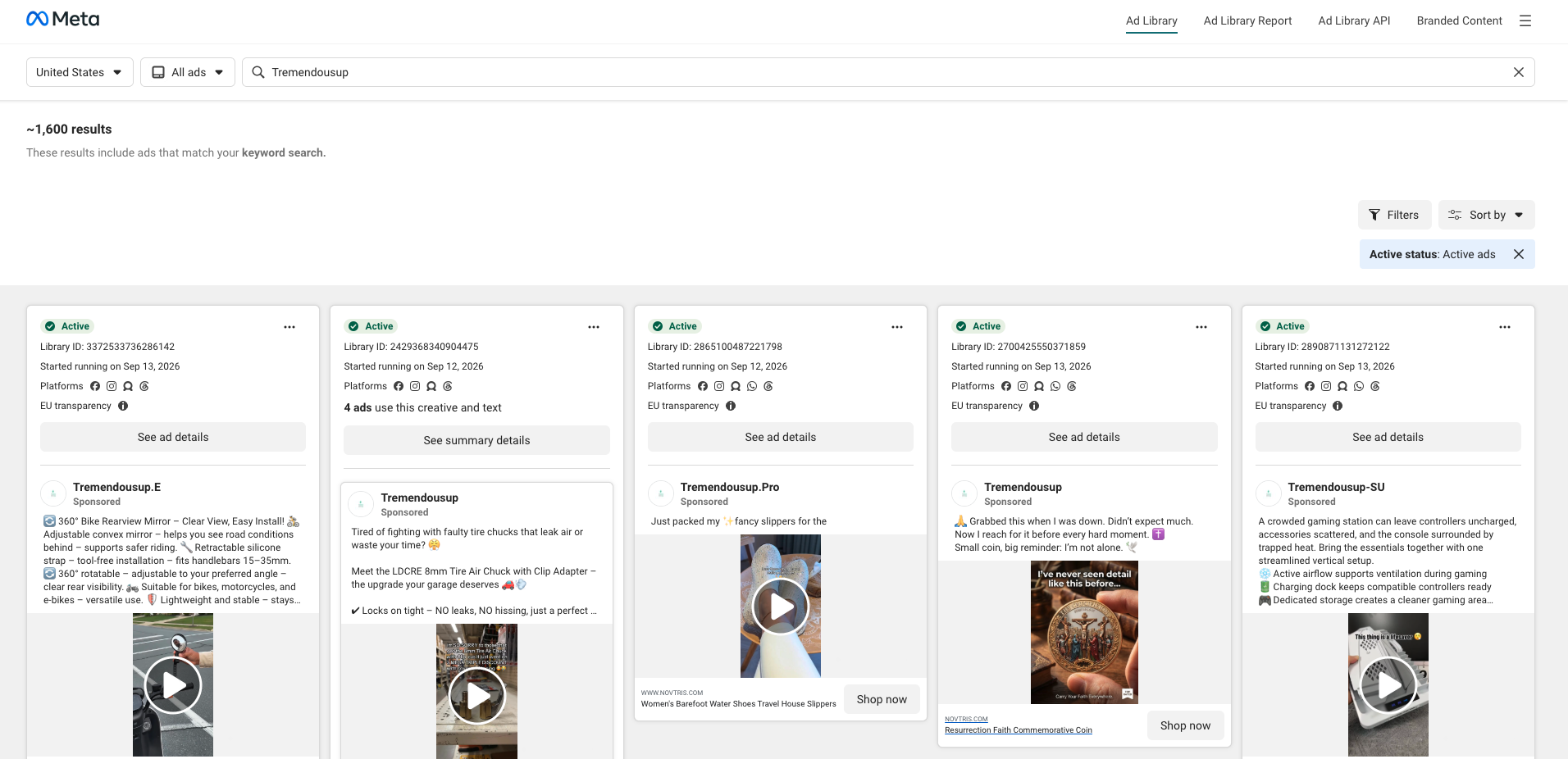
Points 2 and 5 are easy to see on one real advertiser. I searched the library for Tremendousup in the United States, with active ads only. It returned about 1,600 ads under at least five page names: Tremendousup, Tremendousup.E, Tremendousup.Pro, Tremendousup-SU and Tremendousup7. Nothing tied the pages together or showed what ran before.
In Spytrend, the same advertiser has 142,455 ads launched in total, with 4,502 still active and 137,953 stopped, spread across 12 Page IDs, 11 of them live. What does that mean in practice? The library would show only the ads still running, roughly those 4,502. That's about 3% of the history. It would also show them as eleven separate pages, one per live Page ID, with nothing tying them together.
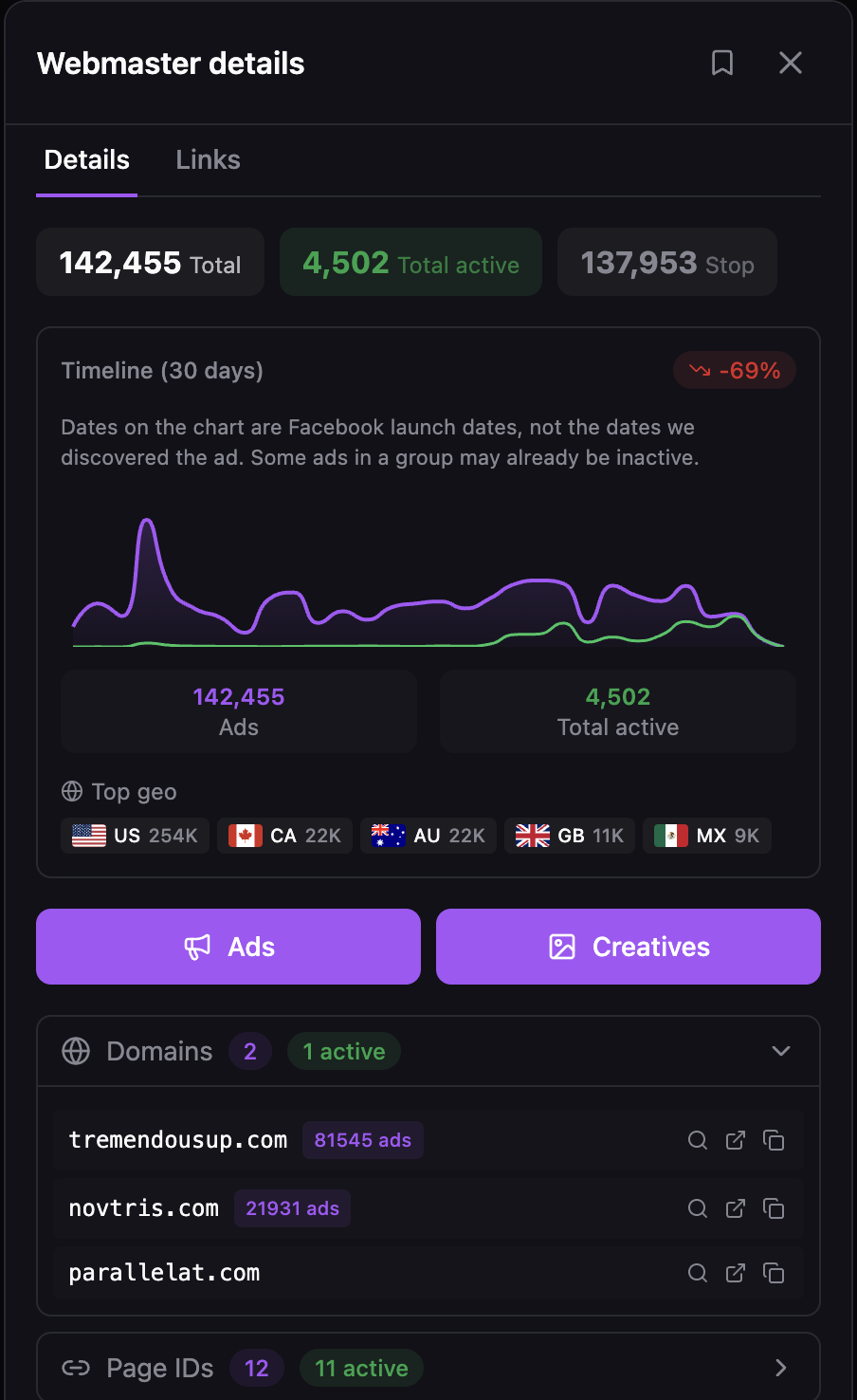
What this check doesn't show: the two counts don't measure the same thing. My library search covered one country and matched a keyword. Spytrend's 4,502 active ads aren't limited to one country. So read the 3% as a rough scale of the gap between the two views.
Meta ad library alternatives for ecommerce, dropshipping and affiliate marketing
The same gap looks different depending on what you sell, so the right tool changes too.
For ecommerce brands
A brand checks competitors it can already name, and the library handles that well. What a brand lacks is the category view. Who else entered the market this quarter, and how long do their ads survive? Spytrend covers that with its 33-category filter and stopped-ad history. BigSpy adds the networks outside Meta, if the competitors advertise there too.
For dropshipping
A dropshipper starts from the product. Minea and Pipiads are built around that direction. They link an ad to the shop selling the item, usually a Shopify store. They offer less on the second look: how many storefronts one seller runs against the same product. Spytrend reads that from domains, pixel and Page IDs grouped into one card.
For affiliate marketing
An affiliate follows offers through networks, and AdSpy's search by affiliate network and offer ID is written for exactly that. The next step is the landing page. The version a reviewer gets and the version a buyer in a given country gets are often different pages. Spytrend requests the real one at $1 per run, refunded if the run fails, on any plan.
Best Facebook, Instagram and TikTok ad library alternative
Meta's library covers ads across Meta's own apps, Facebook and Instagram included. TikTok keeps a separate library, and outside Europe it shows far less. So the network you study sets the shortlist first:
- Facebook and Instagram: all six read Facebook ads. For Instagram on its own, four of them list it as a separate network: AdSpy, BigSpy, PowerAdSpy and Minea.
- TikTok: Pipiads, Minea, BigSpy and Spytrend all cover TikTok alongside Facebook. PowerAdSpy adds it on its top tier. Pipiads reads it through products.
- Everything else: PowerAdSpy and BigSpy reach well beyond Meta, into Google, YouTube and Pinterest. PowerAdSpy's top tier covers 11 networks in all, adding Reddit, Quora, LinkedIn and native.
Meta Ad Library vs paid ad spy tools: what the money changes
The library is free and built for one job: seeing which ads a named page runs today. Paid Meta ad library alternatives charge for the wider questions. Which advertisers exist in a category? Which ads have lasted, what already stopped, and who funds a set of pages? Entry prices among the six above run from a free plan to $149 a month for AdSpy's single plan.
Spytrend describes itself this way: Spytrend is an ad intelligence platform for Facebook and TikTok advertising: an archive of ads going back to 2018, AI-classified into 33 business categories, with every advertiser assembled into a single card — all ads, pages, domains and countries in one place.
It sorts ads into 342 subcategories across 33 categories, where the library has five. It covers 193 countries. Its archive goes back to 2018, most of it from 2025–2026, and keeps ads after they stop. You can sort by active ads, by volume and by new ads over a chosen period. Starter costs nothing and opens ads from three months back in a limited mode. Paid tiers are on the pricing page.
Try it on one competitor you already know. Search their name in the library for your country, count the page names and look for stopped ads. Then run the same name through BigSpy's free plan or Spytrend's Starter and compare. For a longer survey of the category, see the ad spy tools overview. For how advertiser grouping works, see the Webmasters write-up.
FAQ
Best Facebook ad library alternative: which one should you use?
The best Facebook ad library alternative depends on the gap you hit. AdSpy has long Facebook and Instagram history with affiliate data, and BigSpy covers many networks with a free start. Spytrend covers ads that already stopped and the network of pages behind one advertiser. The free library is still enough to check a single page you can already name.
Best TikTok ad library alternative: which tool fits TikTok research?
The best TikTok ad library alternative for product research is Pipiads, if TikTok is your main channel. Minea and BigSpy put TikTok next to Facebook and other networks, and Spytrend lets you study advertisers across Facebook and TikTok by category. TikTok's own library shows little outside Europe, so any of these adds more than it does.
Meta Ad Library free vs paid: what does the money add?
Meta Ad Library free vs paid comes down to history and ownership. The free library shows ads running now, filtered by five categories and sorted by date. Paid tools keep ads after they stop and sort by activity and volume. Some, Spytrend among them, also group pages into one advertiser. The money buys what ran before, and who is behind it.
Meta ad library alternatives for dropshipping: which ones work?
Meta ad library alternatives for dropshipping come in two kinds. Minea and Pipiads start from the product and link each ad to the shop behind it. Spytrend starts from the seller and shows how many storefronts, domains and pages one operator runs. A working pair is one of each. Use a product-first tool to find the item, and the owner card to count how many stores already sell it.
Paid Meta ad library alternatives: are they worth it?
Paid Meta ad library alternatives pay off once your research repeats weekly or covers a whole category, beyond a few known brands. Entry prices among the six tools here run from a free plan to $149 a month. Start on a free tier, BigSpy's or Spytrend's Starter, and see whether the extra data changes your decisions.
Is Spytrend the same as the Meta Ad Library?
No. The Meta Ad Library is Meta's free public record of ads running now. Spytrend is an ad intelligence platform for Facebook and TikTok advertising, with a free Starter plan and paid tiers. It keeps ads after they stop, sorts them into 33 categories and groups each advertiser's pages into one card.