Quick answer: AdSpy vs BigSpy comes down to what you research. AdSpy suits Facebook and Instagram work where you want to search ad comments and affiliate offers. BigSpy covers more networks and starts free. Spytrend groups ads by the owner who runs them.
AdSpy vs BigSpy vs Spytrend at a glance
| AdSpy | BigSpy | Spytrend | |
|---|---|---|---|
| Networks | Facebook and Instagram | 11 listed on its homepage (Sep 29, 2026); Facebook only on the free plan | Facebook, Instagram and TikTok |
| Database (each company's own figures) | 213M+ Facebook and Instagram ads, 30M+ advertisers, 225 countries (Oct 23, 2026) | 1B+ creatives, nearly 10M advertisers (Sep 29, 2026) | 1.4B+ Meta ads (Facebook and Instagram) and 380M+ TikTok ads; 193 countries |
| Free access | No free plan. The account opened for this review got a one-time credit of 1,000 ad views (Sep 22, 2026) | Free plan with no end date, Facebook only: 10 searches a day, no downloads (pricing page, Oct 23, 2026); 5 searches and 20 downloads a day in September | Free Starter plan, no card needed, ads older than three months |
| Price | One plan, $149/mo, labeled introductory (re-checked Oct 23, 2026) | $69, $159, $399 or $499/mo; $49, $119, $299 or $399/mo billed yearly (Oct 23, 2026) | Paid plans with live ads, see the pricing page |
| Filters | 16, including comment search and affiliate offers; sorts by date only | Industry (eCom, Game, Tool), website type, network, country, language; last 90 days by default | 33 business categories, country, platform, format, run length; for ads shown in the EU: reach, gender, age; sort by date or most re-uploaded |
| Groups ads by advertiser? | No | By page, with names masked on the free plan | By owner: domains, Page IDs and pixels in one profile |
| Best for | Searching comments and affiliate offers on Facebook and Instagram | Covering many networks and starting free | Finding who runs a set of ads |
How I tested
To keep it fair, I opened my own accounts on AdSpy and BigSpy and ran the same search in each: "posture corrector" on Facebook, on the same day. Every price and limit here comes from those accounts or from each company's own site, with the date I checked it.
What this test doesn't show: it's one search on one day. My AdSpy account was on the welcome credit and my BigSpy account was on the free plan, so paid-only features aren't covered. I also didn't try BigSpy's Feature Search or Visual Search.
The same search in AdSpy and BigSpy
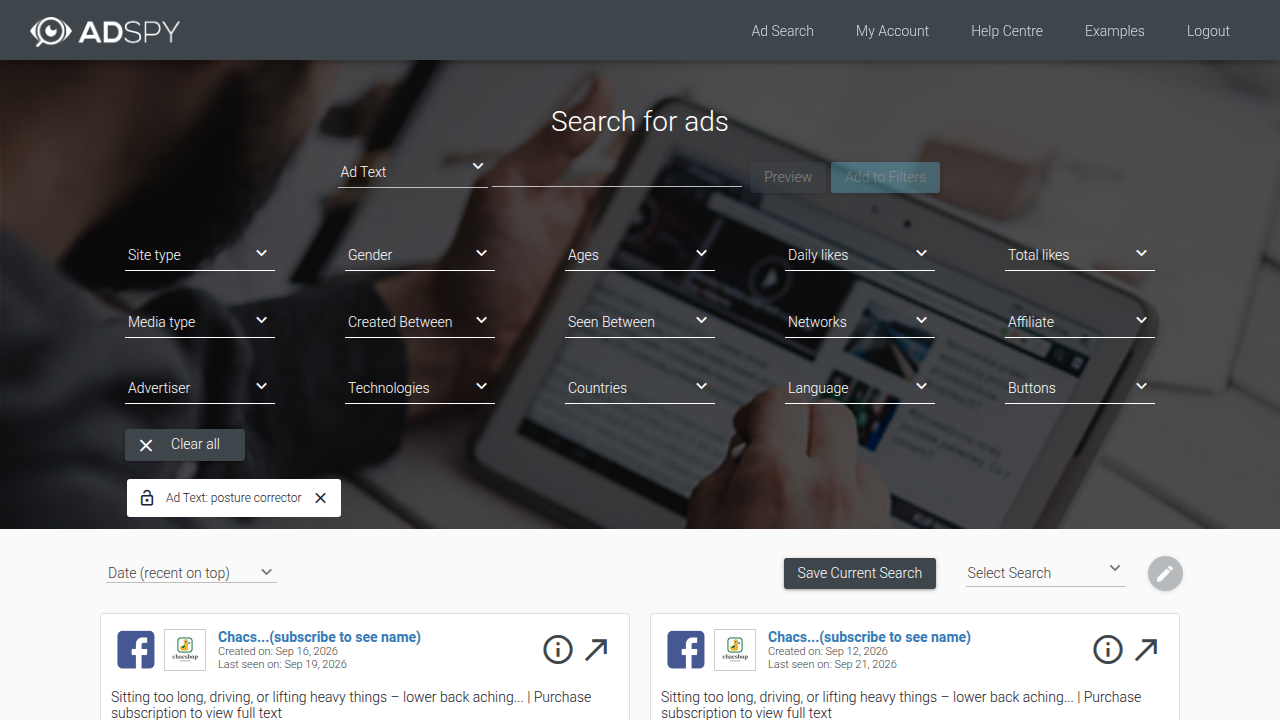
In AdSpy, I typed "posture corrector" into the Ad Text filter. Results come as a scrolling list, newest first, and that's the only sort order. There's no count of how many ads matched. The first two results came from the same advertiser, but the name was hidden: "Chacs...(subscribe to see name)". Each ad's text cut off at "Purchase subscription to view full text."
BigSpy handled the same search differently. I set Industry to eCom, picked Facebook and kept the default 90-day window. It reported "Found 11K related ads." Its default deduplication cut that to 5.9K, and strict deduplication left 2.4K. Names and domains were partly starred out on the free plan ("Smart rector", "Roday"). The network row listed eleven networks, but only Facebook was clickable.
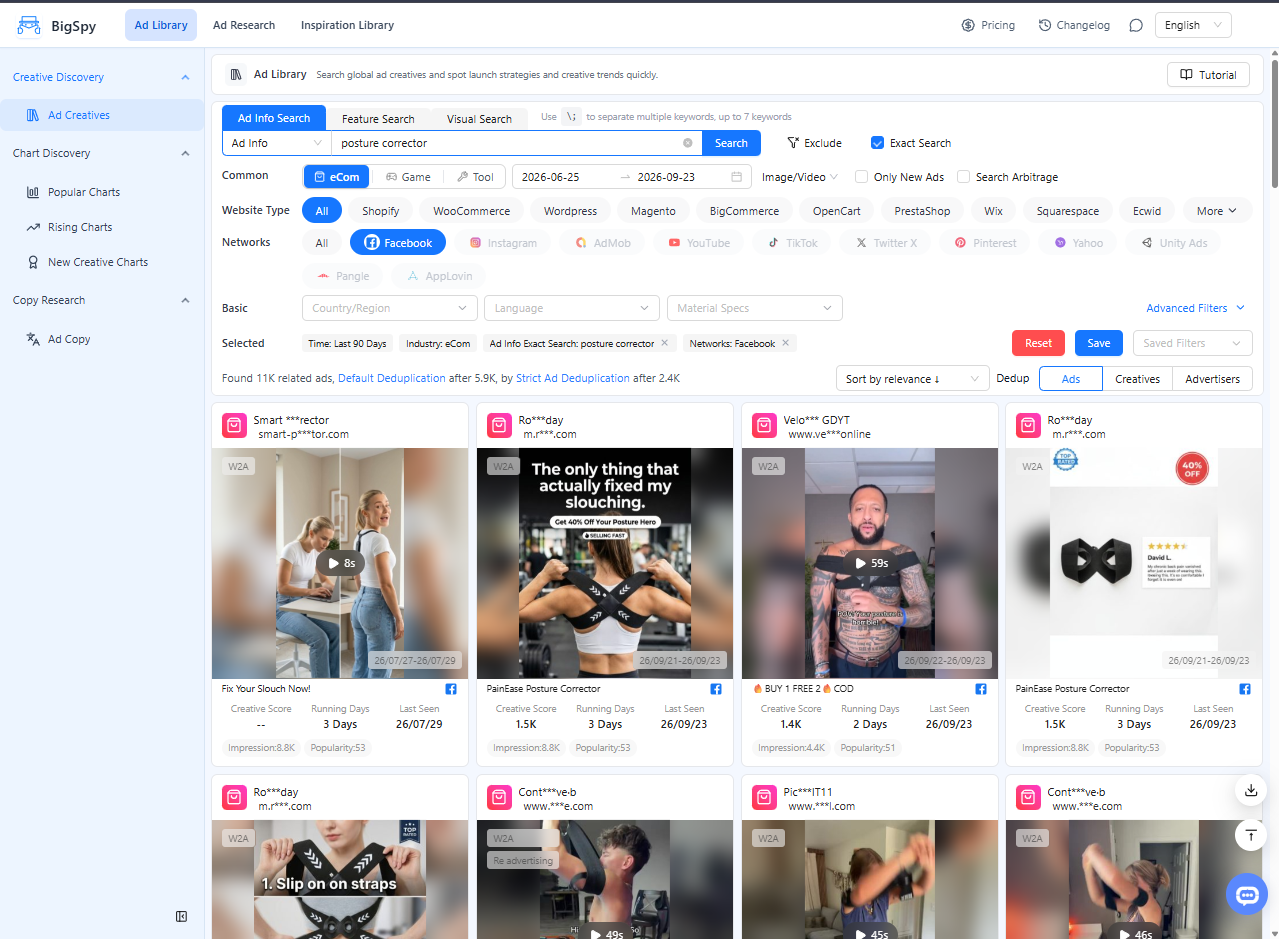
So what's the difference in practice? BigSpy tells you how big the pool is and lets you strip out copies of the same ad. AdSpy shows no count and has no industry filter, so you can't narrow a product search to e-commerce the way BigSpy's eCom setting does. What AdSpy gives you instead is one search box over 213M+ ads from Facebook and Instagram.
Price and free access
AdSpy has one plan: $149 a month, which its homepage calls an introductory offer. It refunds in full within 24 hours of purchase. When I signed up, the account came with a one-time credit of 1,000 ad views. That was enough to open creatives, audience demographics and the tech behind landing pages. Advertiser names and full ad text stayed hidden. The homepage doesn't mention this credit, so don't count on getting it.
BigSpy has a free plan with no end date, Facebook only. In September it gave 5 searches and 20 downloads a day, though on my free account the Download button was greyed out anyway. On October 23, 2026, the public pricing page listed it as 10 searches a day with downloads not included. The paid plans, monthly:
- $69/mo: Facebook, Instagram and, for a limited time, AppLovin; 50 downloads a day
- $159/mo: eight networks, TikTok included
- $399/mo: the same eight, five seats
- $499/mo: 11 networks, 3,000 downloads a day
Billed yearly, the same four cost $49, $119, $299 and $399 a month ($588 to $4,788 a year), as listed on October 23, 2026.
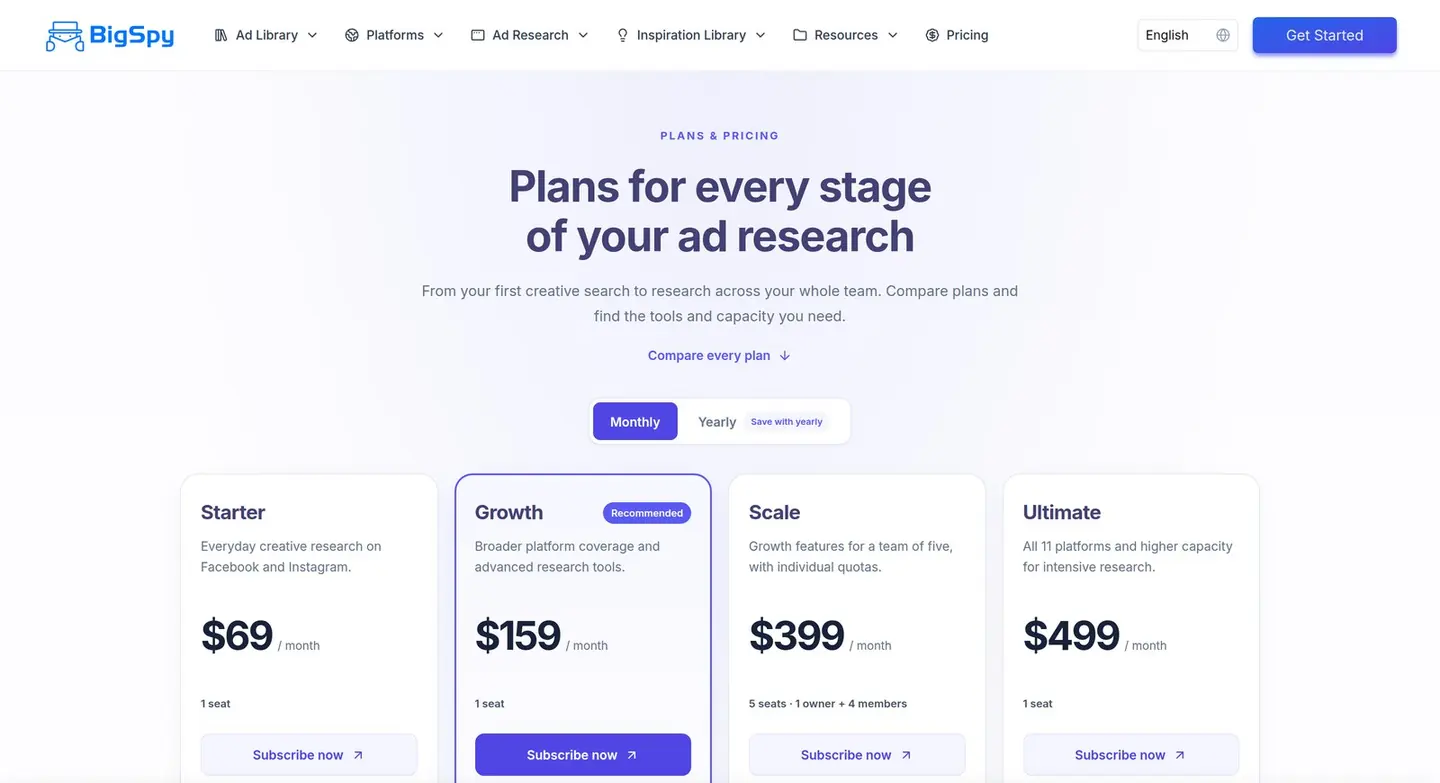
AdSpy's $149 plan lands between BigSpy's first two monthly tiers. On yearly billing it doesn't: BigSpy's Growth, with eight networks, comes to $119 a month, less than AdSpy's single plan. AdSpy offers no yearly option on its homepage.
Neither tool does well on Trustpilot. AdSpy has 2.4 out of 5 from 8 reviews, on a profile the company hasn't claimed. BigSpy has 2.1 out of 5 from 25 reviews (AdSpy, BigSpy). That's too few reviews to settle anything, but it's worth a look before you pay.
Where each one is stronger
AdSpy does better when your research stays on Facebook and Instagram. You can search the comments people leave under ads. Comments are where buyers ask questions and complain, so this is a quick way to hear the objections to an offer. AdSpy also filters by affiliate network, offer ID and landing-page technology. Even on the welcome credit, an ad card opened to demographics, a screenshot of the landing page and the page's tech stack. If you want the data in your own tools, AdSpy sells API access as a separate $149-a-month subscription, listed on my account's Subscription screen.
BigSpy is stronger on reach and on the cost of getting started. Its homepage lists 11 ad channels, it starts free, and its first paid tier is cheaper. It shows how many ads matched and removes duplicates. There's also a Chrome extension for saving ads you find in Meta's and TikTok's own ad libraries.
One thing neither of them does is group ads by the person or company behind them. Both also hid advertiser names on the free access I had.
Where Spytrend fits
Spytrend is an ad intelligence platform for Facebook and TikTok advertising: an archive of ads going back to 2018, AI-classified into 33 business categories, with every advertiser assembled into a single card — all ads, pages, domains and countries in one place.
The unit of search is different. AdSpy and BigSpy return ads that match a query. Spytrend groups ads by the owner behind them, so you can see what else that owner runs. It covers Meta ads (Facebook and Instagram placements) and TikTok, where BigSpy lists 11 ad channels. The free Starter plan needs no card and shows ads older than three months. Paid plans with live ads are on the pricing page.
There's one more step worth comparing: opening the page a real buyer lands on. On my welcome credit, an AdSpy ad card showed a screenshot of the landing page, and AdSpy's homepage says it "bypasses cloakers"; BigSpy's ad detail shows the destination domain. In Spytrend, you can run a Probes check on an ad for 100 tokens (tokens are bought in packs inside your account): it requests the landing page behind the ad, and the result lands in the Probes section.
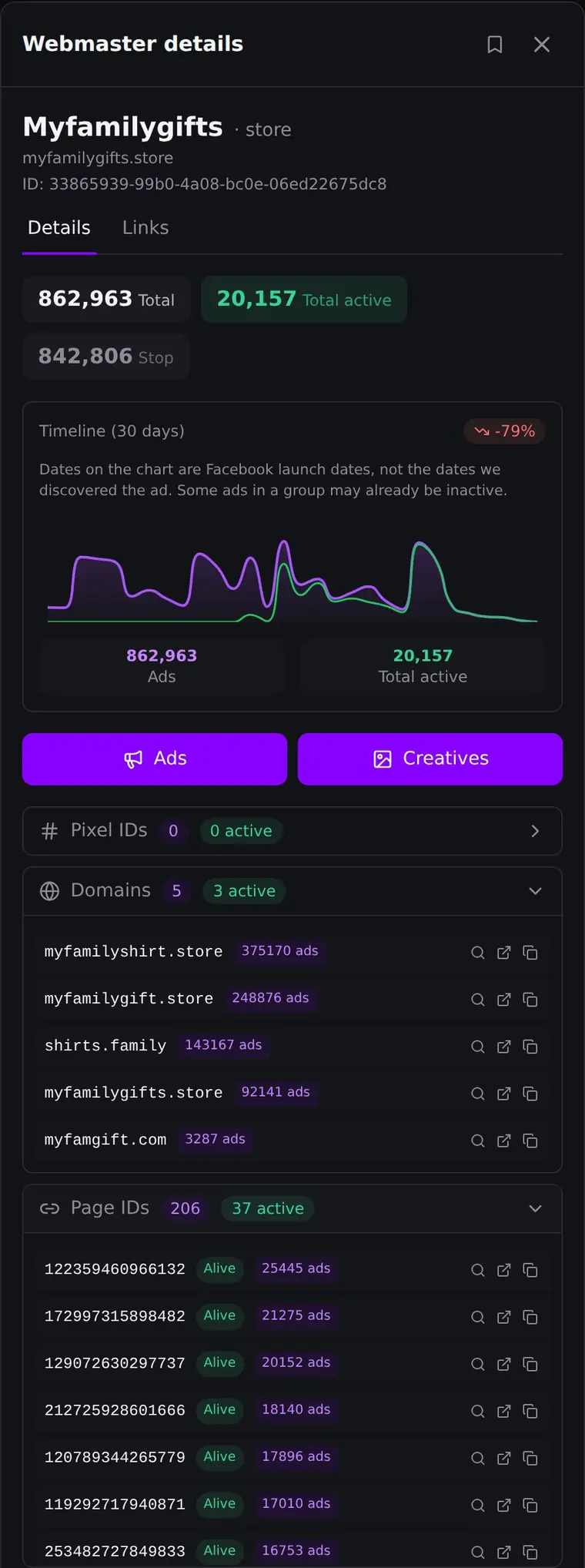
Here's what that looks like. This example comes from the Webmasters section. It's an owner profile, reached from the owner's name. The posture-corrector search doesn't lead here. The owner behind Myfamilygifts (myfamilygifts.store) runs 5 domains, 3 of them active, and 206 Facebook pages, 37 of them active. Together they've run 862,963 ads: 20,157 are live and 842,806 have stopped.
Most of that volume sits on one domain, myfamilyshirt.store, with 354,693 ads. The rest is split across myfamilygift.store (108,944), myfamilygifts.store (90,160), shirts.family (78,529) and myfamgift.com (3,238). The US, the UK and Australia are its top countries.
In a keyword search, 206 pages look like 206 separate advertisers. In the profile they're one business, and you can see which domain carries most of its ads. The Webmasters walkthrough shows how the view works.
Which one to choose
If you research only Facebook and Instagram and want comment or affiliate-offer search, AdSpy covers that. If you need Google Ads, YouTube or Pinterest, or want to start free, BigSpy does. Finding the owner behind an ad, or sorting Facebook, Instagram and TikTok ads by category, is closer to what Spytrend is built for.
You don't have to take my word for any of this. BigSpy and Spytrend both let you search for free, and AdSpy gave my new account a credit of ad views. Run a keyword from your own niche through all three and compare what comes back. For a wider field, see this ad spy tool comparison.
FAQ
AdSpy vs BigSpy: which one is cheaper?
In AdSpy vs BigSpy pricing, BigSpy starts lower. Its first paid tier is $69 a month, while AdSpy has a single $149 plan. BigSpy's tiers climb to $499 for 11 networks, and it also has a free plan. Billed yearly, BigSpy costs $49 to $399 a month (October 23, 2026). AdSpy stays at one price and has no free plan.
BigSpy vs AdSpy reviews: what do users say?
BigSpy vs AdSpy reviews are few, and not warm. On Trustpilot, BigSpy has 2.1 out of 5 from 25 reviews and AdSpy has 2.4 out of 5 from 8 reviews, on a profile AdSpy hasn't claimed. BigSpy costs $69 to $499 a month and AdSpy costs $149. Both samples are too small to lean on.
Is AdSpy worth it?
AdSpy is worth it if your research stays on Facebook and Instagram and you'll use comment search or affiliate-offer filters. The $149 plan unlocks the advertiser names and full ad text that a free account hides. It's a poor fit if you need TikTok, industry categories or ads grouped by owner, because AdSpy offers none of those.
How much does AdSpy cost?
AdSpy costs $149 a month for its one plan, which the homepage labels introductory. There are no seat or credit tiers. AdSpy refunds in full within 24 hours of purchase, and after that at its own discretion. The account opened for this review also got a one-time credit of 1,000 ad views, which the homepage doesn't mention.
Is Spytrend the same as AdSpy?
No. They're separate products from separate companies. AdSpy searches Facebook and Instagram ads one at a time. Spytrend covers Facebook, Instagram and TikTok. It puts each advertiser on a single card with their ads, pages, domains and countries. Spytrend has a free Starter plan, no card needed, that shows ads older than three months.