Spytrend Ad Intelligence Platform 2026
Updated: 2026-09-25
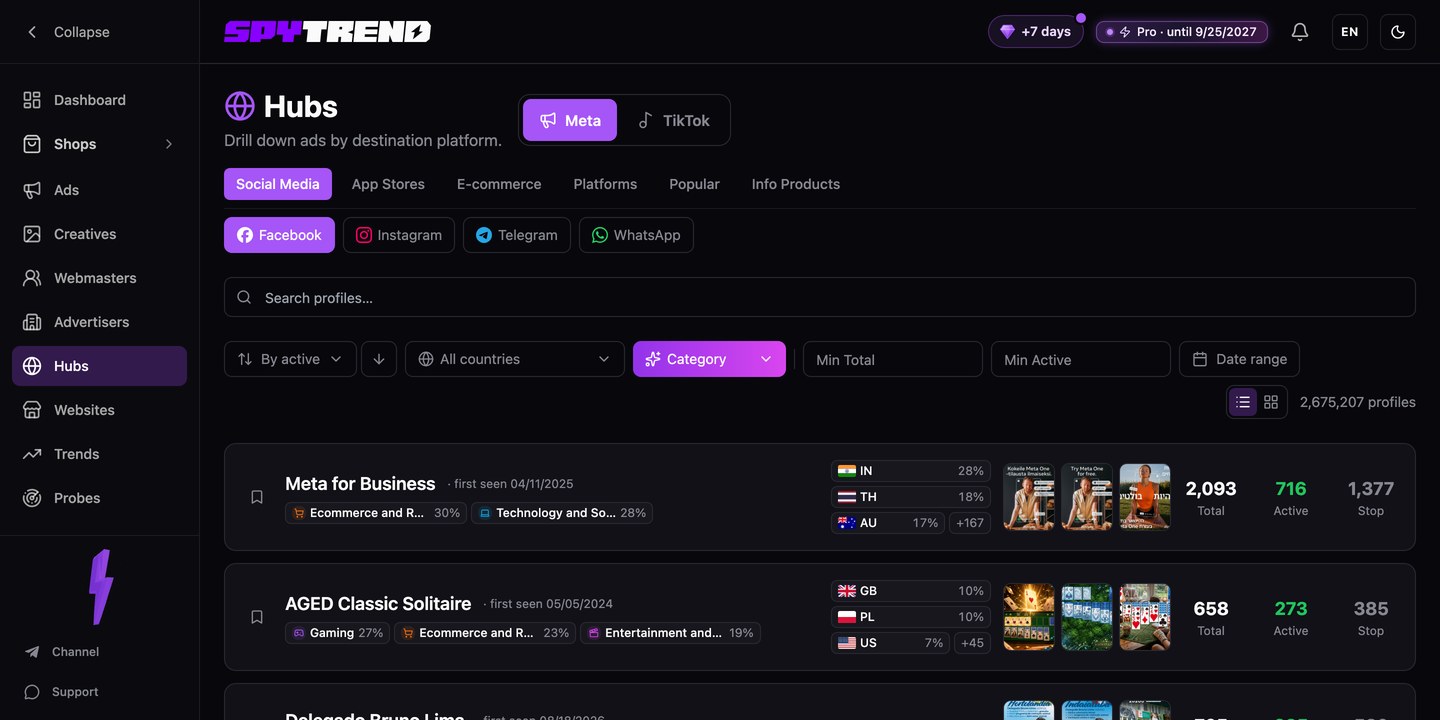
Discover how competitors structure their full ad ecosystems across multiple pixel and domain identities — beyond the Meta Ad Library, which, per Meta's Help Center, shows an advertiser's active ads one Page at a time. Spytrend is a Facebook ad intelligence tool built around webmaster identity resolution: it groups ads not by creative alone, but by the pixel IDs, domains, fan pages, and IP addresses that prove two campaigns belong to the same operator.
Quick Answer
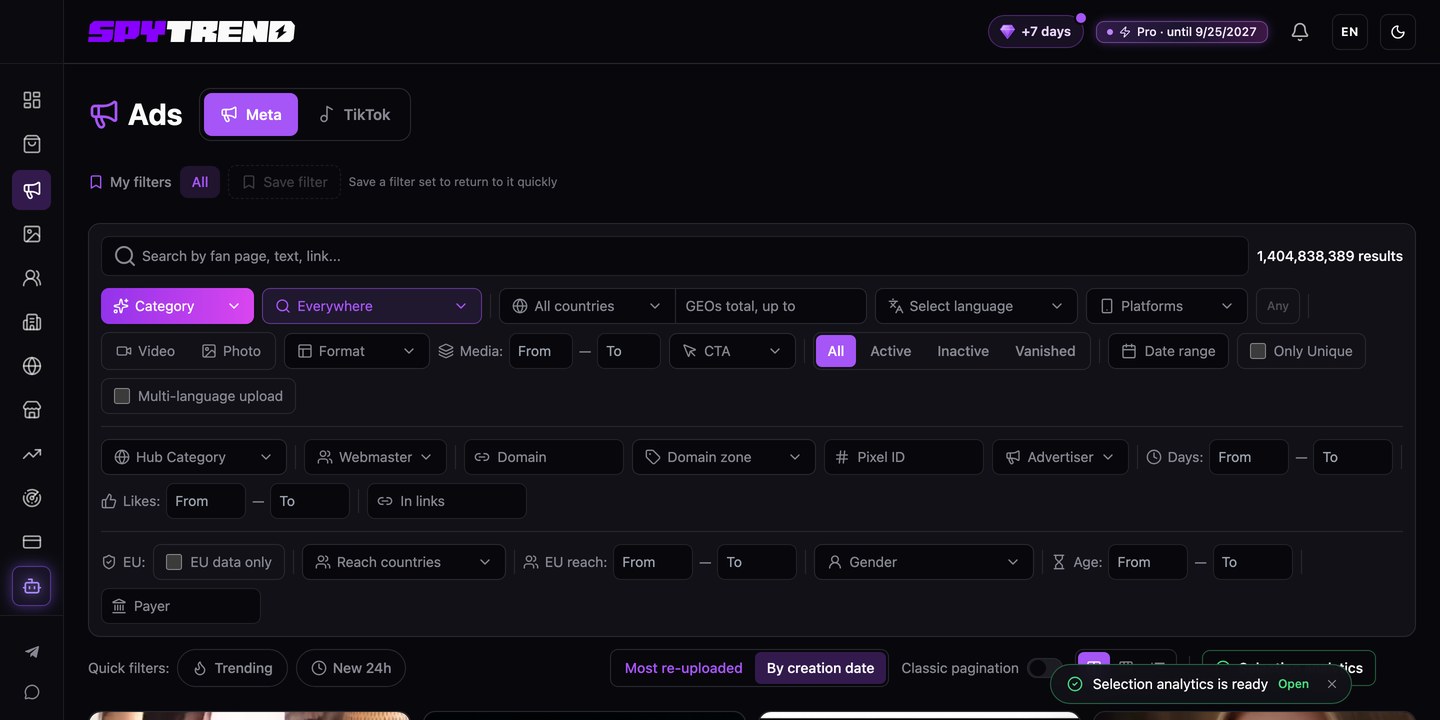
Spytrend is purpose-built for performance marketers who need to see a competitor's complete Facebook ad network — not just individual creatives. By fingerprinting ads across pixel, domain, fan page, and IP identities, it reconstructs full operator ecosystems. Paid plans start at $79/mo under a freemium model; the free Starter plan needs no credit card.
The unique thesis here: Spytrend reveals competitor profitability at scale by aggregating ads under the webmaster identities behind them. A marketer who runs only keyword searches gets individual ads; Spytrend users get the full picture of what an operator is spending money on, what is running long-term (sticky ads = profitable), and where a new trend is just beginning to spike.
This is not a tool for teams that need cross-network coverage (YouTube, Google PPC, Pinterest) or for buyers who rely on Zapier-style workflow automation. Spytrend covers Facebook (Meta) and TikTok, runs on web, and targets one discipline: deep competitive ad intelligence.
How It Compares
Spytrend's core differentiator is webmaster-level grouping — a capability none of the alternatives reviewed here lists on its site. Competitors index large volumes of creatives; Spytrend links those ads to a single operator identity. The table below maps that gap concretely.
| Capability | Spytrend | AdHeart | BigSpy | Tyver |
|---|---|---|---|---|
| Webmaster profiles (pixel/domain/IP/fan page) | ✓ | ✗ | ✗ | ✗ |
| Trend / explosive growth detection | ✓ | ✓ (Uncover trending products by tracking ads that scale) | ✓ (Popular Charts, Rising Charts, trending recommendations) | ✗ |
| Sticky ads / profitability detection | ✓ | ✗ | ✓ (ad cards show Duration and Last Seen) | ✗ |
| Creative deduplication | ✓ | ✗ | ✓ (search with filtering and deduplication) | ✗ |
| Keyword / advertiser search | ✓ | ✓ (Enter any keyword, product name, or advertiser to see real ad campaigns running right now) | ✓ (Enter keywords, advertiser names, IDs, or URLs) | ✓ (Advanced filters: Keywords and phrases, domains, app stores, ad format, CTA, Fan Page, applications and many others) |
| Multi-platform (beyond Facebook/Meta) | ✓ (TikTok) | ✓ (TikTok Ads are already available in Adheart) | ✓ (Explore 11 ad channels, including Facebook, Instagram, TikTok, YouTube, and AppLovin; research products from 40 e-commerce sites, including Shopify and Amazon) | ✗ |
| Starting price | $0 (Starter); Pro $79/mo | $69/mo | $0 (Free plan); Starter $69/mo | $0 /month |
| Free trial | No (free Starter plan, no card) | n/a | n/a | n/a |
Competitor data as of September 2026, from each vendor's own site: AdHeart, BigSpy, Tyver; ✗ means the capability is not listed there.
AdHeart at $69/mo surfaces live campaigns by keyword and advertiser — useful for creative research; operator mapping is not among the features it lists. BigSpy covers 11 ad channels, including Facebook, Instagram, TikTok, YouTube and AppLovin, plus product research across 40 e-commerce sites like Shopify and Amazon, making it the right choice for multi-network creative scouting; an operator grouping layer is not among the features it lists. Tyver starts at $0 /month and offers advanced keyword/domain filters; operator grouping is not among the features it lists either. Spytrend is built to answer: "Who is behind this ad, what else are they running, and is it profitable?"
Key Features
Spytrend's strongest differentiators lead this section. Table-stakes functions (basic creative search) are real but are not what justify the subscription.
Webmaster Identity Resolution
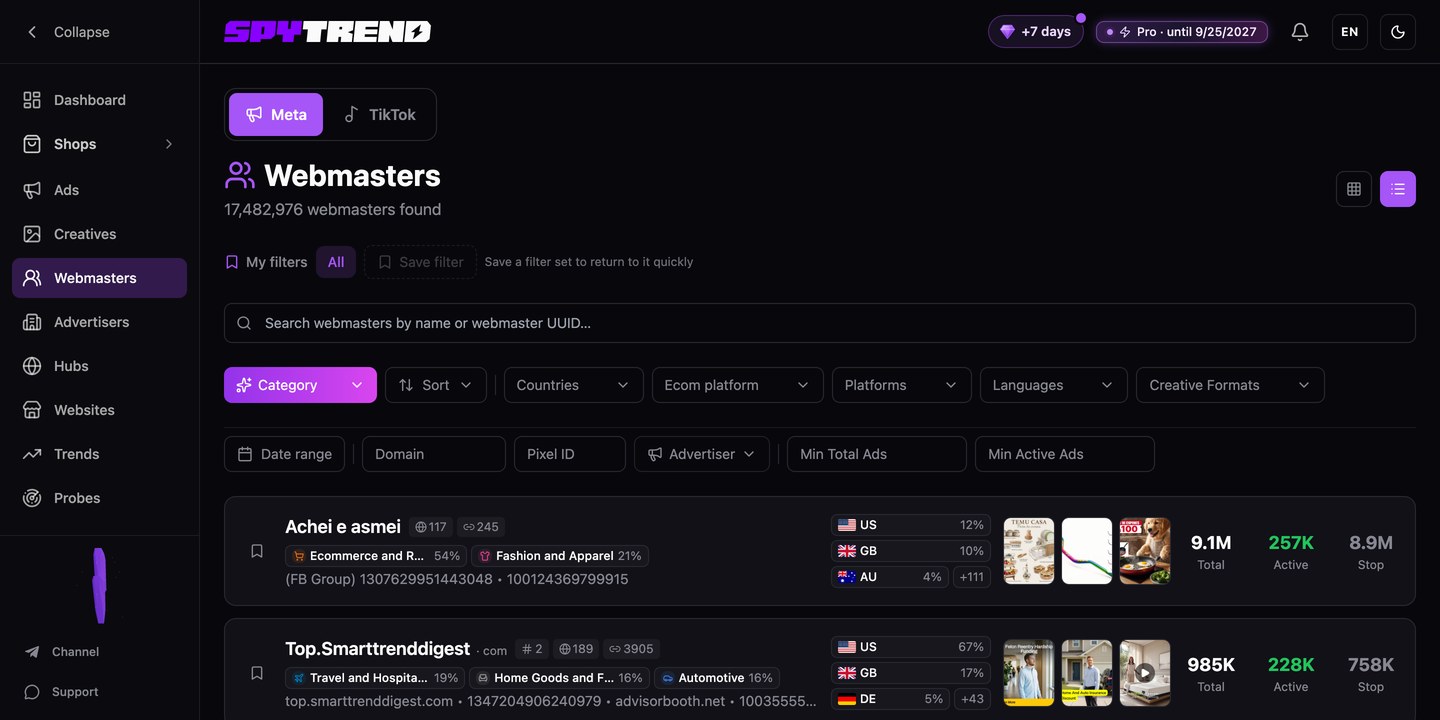
Spytrend's signature capability groups ads under the operator running them by resolving shared pixel IDs, domains, fan pages, and IP addresses. A single advertiser running five domains and three pixel IDs appears as one unified profile, not as 50 unrelated creatives. The Meta Ad Library, per Meta's Help Center, shows an advertiser's active ads one Page at a time.
Explosive Growth Detection / Trend Detection
The platform flags creatives whose new ad launches spike: Explosive growth means at least five new ads yesterday, three times or more the average for the chosen period, with new fan pages joining — a signal that a campaign just found product-market fit or is being scaled aggressively. Early signal catches genuine traction while volume is still low — 2–15 new ads yesterday, launched by at least two new accounts at once. Practitioners use this to enter a winning angle before saturation, not after.
Sticky Ads / Profitability Detection
Ads that keep running month after month are spending money — and operators only keep spending on campaigns that convert. Spytrend's profitability detector identifies these long-running, high-spend campaigns as a high-confidence "winning creative" signal. This is more actionable than a raw "most-seen" sort because it implies margin, not just volume.
Creative Deduplication
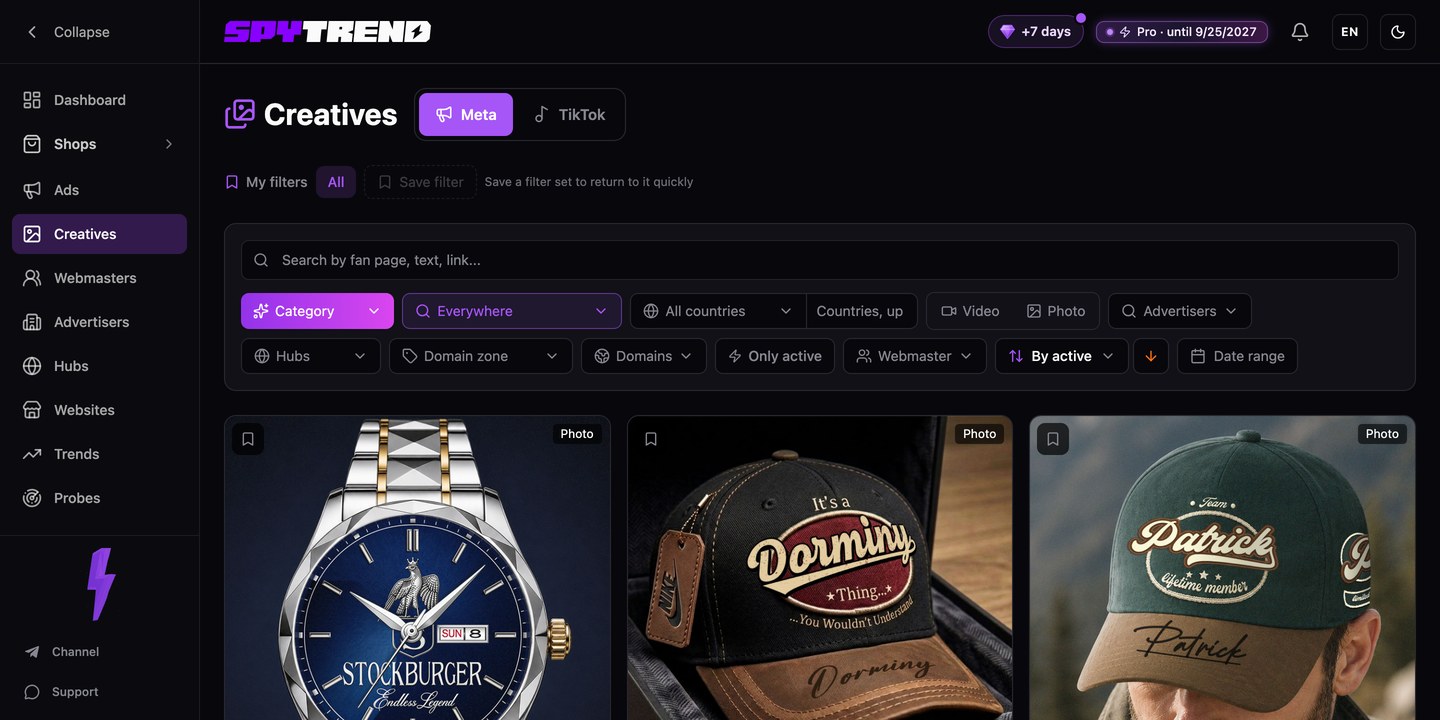
Deduplication collapses visually near-identical creatives into one record, regardless of minor pixel-level edits (resizes, watermark changes, color shifts). Without deduplication, a database of a billion ads can show the same creative hundreds of times under different ad IDs. Spytrend's deduplication means the result set reflects genuinely distinct strategies, not creative clutter.
Revival Detection
A creative that went quiet and then came back is a strong signal: someone tested it, pulled it, analyzed results, and decided it was worth reactivating. Revival detection surfaces exactly these creatives — at most one new ad over the recent days, then three or more yesterday — a behavioral intelligence signal that simple "first seen / last seen" date filters miss entirely.
API Access over MCP
Spytrend exposes an MCP server with 21 tools, enabling programmatic access to ad intelligence data for teams building internal dashboards, automated monitoring pipelines, or agency reporting tools. Sign-in runs over OAuth with the user's own account, so access is tied to individual accounts, not shared workspace tokens.
Use Cases
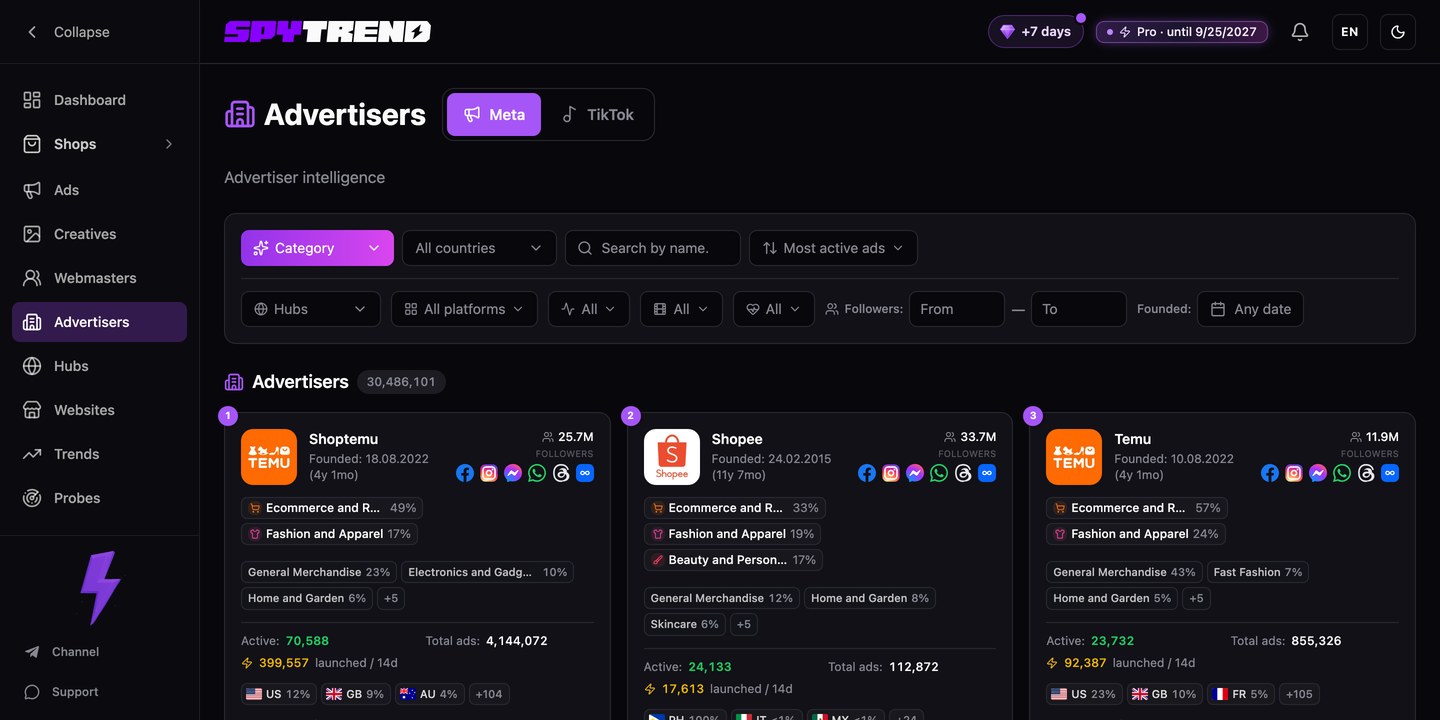
E-Commerce Operator Mapping a Competitor's Full Product Line
A DTC brand suspects a competitor is testing new product angles across multiple Shopify stores under different brand names. Using webmaster identity resolution, the marketer inputs one known domain and Spytrend returns all other domains, fan pages, and pixel IDs linked to the same operator. The result: a complete map of every product the competitor is actively spending behind — not just the ads visible on the one known store.
Agency Creative Strategist Finding Proven Angles Before They Saturate
A creative strategist at a performance agency needs to identify winning ad angles in the health supplement vertical before those angles are overrun by copycat ads. Explosive growth detection surfaces campaigns in their velocity phase — the window after first-scale but before the angle is everywhere. The team runs its own test while competitors are still seeing the ad for the first time.
Media Buyer Validating Offer Profitability Before Testing Budget
Before committing a test budget to a new offer, a media buyer queries Spytrend's profitability detector for the offer category. Ads that have run continuously for 90+ days across the same pixel cluster confirm that at least one operator is finding margin. The buyer enters the market with directional confidence, not just creative inspiration.
Who This Is Not For
Teams whose primary intelligence need is multi-network coverage — YouTube pre-roll, Google display — will find Spytrend's two-platform focus limiting. Spytrend covers Facebook (Meta) and TikTok; BigSpy or similar tools are better suited for cross-platform creative research. Teams that require no-code workflow automation (Zapier triggers, CRM push) should also look elsewhere — Spytrend's integration surface is an MCP server, not a connector ecosystem.
Webmaster Network Reconstruction: From Pixel to Full Ad Ecos
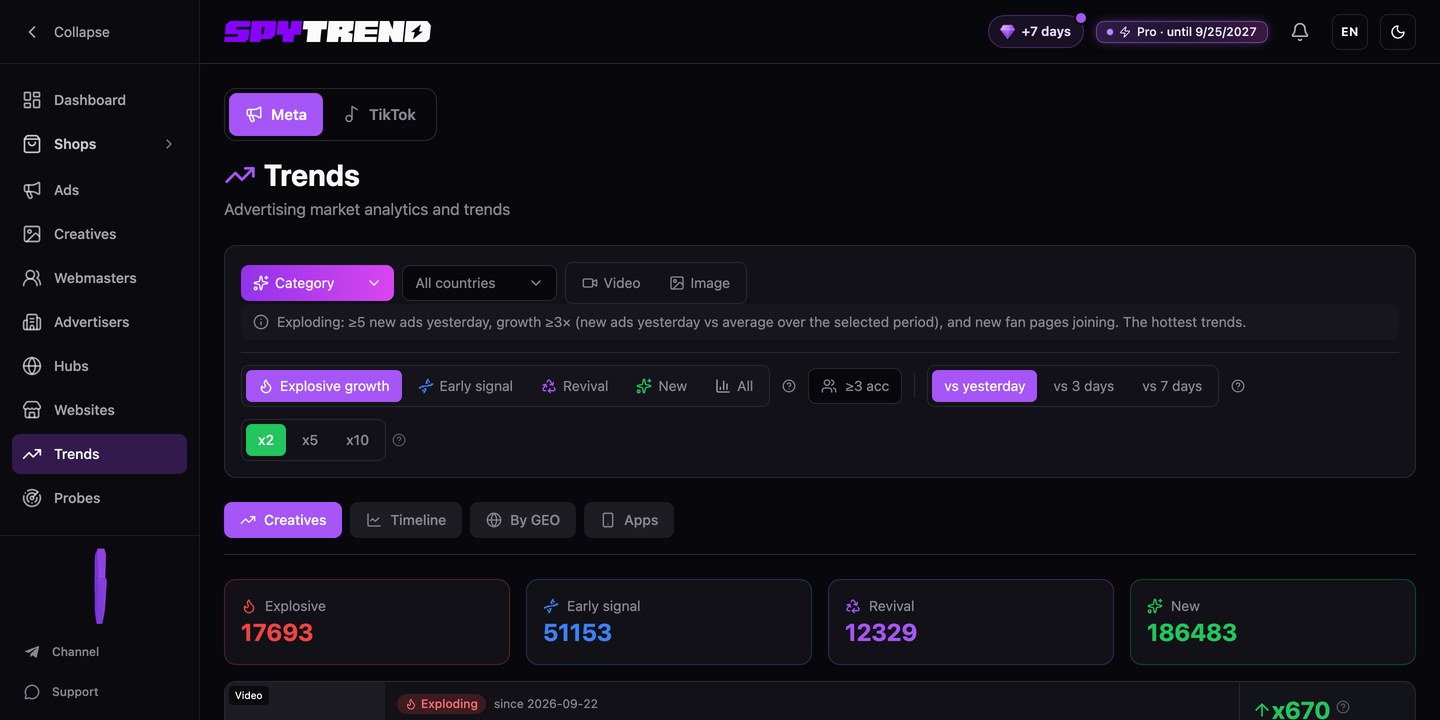
Most Facebook ad intelligence tools are creative databases. Spytrend is an operator intelligence system. The distinction matters: a creative database tells you what an ad looks like; an operator intelligence system tells you who is running it, how many other campaigns they are operating, and whether those campaigns are profitable. This is the data layer that changes competitive strategy from "copy a good ad" to "map a profitable business model."
The reconstruction process works by treating observable ad metadata — pixel fire events, landing page domains, fan page IDs, and IP ranges — as fingerprints. When two ads share a pixel ID, they belong to the same operator, even if they run under different brand names or target different demographics. Spytrend aggregates these signals to build a webmaster profile: one node in the graph representing everything a single operator is actively spending on Facebook.
The practical output for a competitive analyst is a portfolio view of a competitor's Facebook presence. Instead of finding 12 separate ads and manually guessing they might be related, the analyst sees one webmaster node with 12 ads, three domains, two pixel IDs, and a 14-month continuous run on the top creative. That profile answers the strategic question — is this a serious, scaled operation or a test account? — in seconds.
This level of reconstruction is invisible to tools that index at the creative level only. A competitor could run 200 ads across five brand names and appear as five unrelated operators in a standard spy tool. In Spytrend, they appear as one webmaster with 200 ads and a clear spend signature. For agencies managing competitive intelligence for clients in high-spend verticals (insurance, finance, supplements, e-commerce), that visibility is a structural advantage.
Multi-Identity Fingerprinting: How Spytrend Links Pixels, Do
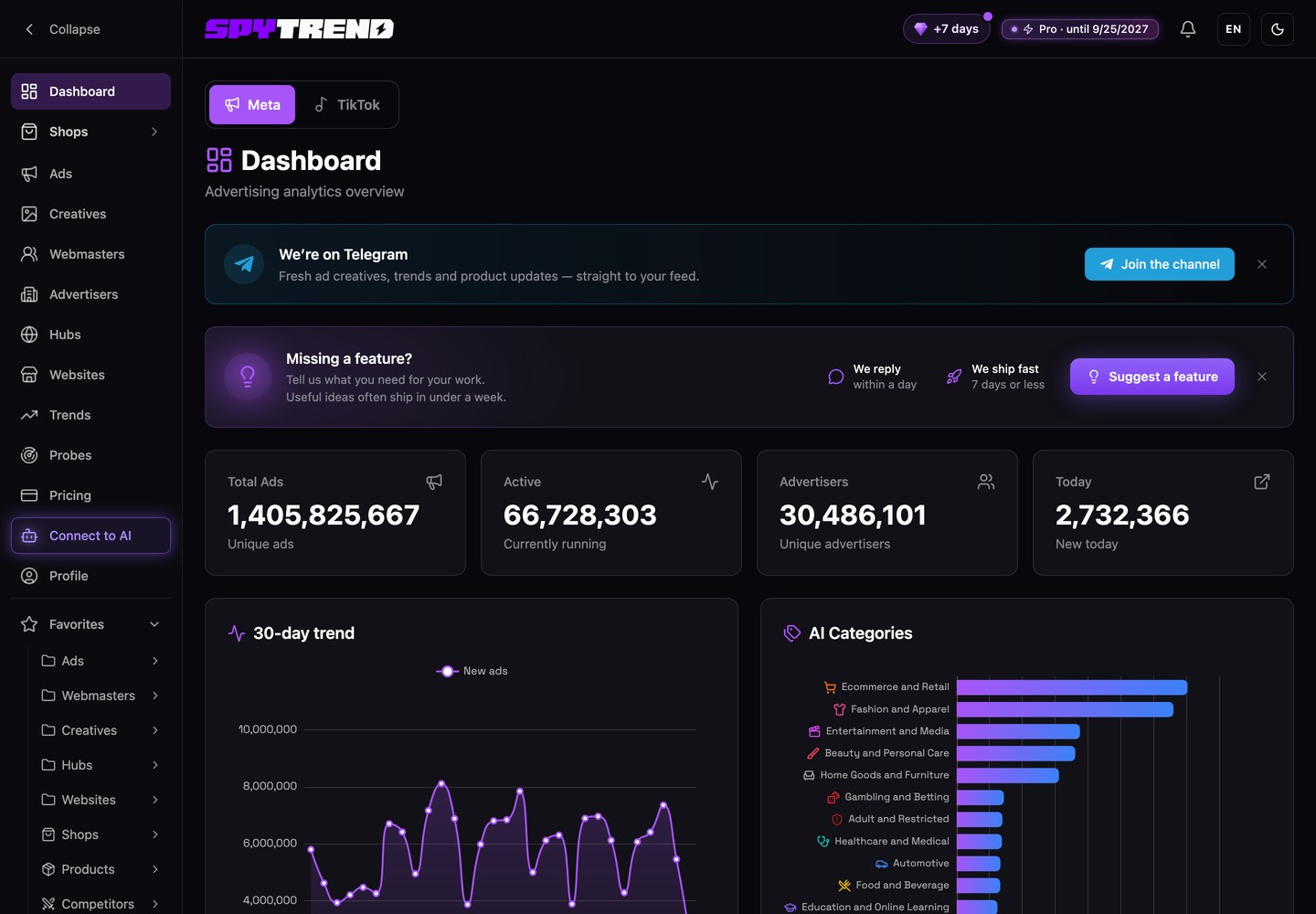
Multi-identity fingerprinting is the technical mechanism behind webmaster profiles. Spytrend ingests four identity signals from each crawled ad: the Meta pixel ID embedded in the landing page, the root domain of the destination URL, the Facebook fan page ID attached to the ad account, and the IP address cluster of the ad's infrastructure. Each signal alone is partial; combined, they form a high-confidence identity graph.
Pixel ID is the strongest single signal. A Meta pixel is placed site-wide, fires on every page load, and is extremely rarely shared between unrelated operators. When Spytrend detects the same pixel ID across ten different ad creatives, it can assert with high confidence that one team made all ten decisions. Domain clustering catches the cases where an operator runs different pixels per brand but routes all landing pages through servers in the same IP block — a pattern common in affiliate marketing networks and multi-brand e-commerce holding companies.
Fan page ID linkage catches a different pattern: operators who manage a single Facebook page across multiple ad accounts, a structure common in agency-run campaigns where the client owns the page but the agency owns the ad account. IP fingerprinting is the lowest-confidence signal but becomes decisive when combined with pixel and domain matches — it eliminates false positives from shared hosting environments.
The insight this delivers: competitor profitability is not in any single ad, it is in the pattern of ads across an operator's portfolio. An operator running 30 ads across three domains on one pixel, with the oldest ad now in its seventh month of continuous spend, is revealing a profitable business model — not just a creative. Spytrend's fingerprinting makes that pattern visible. Analysts who rely on per-creative spy tools are reading individual sentences; Spytrend readers see the whole chapter.
FAQ

Does Spytrend cover ad networks beyond Facebook and Meta?
Yes, TikTok. Spytrend covers Facebook (Meta) and TikTok ads. Teams needing YouTube or Google display intelligence should evaluate a multi-network tool instead.
How does the free plan differ from paid access?
Spytrend offers a free Starter plan with no credit card; it covers the archive of ads older than 90 days. Paid tiers — Pro from $79/mo ($756/yr) and Team — unlock current ads, AI categories, and full TikTok coverage.
What happens if I'm not satisfied after subscribing?
Spytrend provides a 14-day money-back guarantee on first-time payments, processed via Stripe, Visa, Mastercard.
Is API access available on all paid plans?
Yes, through Spytrend's MCP server. Access is tied to each user's own account — sign-in runs over OAuth rather than a shared workspace token. Paid plans get 40,000 tokens a month (1 token per result row); a free account gets 500 tokens in total and archive data only.
How does creative deduplication improve search results?
Deduplication collapses visually near-identical creatives — ads that differ only by minor crops, color adjustments, or watermark placement — into single records. This means a search for a product category returns genuinely distinct creative strategies, not hundreds of minor variants of the same image.
What is revival detection and why does it matter?
Revival detection identifies creatives that were inactive — at most one new ad over the recent days — and picked back up to three or more new ads yesterday. A revived creative has been deliberately tested, evaluated, and returned to spend — a behavioral signal of operator confidence that static "first seen / last seen" date filters cannot surface on their own.