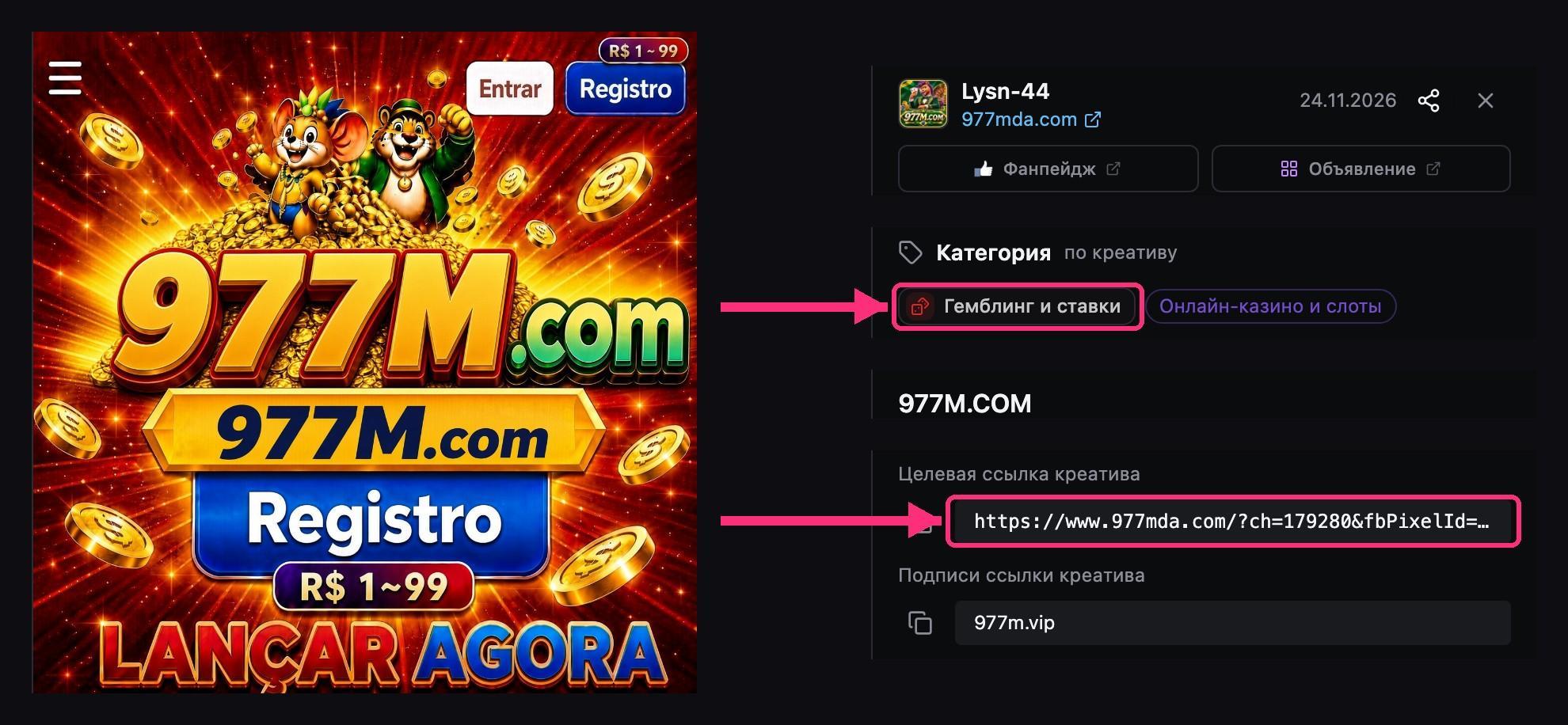
Short answer: Spytrend Gambling Intelligence is an iGaming database of Facebook gambling ads. From the ads we find, we follow the player's path: bypass cloaking, identify the PWA, enter the casino from the target GEO and collect emails. It shows casinos, PWAs, engines and payment systems behind the ads and their email funnels.
Who the data is for
| Who you are | Data you will need first |
|---|---|
| Media buyer | Casinos by GEO, angles in active campaigns, PWAs, official affiliate programs |
| Casino operator | Competitors' ads, payment systems, engines, game catalogs and email funnels |
| PWA provider or engine vendor | Where your solutions and your competitors' solutions are used |
| Payment provider | Which payment systems casinos use and who to pitch an integration to |
| Game studio | Which casinos carry your games and your competitors' games |
| CRM team or agency | Real email sequences, bonuses and retention approaches |
Where the data comes from
We have been collecting and analyzing Facebook ads for a long time. Seeing which creatives media buyers run was no longer enough: we wanted to know what happens on the other side of the ad. So we built a full data collection system: as of November 27, 2026, the Spytrend database held more than 2.7 million (2,714,539) ads in the Gambling and Betting category with a start date in November.

AI picks out gambling among the ads, and then we walk the player's path ourselves: get past the cloaking, identify the PWA provider, connect from the target GEO, install the PWA, land in the casino and sign up with a research account.
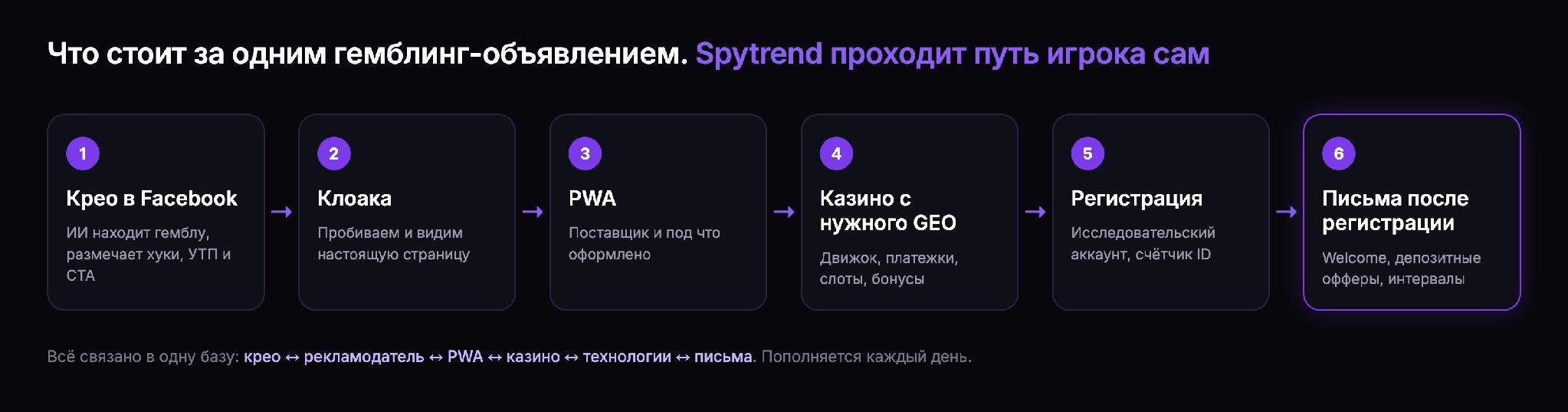
Inside, we study the product and record everything we can identify: the engine, payment systems, game providers, slots, bonuses, interface and other data. After sign-up the account keeps receiving emails and messages, and we rebuild the email funnels: from welcome emails to deposit offers, bonuses and attempts to win the player back.
Everything is linked in one database: creative, advertiser, PWA, casino, technology, games and emails. It grows every day.
Example: you are entering a new GEO
Say you are a media buyer thinking about running gambling traffic in a new country. Here is what the database gives you, step by step:
- See which casinos appear most often in active campaigns there right now and who is increasing ad activity.
- Open their creatives and the angle tagging: which hooks and USPs keep repeating.
- See which PWA providers these funnels run through and what the PWAs are disguised as.
- Check which payment systems the chosen casinos use in that country, so the player can deposit.
- Take the link to the official affiliate program and contact them directly.
A casino operator takes the same path from its side: who the competitors in the market are, which payment systems and slots they have, and how they write to players after sign-up.
Below, for each data type: what exactly you get and how to use it.
Which casinos run the most ads in each GEO
What you get. A list of casinos by country with the number of ads found, new launches and the trend: who is ramping up casino advertising. And the reverse view: which GEOs each casino is promoted in and which angles different advertisers use. For each casino, you can open its creatives and a link to its official casino affiliate program, if there is one.
How to use it. A media buyer entering a new GEO quickly sees who is active there now, which casinos media buyers are promoting and where to get the offer directly. A casino operator sees which competitors are accelerating in its market, which new brands appear and which advertising angles they use.
This is about observed advertising activity. The database has no spend or profit figures.
Which PWA providers are used in the funnels
Which PWA providers show up most often in active campaigns, who leads in a specific GEO, which casinos each one is linked to and how widely they are used over time. You can also see what the PWAs are disguised as: Netflix and other streaming services, games and more.
A media buyer sees which PWAs, and with what disguise, are most common in their vertical right now. A PWA provider sees in which GEOs competitors appear more often and where it has almost no presence. A casino sees which PWAs brands are promoted on in different markets.
Which engines casinos run on
This part is more for the iGaming business itself than for media buyers.
An engine provider gets a list of casinos on competitors' solutions and sees in which markets those solutions are more widespread. This information can be used for B2B sales. An operator studies competitors' tech stack in the markets it cares about.
The database shows which engines are the most common, which brands run on each one and who leads by number of brands in a given GEO. We separate the engine, game aggregators and other components when we can identify them reliably.
Which payment systems casinos use
This is probably the most interesting part of the database. We enter the casino from the target country, sign up and see which payment methods are available to the player.
What you get. For each casino and country: which deposit methods the player sees, which payment systems are most common in the GEO, which payment providers we were able to identify, which casinos work with them and where provider contacts are available. The data is tied to specific casinos and countries, which makes it more than a list of providers.
How to use it. A payment provider gets a map of potential B2B clients: which casinos already work with competitors, in which markets, and who it makes sense to pitch an integration to. A casino operator compares its payment coverage with competitors in the same GEO and finds payment methods it does not offer yet.
We record which payment systems are in place and which integrations are confirmed. The database does not show transaction volumes.
Which slots and game studios appear most often
After sign-up we go through the casinos' game catalogs: which slots operators carry most often and which studios have the widest presence by country.
A game studio sees which casinos already carry its games, which competitors have wider distribution, where its own presence is weak and where it is worth pitching its games. A casino compares its game selection with competitors and finds games or studios that are not in its catalog yet.
A slot in the catalog shows presence. How many players play it is not visible from this.
Which angles and USPs gambling ads use right now
What you get. AI helps tag the creatives: what they show, which hooks, promises, scenarios and CTAs they use. Broken down by GEO and over time, you can see which USPs repeat across different casinos, which visual formats media buyers use, which PWA designs are most common and how ad messaging changes.
How to use it. A media buyer does not have to go through thousands of ads by hand: they immediately see which angles are common in their GEO and use them to pick creatives to look at. A casino marketer sees how competitors position themselves.
We do not claim that the most common angle is the most profitable one. The database shows what actually appears in the market and how the ads change.
How many sign-ups a casino gets per day
Yes, we even work with this.
What you get. In some casinos, sign-up IDs are sequential. Where that is the case and the method has passed validation, we estimate how the counter changes over a period.
How to use it. Operators and analysts get an additional signal about the product's momentum. It is especially interesting to compare counter changes with the same casino's advertising activity.
This is an estimate based on numbering, not access to the casino's internal statistics. We do not present it as an exact number of new players.
Full email funnels: how casinos lead a player to a deposit and try to win them back
This data is usually not visible at all in ad spy tools. We sign up at the casino and then receive its emails and messages.
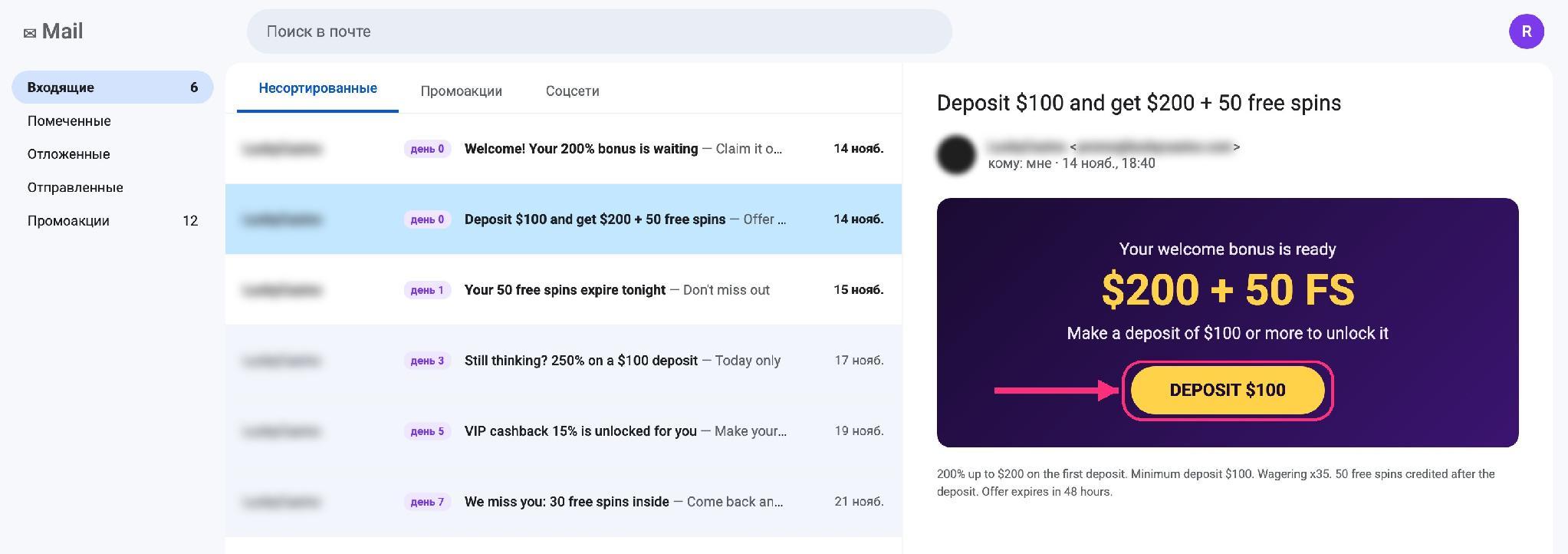
What you get. The communication sequences of a specific casino:
- welcome emails right after sign-up;
- what they offer someone who signed up but has not deposited yet;
- bonuses, free spins and promos;
- how often emails arrive and at what intervals;
- subject lines, headlines, USPs and CTAs;
- which email designs and templates repeat;
- how emails differ across GEOs and at different stages of interaction with the product.
How to use it. If you run your own casino, you can take apart a competitor's CRM strategy: how it greets new players, what offers it makes, how it designs its emails, what it sends in the first hours and days after sign-up. Instead of inventing an email sequence from scratch, you can study dozens of real funnels and find ideas for your own. CRM agencies and marketing automation vendors compare operators' communications by country and brand.
We can link everything into one funnel: Facebook creative → PWA → casino → sign-up → welcome email → follow-up emails and offers. You see both how the player was acquired and how they are handled afterwards.
Scenarios such as reactivation or post-deposit emails are confirmed only where they reached our research accounts. We collect emails only from our own accounts, with no access to anyone else's correspondence. Anonymized samples and findings can be shared with clients.
Official affiliate programs and vendor contacts
Besides analytics, we collect links to casinos' official affiliate programs. Where confirmed contacts of payment and technology vendors exist, we link them to the companies. Find a casino or a vendor in the database and go straight to looking for a partnership.
Why buy this data
Market players usually look for this information by hand, piece by piece. Spytrend Gambling Intelligence collects it in one place and links it together.
And the database is updated daily. You can look not only at who uses what right now, but also at the changes: which casinos media buyers started pushing harder, where a new technology vendor appeared, which payment systems and game providers expanded their presence, which new emails and bonuses showed up in competitors' funnels. Seeing this before your competitors is a plus in itself.
To be straightforward about what the database does not have: advertisers' budgets and profits, transaction volumes, the exact number of sign-ups, and emails that never reached our accounts.
Spytrend is now not only about which creatives are running, but about the whole path: from the ad and the PWA to the casino, payment methods, games and communication with the user after sign-up.
How to get access
The value of this data varies a lot from company to company. Some need only the payment methods and casinos of one GEO, others a ranking of PWA providers or game provider statistics. Some need competitors' full email funnels: emails, sequences, bonuses, USPs and CRM approaches. And some want the entire database, including ad creatives, technology links and regular updates.
That is why there is no fixed price: it is set through an internal auction for access to Spytrend Gambling Intelligence. You can bid for a separate data set, specific GEOs or the full package.
Terms:
- access under an annual contract, paid upfront for 12 months;
- there are no monthly plans for this data;
- the data scope and delivery format are agreed individually;
- before you buy, we can show the methodology, coverage and a demo sample.
To take part, message Spytrend support on Telegram: https://t.me/spytrend
In your message, include:
- Which data you need: casinos, PWAs, engines, payment systems, slots, angles, email funnels or the entire database.
- Which GEOs you are interested in.
- How much you are willing to offer for a year of access.
We will see who really needs this information and how the market values it.
FAQ
Is this data included in a regular Spytrend subscription?
No. Gambling Intelligence is sold separately from the dashboard plans, under an annual contract.
How much does access cost?
There is no fixed price. It is set through an internal auction: you offer your own price for a year of access to the data you need.
Can I buy data for just one GEO or one section?
Yes. You can bid for a separate data set, specific GEOs or the full package.
Where do the casino emails come from?
Only from our own research accounts that sign up at the casinos. We have no access to anyone else's correspondence.
How often is the database updated?
Every day.
Spytrend data for November 2026.
