Quick answer: The right AdSpy alternative depends on what AdSpy’s single $149 plan does for you. For Facebook and Instagram on a smaller bill, BigSpy and PowerAdSpy start at $69; Spytrend costs $79 and adds TikTok and seller grouping. AdPlexity and Anstrex sell native and push products, a segment Spytrend does not cover.
AdSpy alternative comparison: seven tools in one table
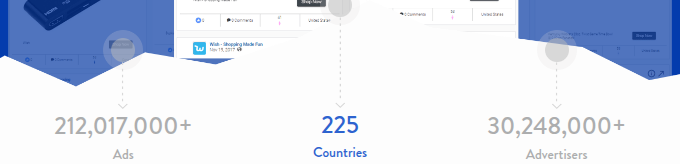
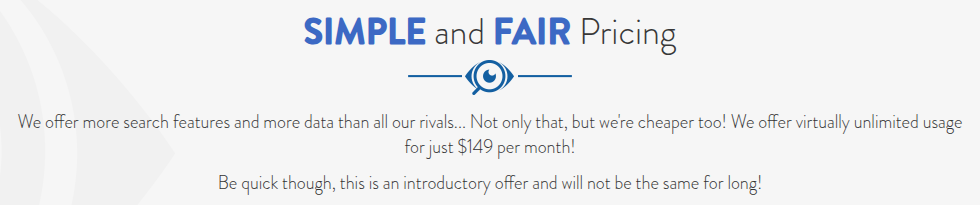
AdSpy is a Facebook and Instagram ad library with one plan. Its homepage counts 212,017,000+ ads and 30,248,000+ advertisers across 225 countries, and offers “virtually unlimited usage for just $149 per month”. Anyone looking for an alternative to AdSpy usually wants one of three things: a lower bill, more ad networks, or a way to see who stands behind the ads. The table puts the same four questions to seven tools, AdSpy included, at monthly prices.
| Tool | Ad networks | Free entry and delay | Price per month | What one card groups |
|---|---|---|---|---|
| AdSpy | Facebook and Instagram | Unpaid account with a view counter: fresh ads, advertiser name and full text hidden | $149, one plan (Oct 6, 2026) | One advertiser page |
| Spytrend | Facebook and TikTok | Starter: ads three months and older | Base $79 billed monthly with 1 AI category (+$50 each); Pro Exclusive $237 every three months ($79 a month, 5 categories); Enterprise $300 with 6 months ahead, all 33 categories (Oct 6, 2026) | One seller: Page IDs, domains and pixels behind the ads |
| BigSpy | 3 networks on Starter, 8 on Growth and Scale, 11 on Ultimate | Not shown on the pricing page | Starter $69, Growth $159, Scale $399 (5 seats), Ultimate $499 (Sep 25, 2026) | Page and domain analysis from Growth |
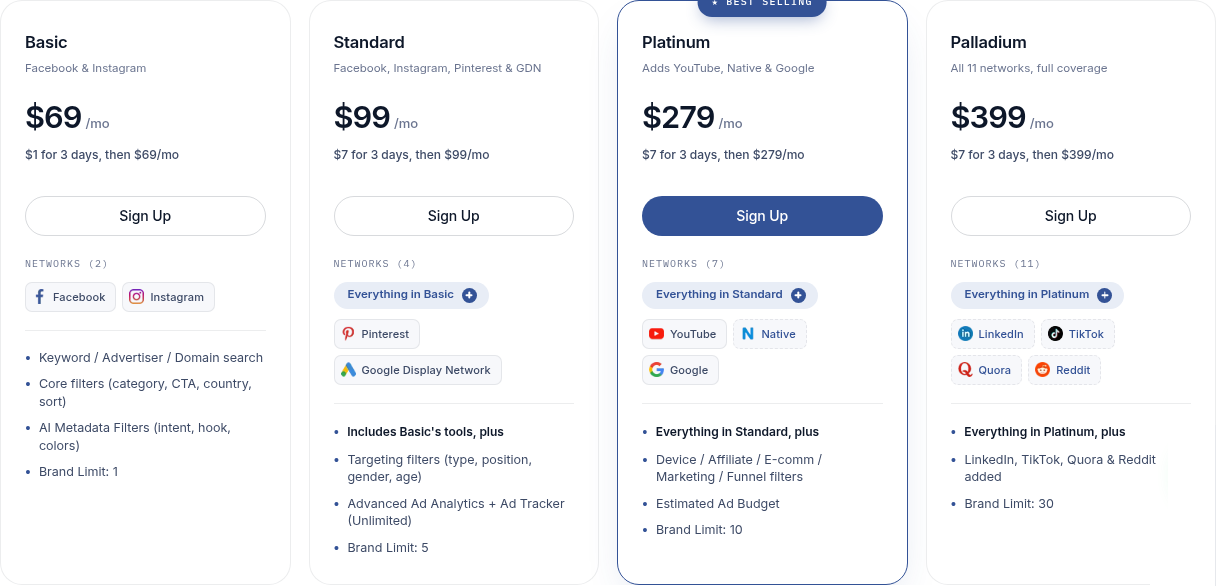
| PowerAdSpy | 2 networks on Basic, 4 on Standard, 7 on Platinum, 11 on Palladium | Basic: $1 for 3 days; other plans $7 for 3 days | Basic $69, Standard $99, Platinum $279, Palladium $399 (Oct 6, 2026) | Brand tracking: limit of 1 to 30 brands by plan |
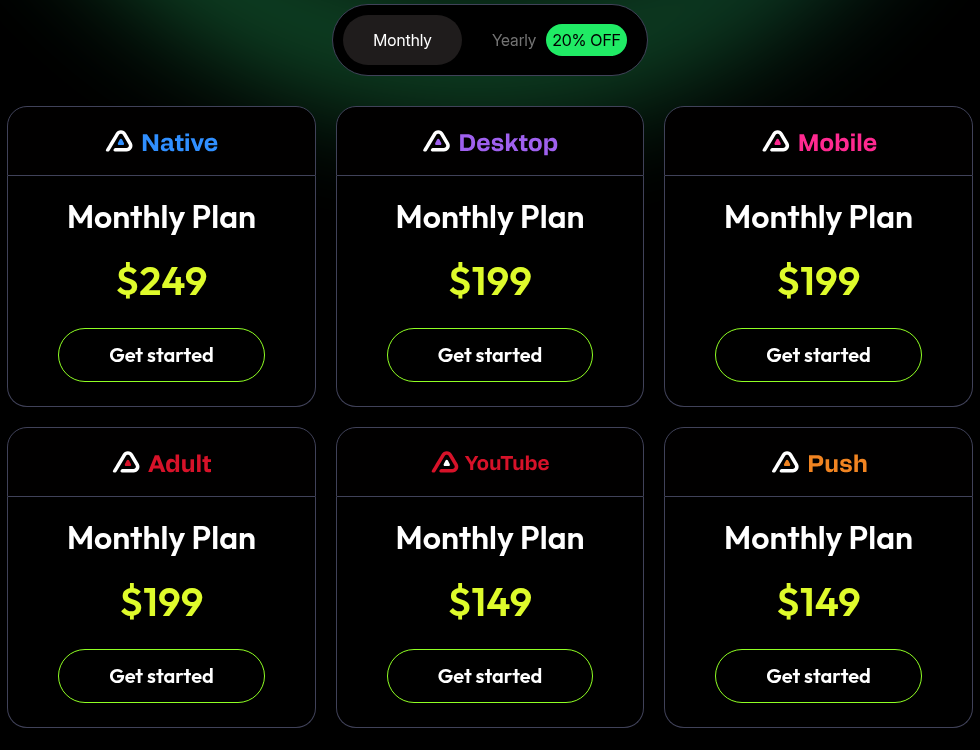
| AdPlexity | Native, Desktop, Mobile, Adult, YouTube, Push: one product each | Paid plans only on the pricing page | $149 to $249 per product; yearly 20% off (Oct 6, 2026) | Not checked |
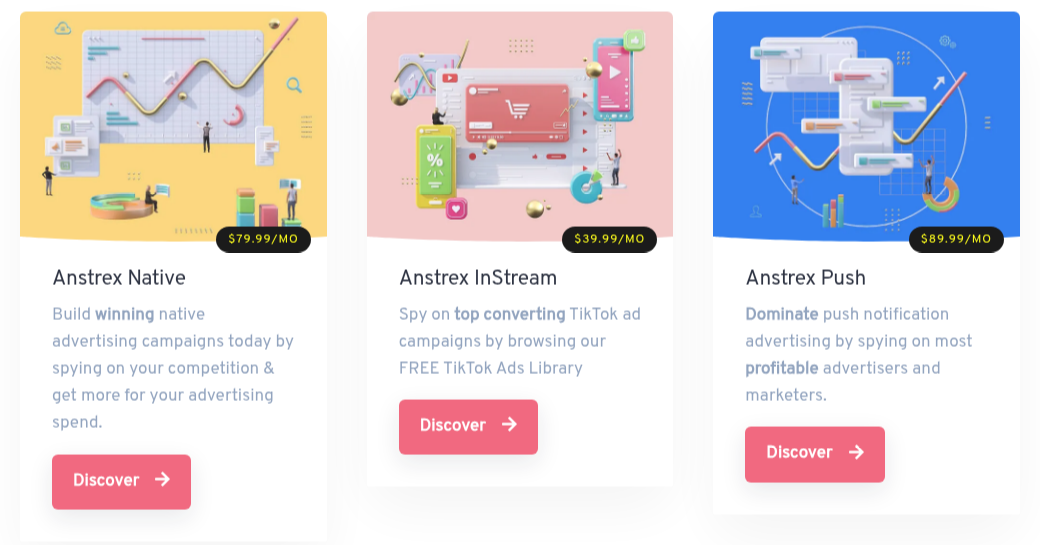
| Anstrex | Native, InStream (TikTok), Push: one product each | InStream advertises a free TikTok ads library | $39.99 to $89.99 per product (Oct 6, 2026) | Not checked |
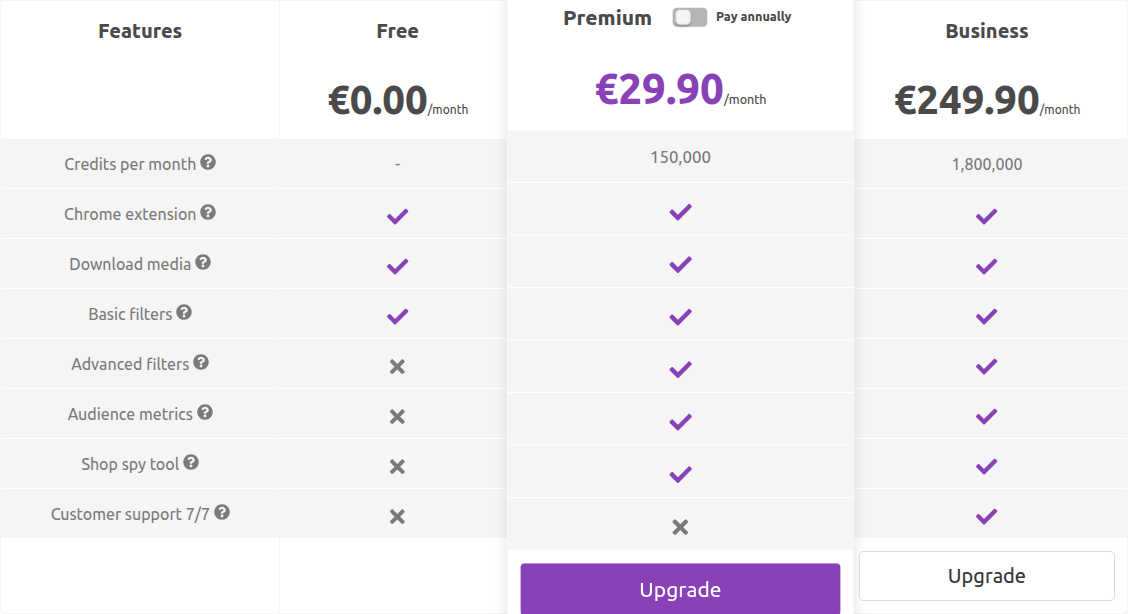
| Dropispy | Free plan at €0; advanced filters, audience metrics and shop spy tool start at Premium | Premium €29.90, Business €249.90; credits (Oct 6, 2026) | Shop spy tool from Premium |
Network coverage is where most switches fail. AdPlexity and Anstrex list no Facebook ad product among their plans. They are built for media buyers who run native or push traffic, a segment Spytrend does not cover, so neither is a like-for-like swap for an AdSpy subscription.
How the seven tools were compared
Data. Which ad networks each plan opens, and what one card puts together: a single ad, one advertiser page, or the operator behind many pages and domains. A tool that groups by advertiser name gives different answers than one that groups by the domains and pixels behind the name, and the table keeps the two apart.
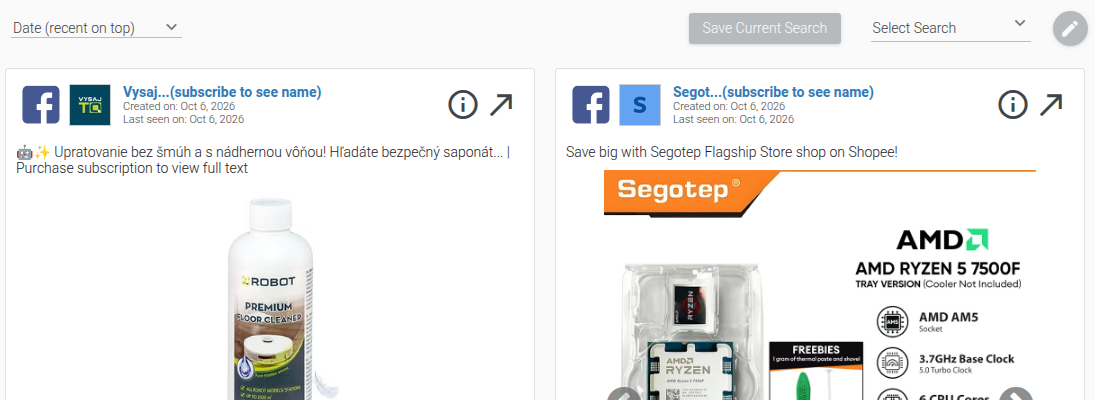
Delay. What you can see before paying, and how fresh it is. AdSpy is the surprise here. An unpaid AdSpy account still listed ads created that same day, but every card hid the advertiser as “(subscribe to see name)” and cut the text at “Purchase subscription to view full text”. The account page showed “Views Left: 890”, a counter instead of a plan.

Spytrend’s free Starter tier has a different limit: the ads are three months and older. For a researcher, fresh but anonymous and free but old are different failures, and neither replaces a paid plan.
Price. The monthly price of the cheapest plan that covers Facebook, and what the next step up costs. For tools sold per traffic type, the price of one product. Where a vendor splits its price by something other than networks, the section below says what that something is.
What was left out. Cells marked “Not checked” stay that way until a vendor page or an account shows the answer. AdPlexity and Anstrex publish prices per product, but grouping depth and free access were not visible on the pages we opened, so the table says so rather than guessing. The same applies to ad-database size: AdSpy publishes counters, the others were not compared on volume, because a bigger counter says little about how many of those ads are useful for one niche.
What you pay instead of $149
The AdSpy price is flat: one plan, $149 a month, Facebook and Instagram. Every alternative splits that price by something else: by networks, by seats, by categories or by traffic type. Here is what $149 or less buys elsewhere.
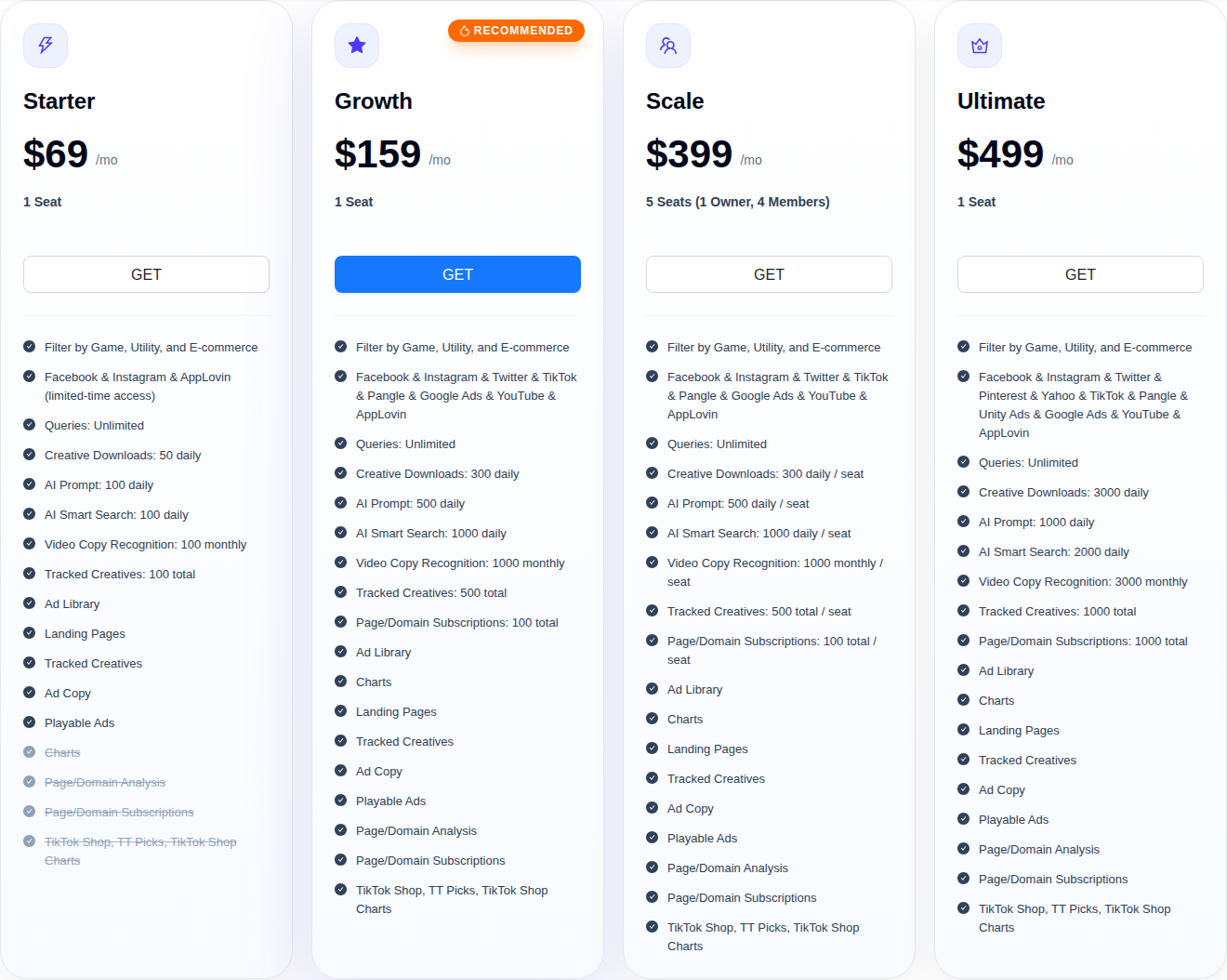
BigSpy Starter at $69 covers Facebook, Instagram and AppLovin (marked limited-time access) with unlimited queries and 50 creative downloads a day. Page/Domain Analysis is crossed out on Starter and begins at Growth, $159, which also adds Twitter, TikTok, Pangle, Google Ads and YouTube for eight networks in total. Scale at $399 keeps the same eight and adds seats, five of them. Ultimate at $499 opens eleven networks, adds Pinterest, Yahoo and Unity Ads, and removes the limit of three industry switches a month that applies to the first three plans.
PowerAdSpy Basic is also $69 for Facebook and Instagram, with a brand limit of 1 and a $1 three-day start. Standard, $99, brings in Pinterest and the Google Display Network, and the brand limit goes to 5. Its Estimated Ad Budget starts at Platinum, $279, together with YouTube, Native and Google. TikTok, LinkedIn, Quora and Reddit need Palladium at $399, where the brand limit is 30. The split here is the number of brands you can track, so a team that follows a dozen competitors lands on Platinum whatever networks it needs.
Spytrend costs $79 a month for Facebook and TikTok, with the full Webmasters section, search by Pixel ID and landing domain, and deduplication on every paid plan. What changes the bill is the number of AI categories and how far ahead you pay. Base is billed monthly with one category included, and each extra one costs $50: two categories are $129 a month, three are $179, which passes AdSpy’s $149. Pro Exclusive is $237 once every three months. The monthly rate is the same $79, but five categories are included instead of one. Enterprise, at $300 a month for those who pay six months up front, includes all 33.
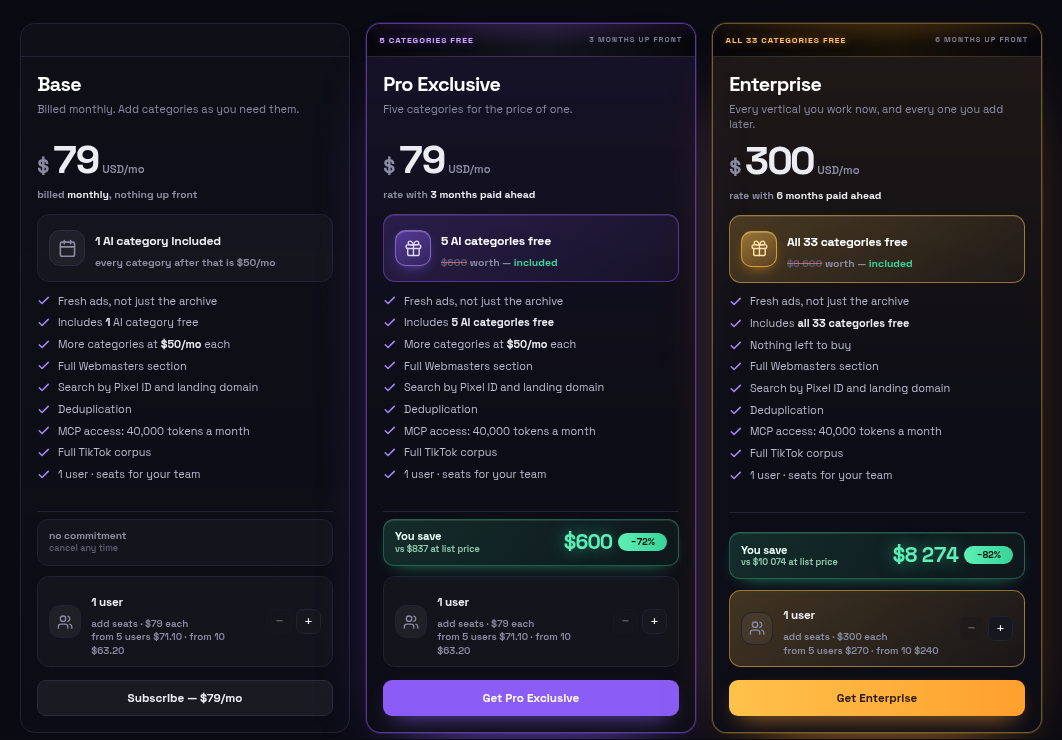
So the comparison with AdSpy’s flat $149 depends on how many verticals you work and whether you commit to a quarter. One vertical on a monthly bill is $79. Five verticals cost the same $79 a month, but the first payment is $237 for three months.
AdPlexity and Anstrex price by traffic type. AdPlexity Native is $249 a month, Desktop, Mobile and Adult $199 each, YouTube and Push $149 each, with 20% off on yearly billing. Anstrex Native is $79.99, InStream for TikTok $39.99 and Push $89.99. Both are native and push libraries first. A media buyer who runs native traffic will find the data in these two, and Spytrend has none of it.
Dropispy is the cheapest way into a Facebook feed with shop data: Premium €29.90 a month with 150,000 credits, and Business €249.90 with 1,800,000. The credit meter is the catch: the plan table lists credits, not how many a research session uses.
Free ways in: what each tool shows before you pay
A free entry only helps if it lets you test what you would pay for. The entrances look like this:
- AdSpy: an unpaid account shows fresh ads but hides advertiser names and full ad text, and counts views down.
- Spytrend: the Starter tier is free, with ads three months and older.
- Dropispy: a free plan at €0, without advanced filters, audience metrics or the shop spy tool.
- PowerAdSpy: no free plan on its pricing page; Basic starts at $1 for three days, the other plans at $7 for three days.
- BigSpy: the pricing page lists four paid plans and no free one.
- AdPlexity: paid plans only. Anstrex: InStream advertises a free TikTok ads library; Native and Push are paid.
For a Facebook media buyer, the useful free test is the one closest to the paid product. AdSpy’s unpaid view is fresh but anonymous, so it shows whether a niche is active without telling you who runs it. Spytrend’s Starter is the reverse: the newest quarter is missing. Dropispy’s free plan strips the filters that make the paid plan worth testing. Treat any of the three as a way to learn the interface, not as a research tool for live ads.
One advertiser or one network: what the Jestijl.nl card shows
In AdSpy, clicking an advertiser opens the ads of that one page. That is the right unit when a brand runs one page. Media buyers rarely do: they spread the same offer across many pages so that one ban does not stop the campaign. Spytrend’s Webmasters section joins those pages by the domains they send traffic to.
Take the network Spytrend titles Jestijl.nl. It counts 1,486,991 ads: 2,690 active and 1,484,301 stopped. It runs on 25 domains, 15 of them active, through 202 Page IDs, 122 of them active. The top countries are the United States with 989K ads and Canada with 896K, then Sweden, France and Switzerland at 26K, 24K and 23K. The 30-day timeline is down 64%.
Above the Domains and Page IDs rows sit two buttons, Ads and Creatives, which open the ads and the creatives of the whole network at once, and a Links tab beside Details. That is the practical difference from a page-by-page search: one click leaves the single page and lands on the operator.
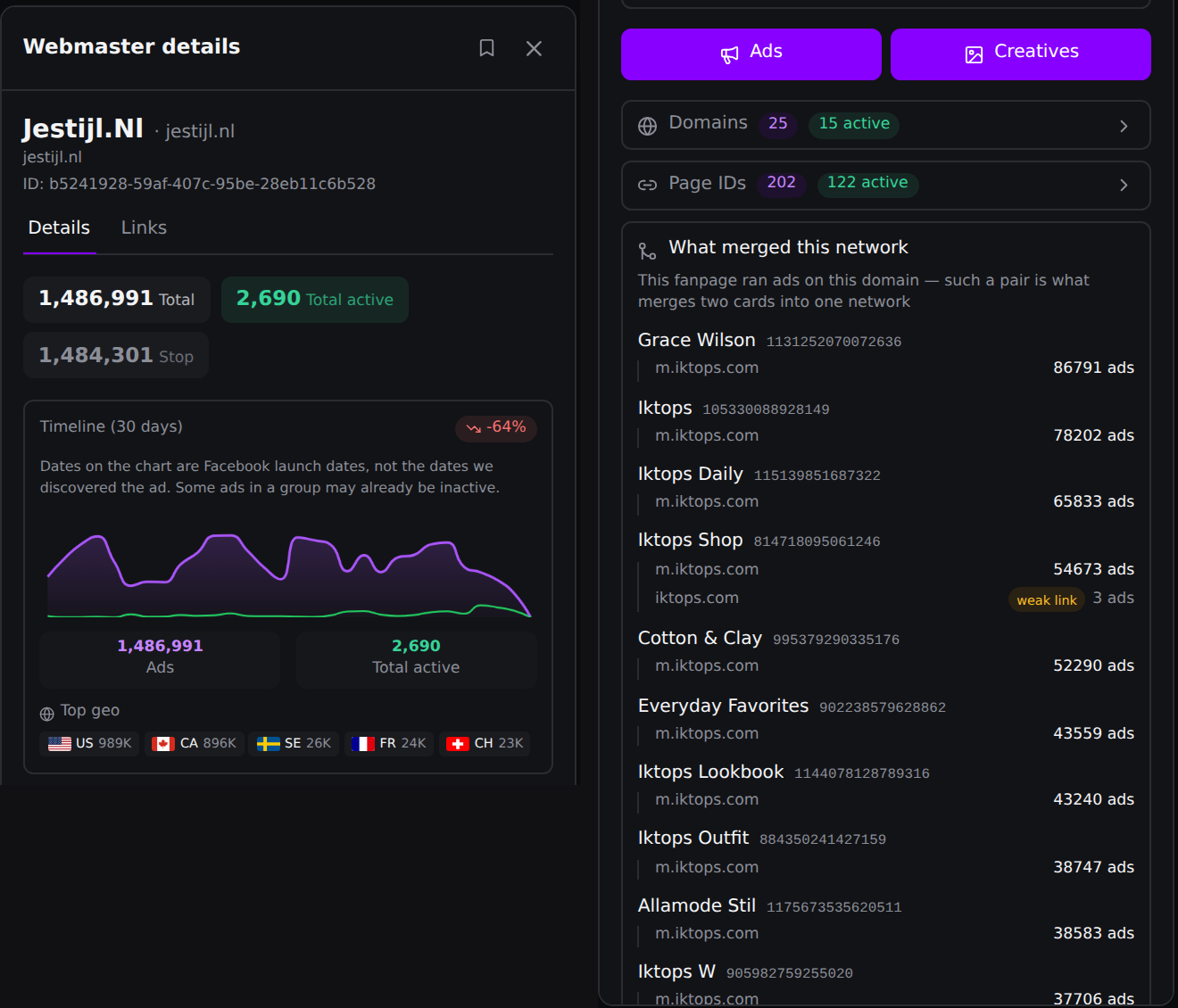
The “What merged this network” list shows the pattern. Pages with different names, Grace Wilson, Iktops, Iktops Daily, Iktops Shop, Cotton & Clay, Everyday Favorites, Iktops Lookbook, Iktops Outfit and Allamode Stil, each sent tens of thousands of ads, from 38,583 to 86,791, to the same site, m.iktops.com. In an ad-by-ad or page-by-page tool, that reads as separate advertisers. The card also says when a link is thin: iktops.com, held by only 3 ads on the Iktops Shop page, carries a “weak link” label, which marks a loose connection rather than a confirmed shared owner.
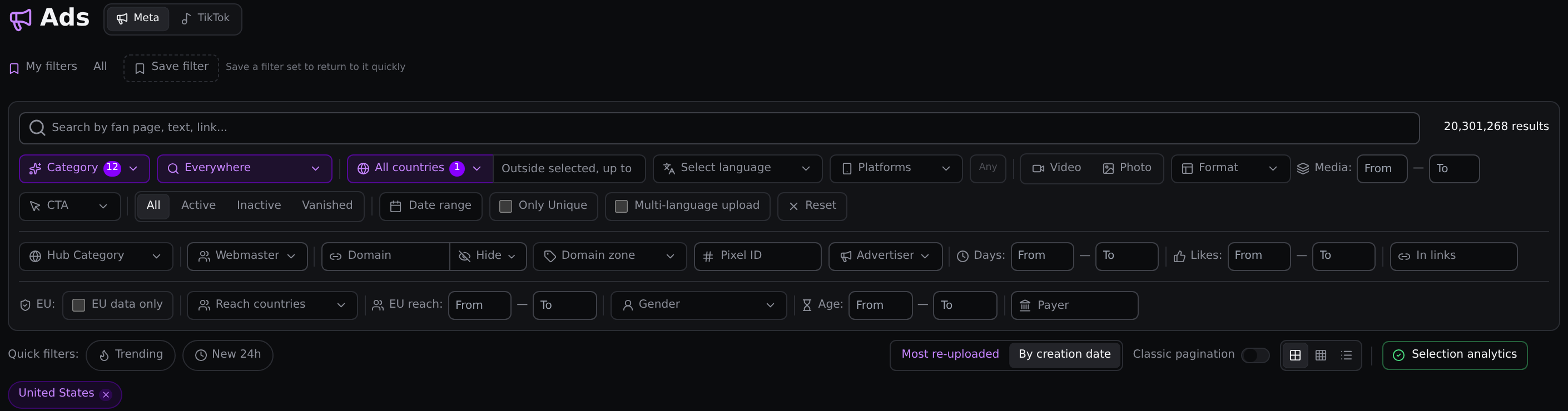
Finding networks like this starts in the Ads filters: by category, then by Pixel ID, domain or webmaster. One category, Fashion and Apparel, with 12 subcategories selected on the Meta tab and the country set to United States returned 20,301,268 ads, and the same panel holds the Pixel ID, domain and webmaster fields.
The Webmasters guide explains where each block of that card comes from.
Which AdSpy alternative for which job
For Facebook and Instagram on less than $149, BigSpy and PowerAdSpy both start at $69. BigSpy gives three networks on that plan and holds page analysis back until $159, while PowerAdSpy limits you to one tracked brand. If you follow several competitors, that brand limit decides the choice before the price does.
When one account has to cover many networks, BigSpy Growth at $159 spreads over eight, and PowerAdSpy Palladium at $399 over eleven. Palladium costs more than AdSpy and Growth only a little more, so the saving is in breadth, not in the bill.
Budget works as a filter before any of this. Below AdSpy’s $149 the list is BigSpy Starter, PowerAdSpy Basic and Standard, Spytrend Base, the three Anstrex products and Dropispy Premium. AdPlexity YouTube and Push match $149 exactly, and BigSpy Growth sits just above it. Past that come the larger plans: PowerAdSpy Platinum and Palladium, BigSpy Scale and Ultimate, the AdPlexity Native, Desktop, Mobile and Adult products, Dropispy Business and Spytrend Enterprise.
For native or push traffic, AdPlexity and Anstrex sell one product per traffic type, and the cheapest entrance is Anstrex Push at $89.99 or AdPlexity Push at $149. Spytrend does not cover native or push, so this job stays with them.
Ecommerce on a tight budget points to Dropispy Premium, as long as the credit meter suits your habits. Facebook plus TikTok, with the network behind the pages, is the job Spytrend was built for: $79 a month, one vertical billed monthly or five with three months paid ahead.
Is AdSpy worth it against that list? It is when you want one flat price for Facebook and Instagram and no category or network arithmetic. That is a real convenience, and none of the alternatives above offers a plan that simple.
When Spytrend is not the right swap
The sentence Spytrend uses for itself, copied as it stands: Spytrend is an ad intelligence platform for Facebook and TikTok advertising: an archive of ads going back to 2018, AI-classified into 33 business categories, with every advertiser assembled into a single card — all ads, pages, domains and countries in one place.
Three cases where another tool on this list does the job better:
- You buy native, push, Google or YouTube traffic. Spytrend’s ad research covers Facebook and TikTok. AdPlexity and Anstrex cover native and push, and BigSpy and PowerAdSpy reach Google and YouTube.
- You research several verticals and want to pay month to month. Billed monthly, three categories cost $179, more than AdSpy’s flat $149. The cheaper five-category rate needs three months paid ahead.
- You want to judge live ads before paying. Spytrend’s Starter shows ads three months and older, so the newest quarter is behind the paywall.
If none of these applies, start on the free Starter tier, then compare plans on the pricing page. The first payment on a paid plan has a 14-day money-back guarantee.
FAQ
AdSpy alternative: which one is cheapest for Facebook and Instagram?
The cheapest AdSpy alternative for Facebook and Instagram is BigSpy or PowerAdSpy at $69 a month. For Facebook plus TikTok with pages grouped into one network, Spytrend starts at $79 a month. For native or push traffic, AdPlexity or Anstrex.
Alternative to AdSpy: is there a free one?
As an alternative to AdSpy, Spytrend’s free Starter tier holds only ads that are three months and older. Dropispy has a free plan without advanced filters. AdSpy’s own unpaid account shows fresh ads with advertiser names and full text hidden.
Is AdSpy worth it: when does the flat $149 pay off?
Is AdSpy worth it? It is when you want Facebook and Instagram for one flat $149 a month. It is less so if you need TikTok, more networks, or the network of pages behind an advertiser; the alternatives above cover those.
AdSpy cost: what do the alternatives charge instead?
AdSpy cost is one plan at $149 a month. The alternatives start lower: $69 for BigSpy and PowerAdSpy, $79 a month for Spytrend with one category (five if paid three months ahead), €29.90 for Dropispy Premium.
AdSpy vs Spytrend: where does the data differ?
In AdSpy vs Spytrend, AdSpy searches Facebook and Instagram ads with one flat plan and shows one advertiser page at a time. Spytrend covers Facebook and TikTok, sorts ads into 33 categories and joins pages, domains and pixels into one network card; its price depends on the number of categories and the billing period.